

pass through. The filtrate is swiftly reintroduced to the reaction conditions (reaction
temperature, reaction recharged with other insoluble components, e.g. bases or
oxidants), and analysis of the filtrate will indicate whether the reaction has continued
post-filtration. If turnover is inhibited by the filtration, it can be said that the
particulates have a direct role in catalysis.
The Hg-poisoning test (aka Hg-drop test) involves spiking a reaction mixture of
interest with elemental Hg at initiation, or more often during catalytic turnover.
Elemental Hg has been shown to be able bind selectively to heterogeneous metal
surfaces to produce an inactive amalgam [64]. Thus if turnover is inhibited by Hg
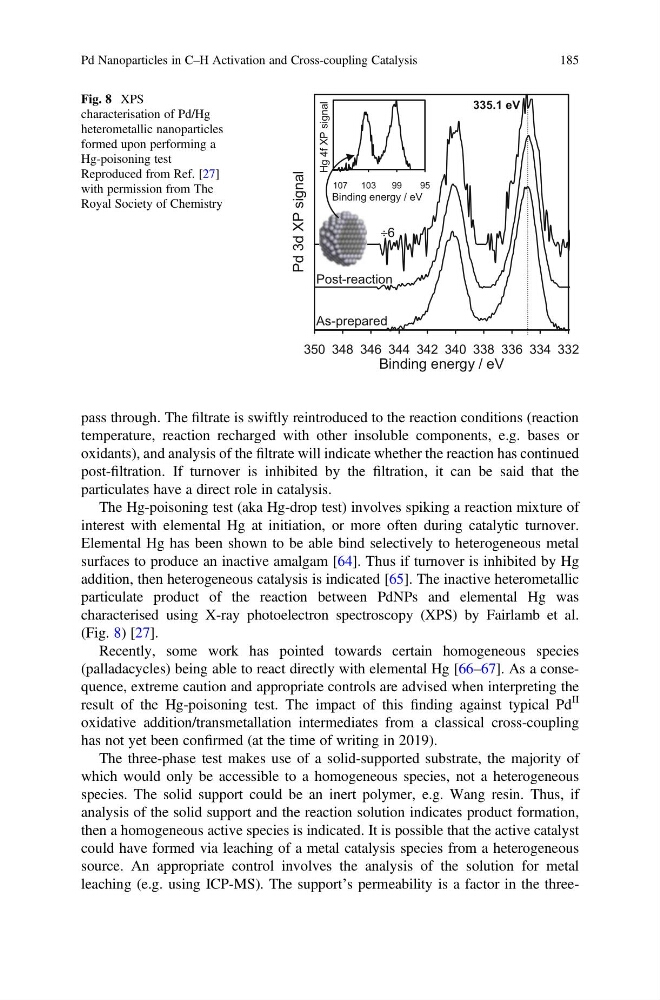
addition, then heterogeneous catalysis is indicated [65]. The inactive heterometallic
particulate product of the reaction between PdNPs and elemental Hg was
characterised using X-ray photoelectron spectroscopy (XPS) by Fairlamb et al.
(Fig. 8) [27].
Recently, some work has pointed towards certain homogeneous species
(palladacycles) being able to react directly with elemental Hg [66–67]. As a consequence, extreme caution and appropriate controls are advised when interpreting the
result of the Hg-poisoning test. The impact of this finding against typical Pd
II
oxidative addition/transmetallation intermediates from a classical cross-coupling
has not yet been confirmed (at the time of writing in 2019).
The three-phase test makes use of a solid-supported substrate, the majority of
which would only be accessible to a homogeneous species, not a heterogeneous
species. The solid support could be an inert polymer, e.g. Wang resin. Thus, if
analysis of the solid support and the reaction solution indicates product formation,
then a homogeneous active species is indicated. It is possible that the active catalyst
could have formed via leaching of a metal catalysis species from a heterogeneous
source. An appropriate control involves the analysis of the solution for metal
leaching (e.g. using ICP-MS). The support’s permeability is a factor in the three332
334
336
338
340
342
344
346
348
350
l
a
n
g
i
s
P
X
d
3
d
P
Binding energy / eV
95
99
103
107
l
a
n
g
i
s
P
X
f
4
g
H
Binding energy / eV
As-prepared
Post-reaction
335.1 eV
6
Fig. 8 XPS
characterisation of Pd/Hg
heterometallic nanoparticles
formed upon performing a
Hg-poisoning test
Reproduced from Ref. [27]
with permission from The
Royal Society of Chemistry
Pd Nanoparticles in C–H Activation and Cross-coupling Catalysis
185
temperature, reaction recharged with other insoluble components, e.g. bases or
oxidants), and analysis of the filtrate will indicate whether the reaction has continued
post-filtration. If turnover is inhibited by the filtration, it can be said that the
particulates have a direct role in catalysis.
The Hg-poisoning test (aka Hg-drop test) involves spiking a reaction mixture of
interest with elemental Hg at initiation, or more often during catalytic turnover.
Elemental Hg has been shown to be able bind selectively to heterogeneous metal
surfaces to produce an inactive amalgam [64]. Thus if turnover is inhibited by Hg
addition, then heterogeneous catalysis is indicated [65]. The inactive heterometallic
particulate product of the reaction between PdNPs and elemental Hg was
characterised using X-ray photoelectron spectroscopy (XPS) by Fairlamb et al.
(Fig. 8) [27].
Recently, some work has pointed towards certain homogeneous species
(palladacycles) being able to react directly with elemental Hg [66–67]. As a consequence, extreme caution and appropriate controls are advised when interpreting the
result of the Hg-poisoning test. The impact of this finding against typical Pd
II
oxidative addition/transmetallation intermediates from a classical cross-coupling
has not yet been confirmed (at the time of writing in 2019).
The three-phase test makes use of a solid-supported substrate, the majority of
which would only be accessible to a homogeneous species, not a heterogeneous
species. The solid support could be an inert polymer, e.g. Wang resin. Thus, if
analysis of the solid support and the reaction solution indicates product formation,
then a homogeneous active species is indicated. It is possible that the active catalyst
could have formed via leaching of a metal catalysis species from a heterogeneous
source. An appropriate control involves the analysis of the solution for metal
leaching (e.g. using ICP-MS). The support’s permeability is a factor in the three332
334
336
338
340
342
344
346
348
350
l
a
n
g
i
s
P
X
d
3
d
P
Binding energy / eV
95
99
103
107
l
a
n
g
i
s
P
X
f
4
g
H
Binding energy / eV
As-prepared
Post-reaction
335.1 eV
6
Fig. 8 XPS
characterisation of Pd/Hg
heterometallic nanoparticles
formed upon performing a
Hg-poisoning test
Reproduced from Ref. [27]
with permission from The
Royal Society of Chemistry
Pd Nanoparticles in C–H Activation and Cross-coupling Catalysis
185