

surface. In some cases, although small nanoparticles form under reaction conditions,
evidence points towards such species not being catalytically active. An example of
which is the direct C–H bond activation of tryptophan derivatives with aryl boronic
acids, in the presence of both Cu
II and Pd
0 [60]. The fact that both PVP-supported
PdNPs and Pd(OAc) 2 can catalyse these reactions is indicative of leached Pd
catalysing the process from a higher-order catalyst reservoir, which does not directly
participate as a catalyst species itself, i.e. by surface catalysis.
The examples above demonstrate that under working reaction conditions,
employing Pd(OAc) 2 can lead to the generation of catalytically viable PdNPs
forming under the reaction conditions. The activity of such nanoparticles most likely
varies according to the specific reaction conditions employed.
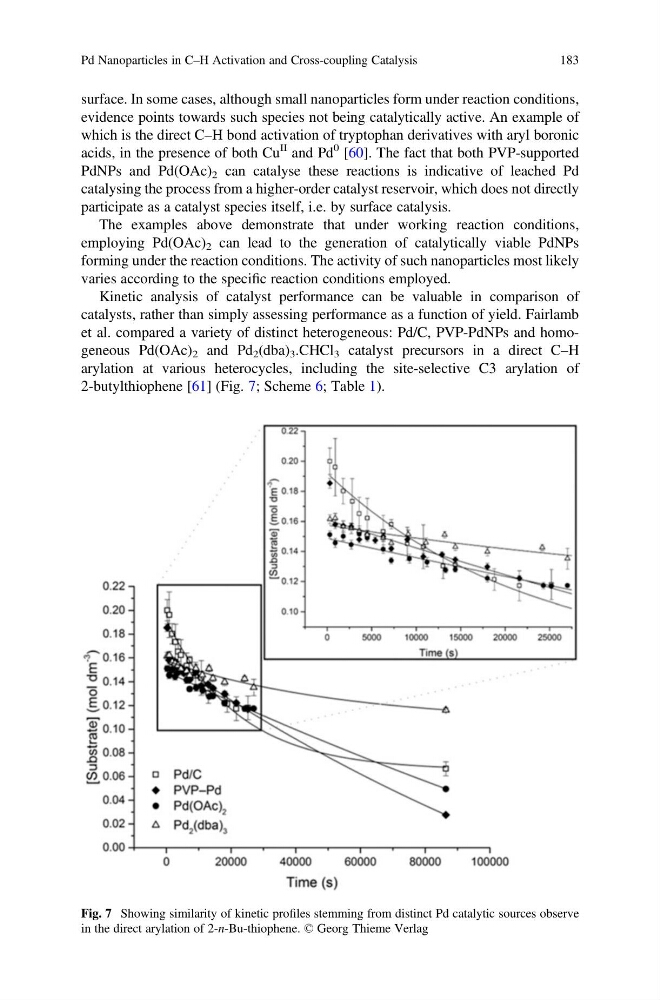
Kinetic analysis of catalyst performance can be valuable in comparison of
catalysts, rather than simply assessing performance as a function of yield. Fairlamb
et al. compared a variety of distinct heterogeneous: Pd/C, PVP-PdNPs and homogeneous Pd(OAc) 2 and Pd 2 (dba) 3 .CHCl 3 catalyst precursors in a direct C–H
arylation at various heterocycles, including the site-selective C3 arylation of
2-butylthiophene [61] (Fig. 7; Scheme 6; Table 1).
Fig. 7 Showing similarity of kinetic profiles stemming from distinct Pd catalytic sources observe
in the direct arylation of 2-n-Bu-thiophene. © Georg Thieme Verlag
Pd Nanoparticles in C–H Activation and Cross-coupling Catalysis
183
evidence points towards such species not being catalytically active. An example of
which is the direct C–H bond activation of tryptophan derivatives with aryl boronic
acids, in the presence of both Cu
II and Pd
0 [60]. The fact that both PVP-supported
PdNPs and Pd(OAc) 2 can catalyse these reactions is indicative of leached Pd
catalysing the process from a higher-order catalyst reservoir, which does not directly
participate as a catalyst species itself, i.e. by surface catalysis.
The examples above demonstrate that under working reaction conditions,
employing Pd(OAc) 2 can lead to the generation of catalytically viable PdNPs
forming under the reaction conditions. The activity of such nanoparticles most likely
varies according to the specific reaction conditions employed.
Kinetic analysis of catalyst performance can be valuable in comparison of
catalysts, rather than simply assessing performance as a function of yield. Fairlamb
et al. compared a variety of distinct heterogeneous: Pd/C, PVP-PdNPs and homogeneous Pd(OAc) 2 and Pd 2 (dba) 3 .CHCl 3 catalyst precursors in a direct C–H
arylation at various heterocycles, including the site-selective C3 arylation of
2-butylthiophene [61] (Fig. 7; Scheme 6; Table 1).
Fig. 7 Showing similarity of kinetic profiles stemming from distinct Pd catalytic sources observe
in the direct arylation of 2-n-Bu-thiophene. © Georg Thieme Verlag
Pd Nanoparticles in C–H Activation and Cross-coupling Catalysis
183