

propagation of PdNPs (see Sect. 5.3 for an example of an application in heterogeneous C–H functionalisation chemistry). If appropriate to a process of interest, GVL
should be considered as a green, non-toxic alternative to other polar aprotic
solvents [58].
Given the importance of polar solvents (e.g. DMF DMAc, NMP, H 2 O, alcohols)
in the proliferation and stabilisation of PdNPs, in reactions involving the degradation
of metal catalyst precursors and concomitant growth of catalytically active Pd
particles, interaction of polar solvents must be considered intrinsic to Pd speciation
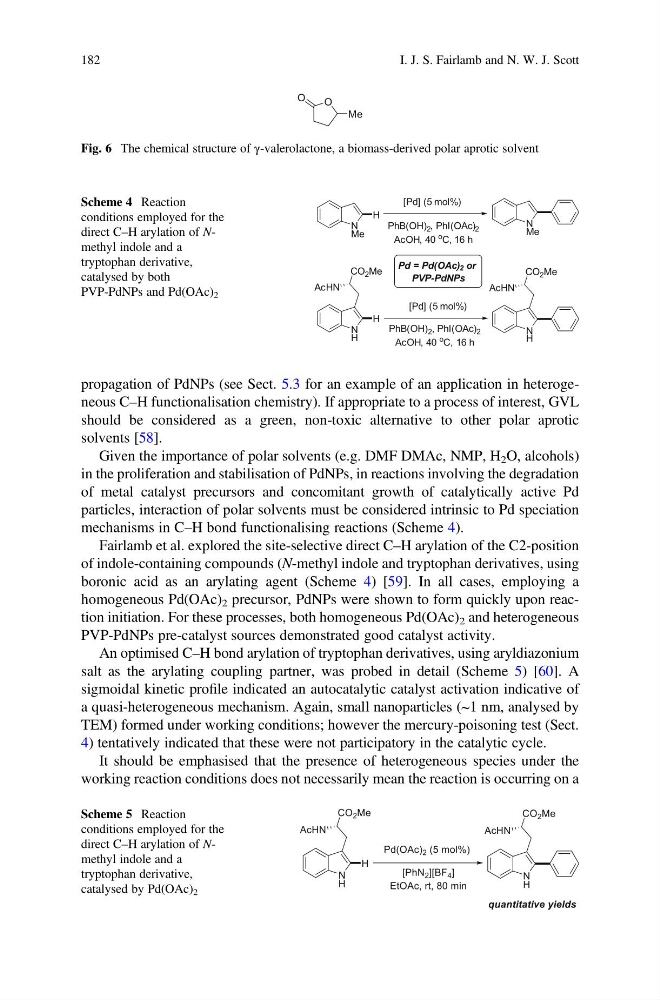
mechanisms in C–H bond functionalising reactions (Scheme 4).
Fairlamb et al. explored the site-selective direct C–H arylation of the C2-position
of indole-containing compounds (N-methyl indole and tryptophan derivatives, using
boronic acid as an arylating agent (Scheme 4) [59]. In all cases, employing a
homogeneous Pd(OAc) 2 precursor, PdNPs were shown to form quickly upon reaction initiation. For these processes, both homogeneous Pd(OAc) 2 and heterogeneous
PVP-PdNPs pre-catalyst sources demonstrated good catalyst activity.
An optimised C–H bond arylation of tryptophan derivatives, using aryldiazonium
salt as the arylating coupling partner, was probed in detail (Scheme 5) [60]. A
sigmoidal kinetic profile indicated an autocatalytic catalyst activation indicative of
a quasi-heterogeneous mechanism. Again, small nanoparticles (~1 nm, analysed by
TEM) formed under working conditions; however the mercury-poisoning test (Sect.
4) tentatively indicated that these were not participatory in the catalytic cycle.
It should be emphasised that the presence of heterogeneous species under the
working reaction conditions does not necessarily mean the reaction is occurring on a
N
H
CO 2 Me
AcHN
H
N
Me
H
PhB(OH) 2 , PhI(OAc) 2
AcOH, 40
o
C, 16 h
N
H
CO 2 Me
AcHN
[Pd] (5 mol%)
PhB(OH) 2 , PhI(OAc) 2
AcOH, 40
o
C, 16 h
Pd = Pd(OAc) 2 or
PVP-PdNPs
[Pd] (5 mol%)
N
Me
Scheme 4 Reaction
conditions employed for the
direct C–H arylation of Nmethyl indole and a
tryptophan derivative,
catalysed by both
PVP-PdNPs and Pd(OAc) 2
Scheme 5 Reaction
conditions employed for the
direct C–H arylation of Nmethyl indole and a
tryptophan derivative,
catalysed by Pd(OAc) 2
Fig. 6 The chemical structure of γ-valerolactone, a biomass-derived polar aprotic solvent
182
I. J. S. Fairlamb and N. W. J. Scott
should be considered as a green, non-toxic alternative to other polar aprotic
solvents [58].
Given the importance of polar solvents (e.g. DMF DMAc, NMP, H 2 O, alcohols)
in the proliferation and stabilisation of PdNPs, in reactions involving the degradation
of metal catalyst precursors and concomitant growth of catalytically active Pd
particles, interaction of polar solvents must be considered intrinsic to Pd speciation
mechanisms in C–H bond functionalising reactions (Scheme 4).
Fairlamb et al. explored the site-selective direct C–H arylation of the C2-position
of indole-containing compounds (N-methyl indole and tryptophan derivatives, using
boronic acid as an arylating agent (Scheme 4) [59]. In all cases, employing a
homogeneous Pd(OAc) 2 precursor, PdNPs were shown to form quickly upon reaction initiation. For these processes, both homogeneous Pd(OAc) 2 and heterogeneous
PVP-PdNPs pre-catalyst sources demonstrated good catalyst activity.
An optimised C–H bond arylation of tryptophan derivatives, using aryldiazonium
salt as the arylating coupling partner, was probed in detail (Scheme 5) [60]. A
sigmoidal kinetic profile indicated an autocatalytic catalyst activation indicative of
a quasi-heterogeneous mechanism. Again, small nanoparticles (~1 nm, analysed by
TEM) formed under working conditions; however the mercury-poisoning test (Sect.
4) tentatively indicated that these were not participatory in the catalytic cycle.
It should be emphasised that the presence of heterogeneous species under the
working reaction conditions does not necessarily mean the reaction is occurring on a
N
H
CO 2 Me
AcHN
H
N
Me
H
PhB(OH) 2 , PhI(OAc) 2
AcOH, 40
o
C, 16 h
N
H
CO 2 Me
AcHN
[Pd] (5 mol%)
PhB(OH) 2 , PhI(OAc) 2
AcOH, 40
o
C, 16 h
Pd = Pd(OAc) 2 or
PVP-PdNPs
[Pd] (5 mol%)
N
Me
Scheme 4 Reaction
conditions employed for the
direct C–H arylation of Nmethyl indole and a
tryptophan derivative,
catalysed by both
PVP-PdNPs and Pd(OAc) 2
Scheme 5 Reaction
conditions employed for the
direct C–H arylation of Nmethyl indole and a
tryptophan derivative,
catalysed by Pd(OAc) 2
Fig. 6 The chemical structure of γ-valerolactone, a biomass-derived polar aprotic solvent
182
I. J. S. Fairlamb and N. W. J. Scott