

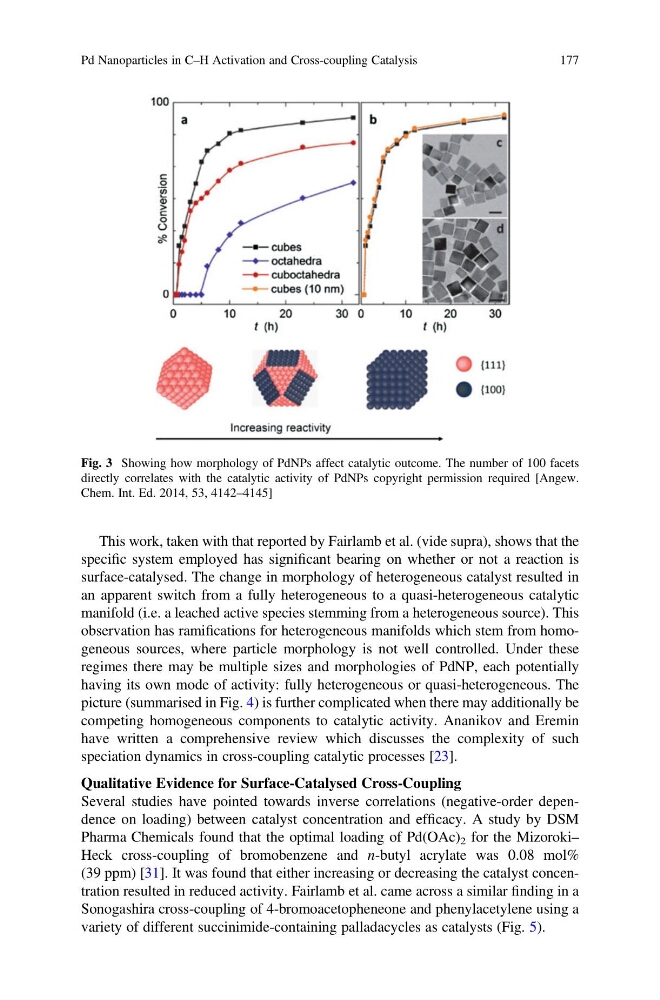
This work, taken with that reported by Fairlamb et al. (vide supra), shows that the
specific system employed has significant bearing on whether or not a reaction is
surface-catalysed. The change in morphology of heterogeneous catalyst resulted in
an apparent switch from a fully heterogeneous to a quasi-heterogeneous catalytic
manifold (i.e. a leached active species stemming from a heterogeneous source). This
observation has ramifications for heterogeneous manifolds which stem from homogeneous sources, where particle morphology is not well controlled. Under these
regimes there may be multiple sizes and morphologies of PdNP, each potentially
having its own mode of activity: fully heterogeneous or quasi-heterogeneous. The
picture (summarised in Fig. 4) is further complicated when there may additionally be
competing homogeneous components to catalytic activity. Ananikov and Eremin
have written a comprehensive review which discusses the complexity of such
speciation dynamics in cross-coupling catalytic processes [23].
Qualitative Evidence for Surface-Catalysed Cross-Coupling
Several studies have pointed towards inverse correlations (negative-order dependence on loading) between catalyst concentration and efficacy. A study by DSM
Pharma Chemicals found that the optimal loading of Pd(OAc) 2 for the Mizoroki–
Heck cross-coupling of bromobenzene and n-butyl acrylate was 0.08 mol%
(39 ppm) [31]. It was found that either increasing or decreasing the catalyst concentration resulted in reduced activity. Fairlamb et al. came across a similar finding in a
Sonogashira cross-coupling of 4-bromoacetopheneone and phenylacetylene using a
variety of different succinimide-containing palladacycles as catalysts (Fig. 5).
Fig. 3 Showing how morphology of PdNPs affect catalytic outcome. The number of 100 facets
directly correlates with the catalytic activity of PdNPs copyright permission required [Angew.
Chem. Int. Ed. 2014, 53, 4142–4145]
Pd Nanoparticles in C–H Activation and Cross-coupling Catalysis
177
specific system employed has significant bearing on whether or not a reaction is
surface-catalysed. The change in morphology of heterogeneous catalyst resulted in
an apparent switch from a fully heterogeneous to a quasi-heterogeneous catalytic
manifold (i.e. a leached active species stemming from a heterogeneous source). This
observation has ramifications for heterogeneous manifolds which stem from homogeneous sources, where particle morphology is not well controlled. Under these
regimes there may be multiple sizes and morphologies of PdNP, each potentially
having its own mode of activity: fully heterogeneous or quasi-heterogeneous. The
picture (summarised in Fig. 4) is further complicated when there may additionally be
competing homogeneous components to catalytic activity. Ananikov and Eremin
have written a comprehensive review which discusses the complexity of such
speciation dynamics in cross-coupling catalytic processes [23].
Qualitative Evidence for Surface-Catalysed Cross-Coupling
Several studies have pointed towards inverse correlations (negative-order dependence on loading) between catalyst concentration and efficacy. A study by DSM
Pharma Chemicals found that the optimal loading of Pd(OAc) 2 for the Mizoroki–
Heck cross-coupling of bromobenzene and n-butyl acrylate was 0.08 mol%
(39 ppm) [31]. It was found that either increasing or decreasing the catalyst concentration resulted in reduced activity. Fairlamb et al. came across a similar finding in a
Sonogashira cross-coupling of 4-bromoacetopheneone and phenylacetylene using a
variety of different succinimide-containing palladacycles as catalysts (Fig. 5).
Fig. 3 Showing how morphology of PdNPs affect catalytic outcome. The number of 100 facets
directly correlates with the catalytic activity of PdNPs copyright permission required [Angew.
Chem. Int. Ed. 2014, 53, 4142–4145]
Pd Nanoparticles in C–H Activation and Cross-coupling Catalysis
177