

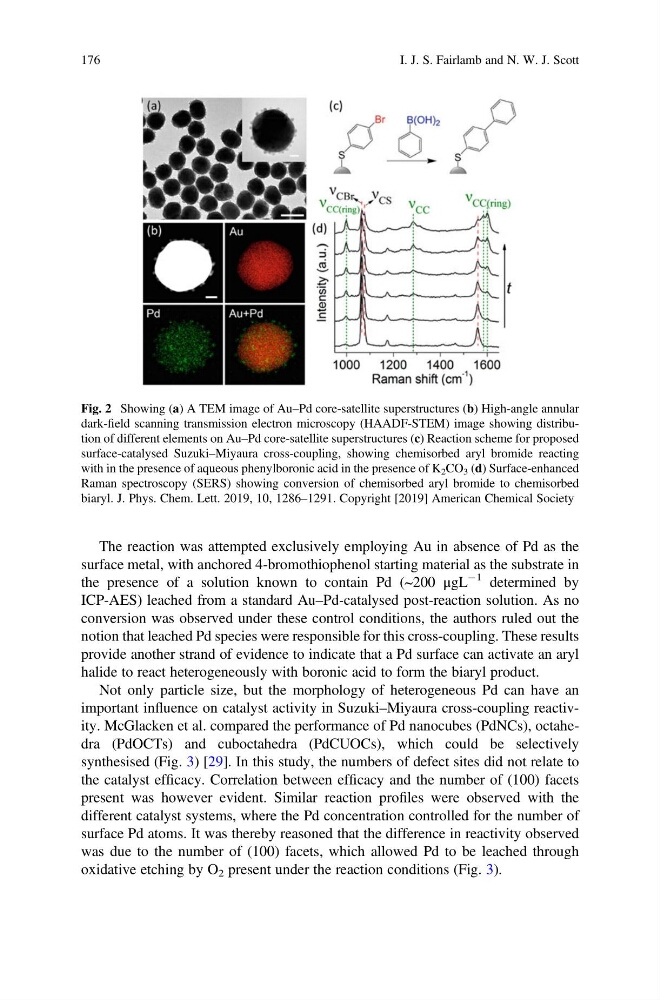
The reaction was attempted exclusively employing Au in absence of Pd as the
surface metal, with anchored 4-bromothiophenol starting material as the substrate in
the presence of a solution known to contain Pd (~200 μgL
À1 determined by
ICP-AES) leached from a standard Au–Pd-catalysed post-reaction solution. As no
conversion was observed under these control conditions, the authors ruled out the
notion that leached Pd species were responsible for this cross-coupling. These results
provide another strand of evidence to indicate that a Pd surface can activate an aryl
halide to react heterogeneously with boronic acid to form the biaryl product.
Not only particle size, but the morphology of heterogeneous Pd can have an
important influence on catalyst activity in Suzuki–Miyaura cross-coupling reactivity. McGlacken et al. compared the performance of Pd nanocubes (PdNCs), octahedra (PdOCTs) and cuboctahedra (PdCUOCs), which could be selectively
synthesised (Fig. 3) [29]. In this study, the numbers of defect sites did not relate to
the catalyst efficacy. Correlation between efficacy and the number of (100) facets
present was however evident. Similar reaction profiles were observed with the
different catalyst systems, where the Pd concentration controlled for the number of
surface Pd atoms. It was thereby reasoned that the difference in reactivity observed
was due to the number of (100) facets, which allowed Pd to be leached through
oxidative etching by O 2 present under the reaction conditions (Fig. 3).
Fig. 2 Showing (a) A TEM image of Au–Pd core-satellite superstructures (b) High-angle annular
dark-field scanning transmission electron microscopy (HAADF-STEM) image showing distribution of different elements on Au–Pd core-satellite superstructures (c) Reaction scheme for proposed
surface-catalysed Suzuki–Miyaura cross-coupling, showing chemisorbed aryl bromide reacting
with in the presence of aqueous phenylboronic acid in the presence of K 2 CO 3 (d) Surface-enhanced
Raman spectroscopy (SERS) showing conversion of chemisorbed aryl bromide to chemisorbed
biaryl. J. Phys. Chem. Lett. 2019, 10, 1286–1291. Copyright [2019] American Chemical Society
176
I. J. S. Fairlamb and N. W. J. Scott
surface metal, with anchored 4-bromothiophenol starting material as the substrate in
the presence of a solution known to contain Pd (~200 μgL
À1 determined by
ICP-AES) leached from a standard Au–Pd-catalysed post-reaction solution. As no
conversion was observed under these control conditions, the authors ruled out the
notion that leached Pd species were responsible for this cross-coupling. These results
provide another strand of evidence to indicate that a Pd surface can activate an aryl
halide to react heterogeneously with boronic acid to form the biaryl product.
Not only particle size, but the morphology of heterogeneous Pd can have an
important influence on catalyst activity in Suzuki–Miyaura cross-coupling reactivity. McGlacken et al. compared the performance of Pd nanocubes (PdNCs), octahedra (PdOCTs) and cuboctahedra (PdCUOCs), which could be selectively
synthesised (Fig. 3) [29]. In this study, the numbers of defect sites did not relate to
the catalyst efficacy. Correlation between efficacy and the number of (100) facets
present was however evident. Similar reaction profiles were observed with the
different catalyst systems, where the Pd concentration controlled for the number of
surface Pd atoms. It was thereby reasoned that the difference in reactivity observed
was due to the number of (100) facets, which allowed Pd to be leached through
oxidative etching by O 2 present under the reaction conditions (Fig. 3).
Fig. 2 Showing (a) A TEM image of Au–Pd core-satellite superstructures (b) High-angle annular
dark-field scanning transmission electron microscopy (HAADF-STEM) image showing distribution of different elements on Au–Pd core-satellite superstructures (c) Reaction scheme for proposed
surface-catalysed Suzuki–Miyaura cross-coupling, showing chemisorbed aryl bromide reacting
with in the presence of aqueous phenylboronic acid in the presence of K 2 CO 3 (d) Surface-enhanced
Raman spectroscopy (SERS) showing conversion of chemisorbed aryl bromide to chemisorbed
biaryl. J. Phys. Chem. Lett. 2019, 10, 1286–1291. Copyright [2019] American Chemical Society
176
I. J. S. Fairlamb and N. W. J. Scott