

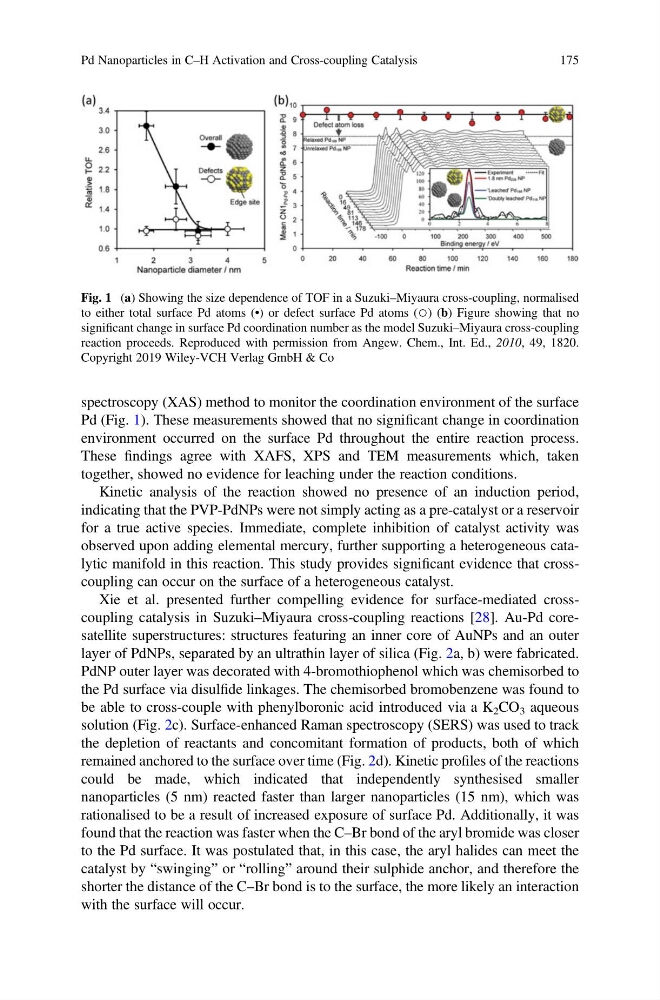
spectroscopy (XAS) method to monitor the coordination environment of the surface
Pd (Fig. 1). These measurements showed that no significant change in coordination
environment occurred on the surface Pd throughout the entire reaction process.
These findings agree with XAFS, XPS and TEM measurements which, taken
together, showed no evidence for leaching under the reaction conditions.
Kinetic analysis of the reaction showed no presence of an induction period,
indicating that the PVP-PdNPs were not simply acting as a pre-catalyst or a reservoir
for a true active species. Immediate, complete inhibition of catalyst activity was
observed upon adding elemental mercury, further supporting a heterogeneous catalytic manifold in this reaction. This study provides significant evidence that crosscoupling can occur on the surface of a heterogeneous catalyst.
Xie et al. presented further compelling evidence for surface-mediated crosscoupling catalysis in Suzuki–Miyaura cross-coupling reactions [28]. Au-Pd coresatellite superstructures: structures featuring an inner core of AuNPs and an outer
layer of PdNPs, separated by an ultrathin layer of silica (Fig. 2a, b) were fabricated.
PdNP outer layer was decorated with 4-bromothiophenol which was chemisorbed to
the Pd surface via disulfide linkages. The chemisorbed bromobenzene was found to
be able to cross-couple with phenylboronic acid introduced via a K 2 CO 3 aqueous
solution (Fig. 2c). Surface-enhanced Raman spectroscopy (SERS) was used to track
the depletion of reactants and concomitant formation of products, both of which
remained anchored to the surface over time (Fig. 2d). Kinetic profiles of the reactions
could be made, which indicated that independently synthesised smaller
nanoparticles (5 nm) reacted faster than larger nanoparticles (15 nm), which was
rationalised to be a result of increased exposure of surface Pd. Additionally, it was
found that the reaction was faster when the C–Br bond of the aryl bromide was closer
to the Pd surface. It was postulated that, in this case, the aryl halides can meet the
catalyst by “swinging” or “rolling” around their sulphide anchor, and therefore the
shorter the distance of the C–Br bond is to the surface, the more likely an interaction
with the surface will occur.
Fig. 1 (a) Showing the size dependence of TOF in a Suzuki–Miyaura cross-coupling, normalised
to either total surface Pd atoms (•) or defect surface Pd atoms (○) (b) Figure showing that no
significant change in surface Pd coordination number as the model Suzuki–Miyaura cross-coupling
reaction proceeds. Reproduced with permission from Angew. Chem., Int. Ed., 2010, 49, 1820.
Copyright 2019 Wiley-VCH Verlag GmbH & Co
Pd Nanoparticles in C–H Activation and Cross-coupling Catalysis
175
Pd (Fig. 1). These measurements showed that no significant change in coordination
environment occurred on the surface Pd throughout the entire reaction process.
These findings agree with XAFS, XPS and TEM measurements which, taken
together, showed no evidence for leaching under the reaction conditions.
Kinetic analysis of the reaction showed no presence of an induction period,
indicating that the PVP-PdNPs were not simply acting as a pre-catalyst or a reservoir
for a true active species. Immediate, complete inhibition of catalyst activity was
observed upon adding elemental mercury, further supporting a heterogeneous catalytic manifold in this reaction. This study provides significant evidence that crosscoupling can occur on the surface of a heterogeneous catalyst.
Xie et al. presented further compelling evidence for surface-mediated crosscoupling catalysis in Suzuki–Miyaura cross-coupling reactions [28]. Au-Pd coresatellite superstructures: structures featuring an inner core of AuNPs and an outer
layer of PdNPs, separated by an ultrathin layer of silica (Fig. 2a, b) were fabricated.
PdNP outer layer was decorated with 4-bromothiophenol which was chemisorbed to
the Pd surface via disulfide linkages. The chemisorbed bromobenzene was found to
be able to cross-couple with phenylboronic acid introduced via a K 2 CO 3 aqueous
solution (Fig. 2c). Surface-enhanced Raman spectroscopy (SERS) was used to track
the depletion of reactants and concomitant formation of products, both of which
remained anchored to the surface over time (Fig. 2d). Kinetic profiles of the reactions
could be made, which indicated that independently synthesised smaller
nanoparticles (5 nm) reacted faster than larger nanoparticles (15 nm), which was
rationalised to be a result of increased exposure of surface Pd. Additionally, it was
found that the reaction was faster when the C–Br bond of the aryl bromide was closer
to the Pd surface. It was postulated that, in this case, the aryl halides can meet the
catalyst by “swinging” or “rolling” around their sulphide anchor, and therefore the
shorter the distance of the C–Br bond is to the surface, the more likely an interaction
with the surface will occur.
Fig. 1 (a) Showing the size dependence of TOF in a Suzuki–Miyaura cross-coupling, normalised
to either total surface Pd atoms (•) or defect surface Pd atoms (○) (b) Figure showing that no
significant change in surface Pd coordination number as the model Suzuki–Miyaura cross-coupling
reaction proceeds. Reproduced with permission from Angew. Chem., Int. Ed., 2010, 49, 1820.
Copyright 2019 Wiley-VCH Verlag GmbH & Co
Pd Nanoparticles in C–H Activation and Cross-coupling Catalysis
175