

catalyst systems for C–H bond functionalisation reactions. Gomez et al. wrote a
critical review a few years ago [25], defining the new field of study as “molecular
transformation of unactivated C–H bonds present in feedstock and readily available
hydrocarbons into valuable chemicals by nanoparticle-leveraged C–H activation”.
2 Evidence for Catalytically Active Heterogeneous Species
in Classic Cross-Coupling Processes
From a green and sustainable chemistry perspective, there is a clear benefit of direct
C–H activation, over the classic C–X/C–M cross-coupling regime. This book
chapter will focus on heterogeneous C–H cross-coupling processes. There is however still limited mechanistic understanding of how heterogeneous cross-coupling
reactions occur, particularly regarding C–H bond activation and functionalisation
processes. Understanding heterogeneous catalysis in classical cross-coupling systems is broader and may hence allow to inform an approach to mechanistic understanding in heterogeneous C–H bond activation systems. This section discusses
literature evidence for a heterogeneous catalytic activity in classic cross-coupling
reactions.
Direct Evidence for Surface-Catalysed Cross-Coupling
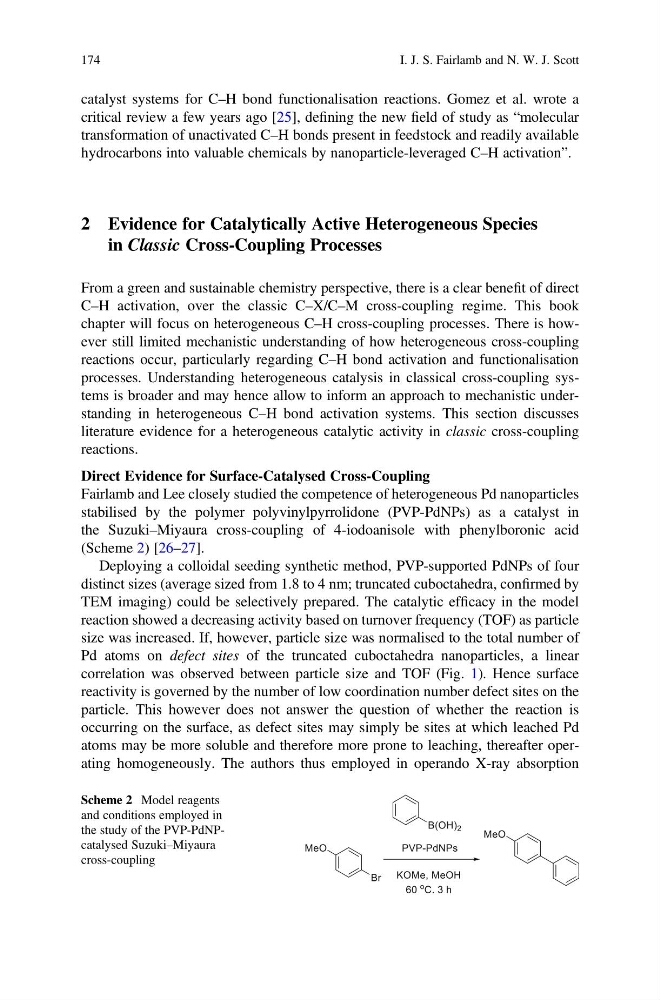
Fairlamb and Lee closely studied the competence of heterogeneous Pd nanoparticles
stabilised by the polymer polyvinylpyrrolidone (PVP-PdNPs) as a catalyst in
the Suzuki–Miyaura cross-coupling of 4-iodoanisole with phenylboronic acid
(Scheme 2) [26–27].
Deploying a colloidal seeding synthetic method, PVP-supported PdNPs of four
distinct sizes (average sized from 1.8 to 4 nm; truncated cuboctahedra, confirmed by
TEM imaging) could be selectively prepared. The catalytic efficacy in the model
reaction showed a decreasing activity based on turnover frequency (TOF) as particle
size was increased. If, however, particle size was normalised to the total number of
Pd atoms on defect sites of the truncated cuboctahedra nanoparticles, a linear
correlation was observed between particle size and TOF (Fig. 1). Hence surface
reactivity is governed by the number of low coordination number defect sites on the
particle. This however does not answer the question of whether the reaction is
occurring on the surface, as defect sites may simply be sites at which leached Pd
atoms may be more soluble and therefore more prone to leaching, thereafter operating homogeneously. The authors thus employed in operando X-ray absorption
Scheme 2 Model reagents
and conditions employed in
the study of the PVP-PdNPcatalysed Suzuki–Miyaura
cross-coupling
174
I. J. S. Fairlamb and N. W. J. Scott
critical review a few years ago [25], defining the new field of study as “molecular
transformation of unactivated C–H bonds present in feedstock and readily available
hydrocarbons into valuable chemicals by nanoparticle-leveraged C–H activation”.
2 Evidence for Catalytically Active Heterogeneous Species
in Classic Cross-Coupling Processes
From a green and sustainable chemistry perspective, there is a clear benefit of direct
C–H activation, over the classic C–X/C–M cross-coupling regime. This book
chapter will focus on heterogeneous C–H cross-coupling processes. There is however still limited mechanistic understanding of how heterogeneous cross-coupling
reactions occur, particularly regarding C–H bond activation and functionalisation
processes. Understanding heterogeneous catalysis in classical cross-coupling systems is broader and may hence allow to inform an approach to mechanistic understanding in heterogeneous C–H bond activation systems. This section discusses
literature evidence for a heterogeneous catalytic activity in classic cross-coupling
reactions.
Direct Evidence for Surface-Catalysed Cross-Coupling
Fairlamb and Lee closely studied the competence of heterogeneous Pd nanoparticles
stabilised by the polymer polyvinylpyrrolidone (PVP-PdNPs) as a catalyst in
the Suzuki–Miyaura cross-coupling of 4-iodoanisole with phenylboronic acid
(Scheme 2) [26–27].
Deploying a colloidal seeding synthetic method, PVP-supported PdNPs of four
distinct sizes (average sized from 1.8 to 4 nm; truncated cuboctahedra, confirmed by
TEM imaging) could be selectively prepared. The catalytic efficacy in the model
reaction showed a decreasing activity based on turnover frequency (TOF) as particle
size was increased. If, however, particle size was normalised to the total number of
Pd atoms on defect sites of the truncated cuboctahedra nanoparticles, a linear
correlation was observed between particle size and TOF (Fig. 1). Hence surface
reactivity is governed by the number of low coordination number defect sites on the
particle. This however does not answer the question of whether the reaction is
occurring on the surface, as defect sites may simply be sites at which leached Pd
atoms may be more soluble and therefore more prone to leaching, thereafter operating homogeneously. The authors thus employed in operando X-ray absorption
Scheme 2 Model reagents
and conditions employed in
the study of the PVP-PdNPcatalysed Suzuki–Miyaura
cross-coupling
174
I. J. S. Fairlamb and N. W. J. Scott