

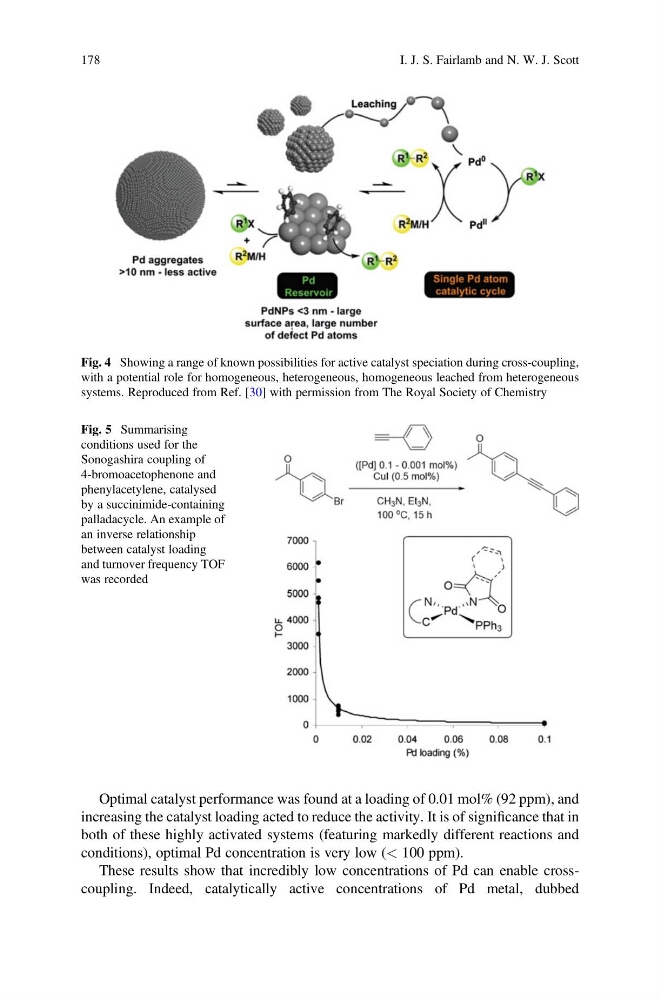
Optimal catalyst performance was found at a loading of 0.01 mol% (92 ppm), and
increasing the catalyst loading acted to reduce the activity. It is of significance that in
both of these highly activated systems (featuring markedly different reactions and
conditions), optimal Pd concentration is very low (< 100 ppm).
These results show that incredibly low concentrations of Pd can enable crosscoupling. Indeed, catalytically active concentrations of Pd metal, dubbed
Fig. 4 Showing a range of known possibilities for active catalyst speciation during cross-coupling,
with a potential role for homogeneous, heterogeneous, homogeneous leached from heterogeneous
systems. Reproduced from Ref. [30] with permission from The Royal Society of Chemistry
Fig. 5 Summarising
conditions used for the
Sonogashira coupling of
4-bromoacetophenone and
phenylacetylene, catalysed
by a succinimide-containing
palladacycle. An example of
an inverse relationship
between catalyst loading
and turnover frequency TOF
was recorded
178
I. J. S. Fairlamb and N. W. J. Scott
increasing the catalyst loading acted to reduce the activity. It is of significance that in
both of these highly activated systems (featuring markedly different reactions and
conditions), optimal Pd concentration is very low (< 100 ppm).
These results show that incredibly low concentrations of Pd can enable crosscoupling. Indeed, catalytically active concentrations of Pd metal, dubbed
Fig. 4 Showing a range of known possibilities for active catalyst speciation during cross-coupling,
with a potential role for homogeneous, heterogeneous, homogeneous leached from heterogeneous
systems. Reproduced from Ref. [30] with permission from The Royal Society of Chemistry
Fig. 5 Summarising
conditions used for the
Sonogashira coupling of
4-bromoacetophenone and
phenylacetylene, catalysed
by a succinimide-containing
palladacycle. An example of
an inverse relationship
between catalyst loading
and turnover frequency TOF
was recorded
178
I. J. S. Fairlamb and N. W. J. Scott