

5 Polybenzyl Ethers (Fréchet-Type) Dendrimer
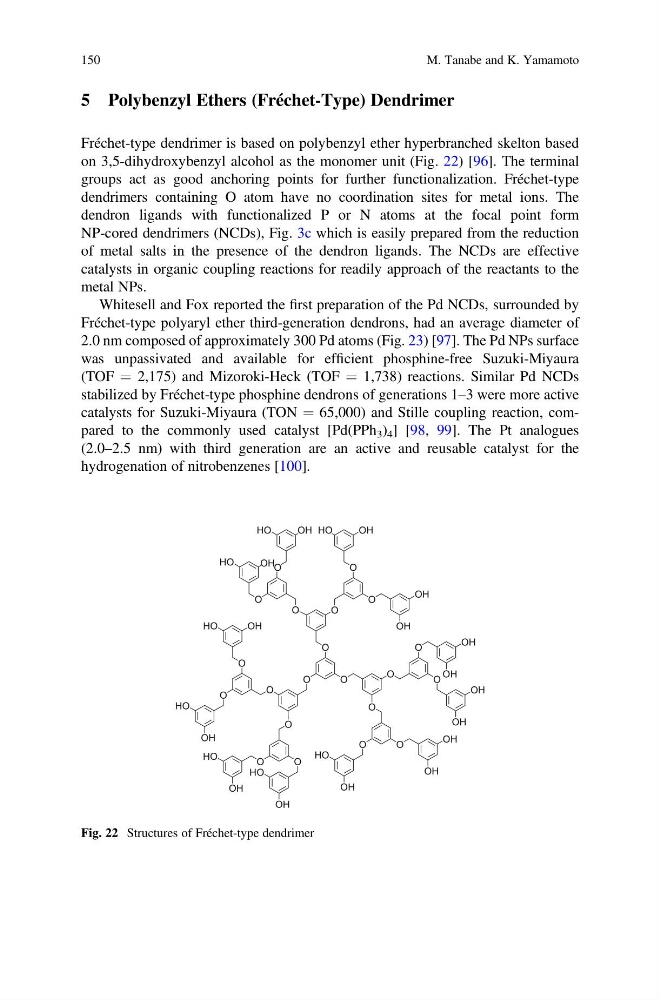
Fréchet-type dendrimer is based on polybenzyl ether hyperbranched skelton based
on 3,5-dihydroxybenzyl alcohol as the monomer unit (Fig. 22) [96]. The terminal
groups act as good anchoring points for further functionalization. Fréchet-type
dendrimers containing O atom have no coordination sites for metal ions. The
dendron ligands with functionalized P or N atoms at the focal point form
NP-cored dendrimers (NCDs), Fig. 3c which is easily prepared from the reduction
of metal salts in the presence of the dendron ligands. The NCDs are effective
catalysts in organic coupling reactions for readily approach of the reactants to the
metal NPs.
Whitesell and Fox reported the first preparation of the Pd NCDs, surrounded by
Fréchet-type polyaryl ether third-generation dendrons, had an average diameter of
2.0 nm composed of approximately 300 Pd atoms (Fig. 23) [97]. The Pd NPs surface
was unpassivated and available for efficient phosphine-free Suzuki-Miyaura
(TOF ¼ 2,175) and Mizoroki-Heck (TOF ¼ 1,738) reactions. Similar Pd NCDs
stabilized by Fréchet-type phosphine dendrons of generations 1–3 were more active
catalysts for Suzuki-Miyaura (TON ¼ 65,000) and Stille coupling reaction, compared to the commonly used catalyst [Pd(PPh 3 ) 4 ] [98, 99]. The Pt analogues
(2.0–2.5 nm) with third generation are an active and reusable catalyst for the
hydrogenation of nitrobenzenes [100].
O
O
O
O
O
O
HO
OH
OH
OH
O
O
O
OH
OH
OH
OH
O
O
O
OH
OH
OH
HO
O
O
O
OH
HO
HO
OH
O
O
O
HO
OH
OH
HO
O
O
O
OH
HO
HO
OH
Fig. 22 Structures of Fréchet-type dendrimer
150
M. Tanabe and K. Yamamoto
Fréchet-type dendrimer is based on polybenzyl ether hyperbranched skelton based
on 3,5-dihydroxybenzyl alcohol as the monomer unit (Fig. 22) [96]. The terminal
groups act as good anchoring points for further functionalization. Fréchet-type
dendrimers containing O atom have no coordination sites for metal ions. The
dendron ligands with functionalized P or N atoms at the focal point form
NP-cored dendrimers (NCDs), Fig. 3c which is easily prepared from the reduction
of metal salts in the presence of the dendron ligands. The NCDs are effective
catalysts in organic coupling reactions for readily approach of the reactants to the
metal NPs.
Whitesell and Fox reported the first preparation of the Pd NCDs, surrounded by
Fréchet-type polyaryl ether third-generation dendrons, had an average diameter of
2.0 nm composed of approximately 300 Pd atoms (Fig. 23) [97]. The Pd NPs surface
was unpassivated and available for efficient phosphine-free Suzuki-Miyaura
(TOF ¼ 2,175) and Mizoroki-Heck (TOF ¼ 1,738) reactions. Similar Pd NCDs
stabilized by Fréchet-type phosphine dendrons of generations 1–3 were more active
catalysts for Suzuki-Miyaura (TON ¼ 65,000) and Stille coupling reaction, compared to the commonly used catalyst [Pd(PPh 3 ) 4 ] [98, 99]. The Pt analogues
(2.0–2.5 nm) with third generation are an active and reusable catalyst for the
hydrogenation of nitrobenzenes [100].
O
O
O
O
O
O
HO
OH
OH
OH
O
O
O
OH
OH
OH
OH
O
O
O
OH
OH
OH
HO
O
O
O
OH
HO
HO
OH
O
O
O
HO
OH
OH
HO
O
O
O
OH
HO
HO
OH
Fig. 22 Structures of Fréchet-type dendrimer
150
M. Tanabe and K. Yamamoto