

triazole-free dendrimer (DSN) were very rapidly oxidized at their surface, resulting
in very poor catalytic conversion [92]. Therefore, the dendrimer ligands play a
crucial role, which prevents aggregation of the NPs or air oxidation.
Magnetic dendritic catalysts have received attention because they can be recovered easily from reaction mixtures by exposure to an external magnetic field.
Classical fixation of NPs on supports has been done mainly for the reduction of
metal salts in the presence of the support. However, this process can cause aggregation of the NPs. Simple impregnation of SiO 2 -coated γ-Fe 2 O 3 NPs with Pd NPs
was succeeded by Astruc’s group and produced stable, efficient, and recyclable
heterogeneous catalysts for a variety of cross-coupling reactions at a low level of Pd
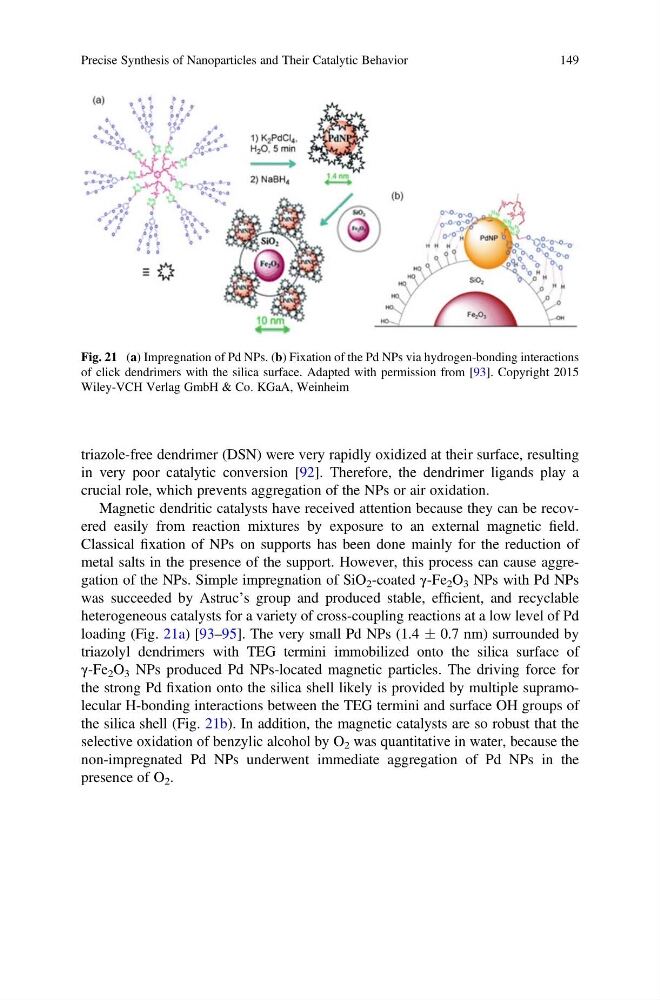
loading (Fig. 21a) [93–95]. The very small Pd NPs (1.4 Æ 0.7 nm) surrounded by
triazolyl dendrimers with TEG termini immobilized onto the silica surface of
γ-Fe 2 O 3 NPs produced Pd NPs-located magnetic particles. The driving force for
the strong Pd fixation onto the silica shell likely is provided by multiple supramolecular H-bonding interactions between the TEG termini and surface OH groups of
the silica shell (Fig. 21b). In addition, the magnetic catalysts are so robust that the
selective oxidation of benzylic alcohol by O 2 was quantitative in water, because the
non-impregnated Pd NPs underwent immediate aggregation of Pd NPs in the
presence of O 2 .
Fig. 21 (a) Impregnation of Pd NPs. (b) Fixation of the Pd NPs via hydrogen-bonding interactions
of click dendrimers with the silica surface. Adapted with permission from [93]. Copyright 2015
Wiley-VCH Verlag GmbH & Co. KGaA, Weinheim
Precise Synthesis of Nanoparticles and Their Catalytic Behavior
149
in very poor catalytic conversion [92]. Therefore, the dendrimer ligands play a
crucial role, which prevents aggregation of the NPs or air oxidation.
Magnetic dendritic catalysts have received attention because they can be recovered easily from reaction mixtures by exposure to an external magnetic field.
Classical fixation of NPs on supports has been done mainly for the reduction of
metal salts in the presence of the support. However, this process can cause aggregation of the NPs. Simple impregnation of SiO 2 -coated γ-Fe 2 O 3 NPs with Pd NPs
was succeeded by Astruc’s group and produced stable, efficient, and recyclable
heterogeneous catalysts for a variety of cross-coupling reactions at a low level of Pd
loading (Fig. 21a) [93–95]. The very small Pd NPs (1.4 Æ 0.7 nm) surrounded by
triazolyl dendrimers with TEG termini immobilized onto the silica surface of
γ-Fe 2 O 3 NPs produced Pd NPs-located magnetic particles. The driving force for
the strong Pd fixation onto the silica shell likely is provided by multiple supramolecular H-bonding interactions between the TEG termini and surface OH groups of
the silica shell (Fig. 21b). In addition, the magnetic catalysts are so robust that the
selective oxidation of benzylic alcohol by O 2 was quantitative in water, because the
non-impregnated Pd NPs underwent immediate aggregation of Pd NPs in the
presence of O 2 .
Fig. 21 (a) Impregnation of Pd NPs. (b) Fixation of the Pd NPs via hydrogen-bonding interactions
of click dendrimers with the silica surface. Adapted with permission from [93]. Copyright 2015
Wiley-VCH Verlag GmbH & Co. KGaA, Weinheim
Precise Synthesis of Nanoparticles and Their Catalytic Behavior
149