

1.2 Æ 0.2 nm; G2. 1.6 Æ 0.3 nm). In contrast, the smallest dendrimer G0 formed a Pd
DSN (1.2 Æ 0.2 nm) due to its small size, with an open structure (Fig. 3b). The Pd
NPs were stabilized by seven dendrimers [82, 83]. The interdendritic Pd DSNs were
highly efficient, stable, and size-selective hydrogenation catalysts for various olefins
in organic solvents [84] and Suzuki-Miyaura coupling reactions with 1 ppm of the
Pd atom [85]. A water-soluble “click” dendrimer was achieved by incorporation of
hydrophilic sulfonate. The Pd DSNs (2.3 Æ 0.2 nm), formed by the smallest
dendrimer (G0), were highly stable in air and were catalytically active for olefin
hydrogenation and coupling reactions using a low amount of palladium (0.01 mol%
Pd) [86].
Triethylene glycol (TEG) termini in the click dendrimer provide interdendritic
assembly of DSNs, which protects the Pd NPs better than a single dendrimer [87–
89]. The very small Pd NPs (1.4 Æ 0.7 nm) were active in water/ethanol and
catalyzed various cross-coupling reactions, such as Suzuki-Miyaura, Heck, and
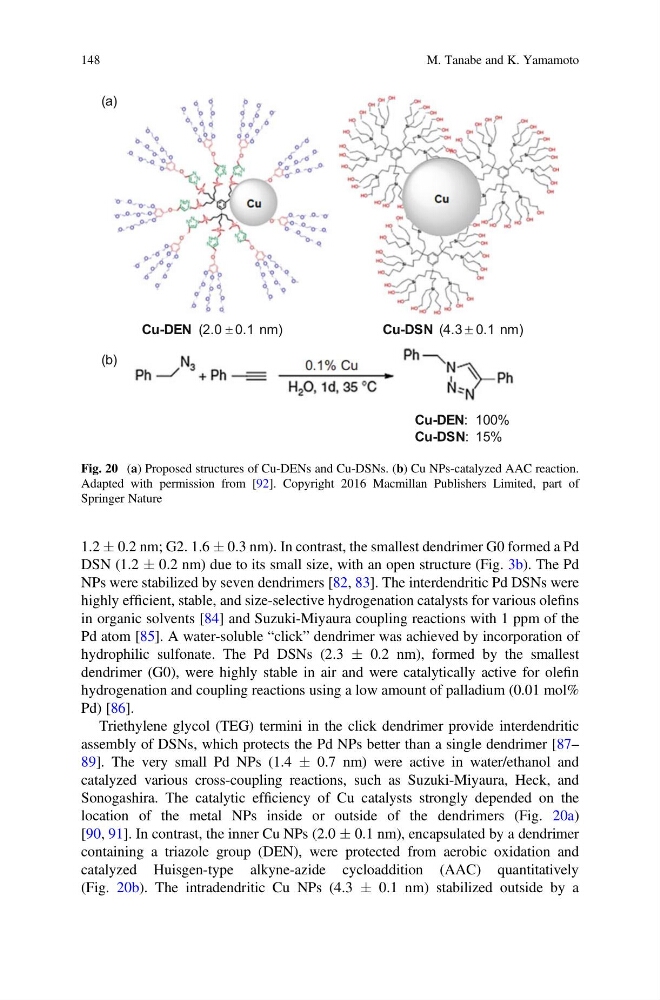
Sonogashira. The catalytic efficiency of Cu catalysts strongly depended on the
location of the metal NPs inside or outside of the dendrimers (Fig. 20a)
[90, 91]. In contrast, the inner Cu NPs (2.0 Æ 0.1 nm), encapsulated by a dendrimer
containing a triazole group (DEN), were protected from aerobic oxidation and
catalyzed Huisgen-type alkyne-azide cycloaddition (AAC) quantitatively
(Fig. 20b). The intradendritic Cu NPs (4.3 Æ 0.1 nm) stabilized outside by a
Cu-DEN (2.0 0.1 nm)
Cu-DSN (4.3 0.1 nm)
Cu-DEN: 100%
Cu-DSN: 15%
(a)
(b)
Fig. 20 (a) Proposed structures of Cu-DENs and Cu-DSNs. (b) Cu NPs-catalyzed AAC reaction.
Adapted with permission from [92]. Copyright 2016 Macmillan Publishers Limited, part of
Springer Nature
148
M. Tanabe and K. Yamamoto
DSN (1.2 Æ 0.2 nm) due to its small size, with an open structure (Fig. 3b). The Pd
NPs were stabilized by seven dendrimers [82, 83]. The interdendritic Pd DSNs were
highly efficient, stable, and size-selective hydrogenation catalysts for various olefins
in organic solvents [84] and Suzuki-Miyaura coupling reactions with 1 ppm of the
Pd atom [85]. A water-soluble “click” dendrimer was achieved by incorporation of
hydrophilic sulfonate. The Pd DSNs (2.3 Æ 0.2 nm), formed by the smallest
dendrimer (G0), were highly stable in air and were catalytically active for olefin
hydrogenation and coupling reactions using a low amount of palladium (0.01 mol%
Pd) [86].
Triethylene glycol (TEG) termini in the click dendrimer provide interdendritic
assembly of DSNs, which protects the Pd NPs better than a single dendrimer [87–
89]. The very small Pd NPs (1.4 Æ 0.7 nm) were active in water/ethanol and
catalyzed various cross-coupling reactions, such as Suzuki-Miyaura, Heck, and
Sonogashira. The catalytic efficiency of Cu catalysts strongly depended on the
location of the metal NPs inside or outside of the dendrimers (Fig. 20a)
[90, 91]. In contrast, the inner Cu NPs (2.0 Æ 0.1 nm), encapsulated by a dendrimer
containing a triazole group (DEN), were protected from aerobic oxidation and
catalyzed Huisgen-type alkyne-azide cycloaddition (AAC) quantitatively
(Fig. 20b). The intradendritic Cu NPs (4.3 Æ 0.1 nm) stabilized outside by a
Cu-DEN (2.0 0.1 nm)
Cu-DSN (4.3 0.1 nm)
Cu-DEN: 100%
Cu-DSN: 15%
(a)
(b)
Fig. 20 (a) Proposed structures of Cu-DENs and Cu-DSNs. (b) Cu NPs-catalyzed AAC reaction.
Adapted with permission from [92]. Copyright 2016 Macmillan Publishers Limited, part of
Springer Nature
148
M. Tanabe and K. Yamamoto