

with increasing particle size, suggesting that some atoms were located in the
catalytically inactive core. Similar size effect of Pd NPs on catalytic hydrogenation
of allyl alcohol is sensitive to the electronic properties of the Pd NPs with a
diameter < 1.5 nm, because the hydrogenation rates were not relative to any specific
category of defect or face atom [25].
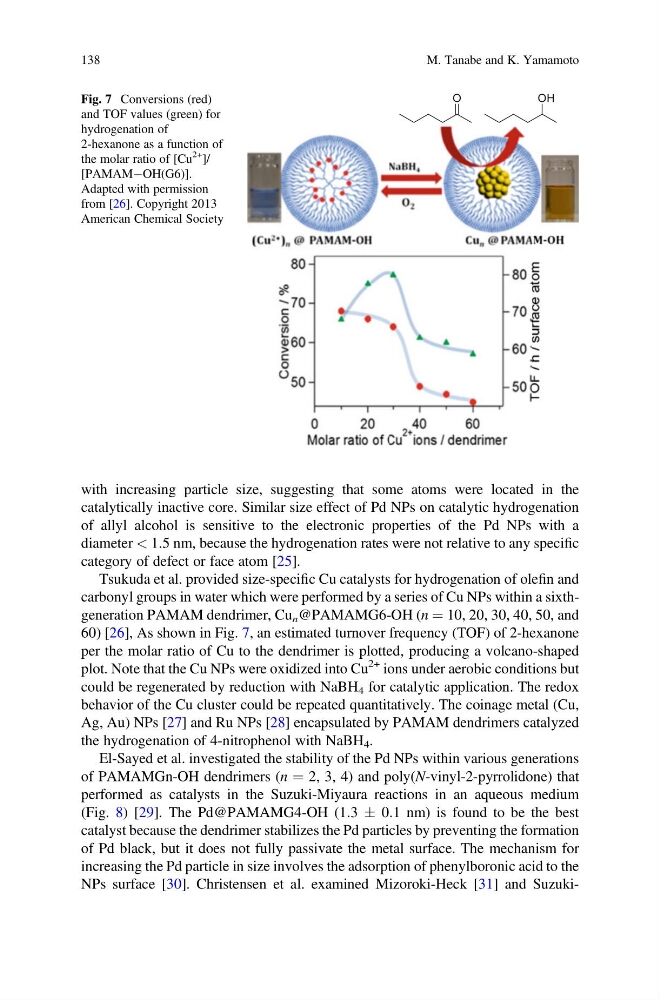
Tsukuda et al. provided size-specific Cu catalysts for hydrogenation of olefin and
carbonyl groups in water which were performed by a series of Cu NPs within a sixthgeneration PAMAM dendrimer, Cu n @PAMAMG6-OH (n ¼ 10, 20, 30, 40, 50, and
60) [26], As shown in Fig. 7, an estimated turnover frequency (TOF) of 2-hexanone
per the molar ratio of Cu to the dendrimer is plotted, producing a volcano-shaped
plot. Note that the Cu NPs were oxidized into Cu
2+ ions under aerobic conditions but
could be regenerated by reduction with NaBH 4 for catalytic application. The redox
behavior of the Cu cluster could be repeated quantitatively. The coinage metal (Cu,
Ag, Au) NPs [27] and Ru NPs [28] encapsulated by PAMAM dendrimers catalyzed
the hydrogenation of 4-nitrophenol with NaBH 4 .
El-Sayed et al. investigated the stability of the Pd NPs within various generations
of PAMAMGn-OH dendrimers (n ¼ 2, 3, 4) and poly(N-vinyl-2-pyrrolidone) that
performed as catalysts in the Suzuki-Miyaura reactions in an aqueous medium
(Fig. 8) [29]. The Pd@PAMAMG4-OH (1.3 Æ 0.1 nm) is found to be the best
catalyst because the dendrimer stabilizes the Pd particles by preventing the formation
of Pd black, but it does not fully passivate the metal surface. The mechanism for
increasing the Pd particle in size involves the adsorption of phenylboronic acid to the
NPs surface [30]. Christensen et al. examined Mizoroki-Heck [31] and SuzukiFig. 7 Conversions (red)
and TOF values (green) for
hydrogenation of
2-hexanone as a function of
the molar ratio of [Cu
2+ ]/
[PAMAMÀOH(G6)].
Adapted with permission
from [26]. Copyright 2013
American Chemical Society
138
M. Tanabe and K. Yamamoto
catalytically inactive core. Similar size effect of Pd NPs on catalytic hydrogenation
of allyl alcohol is sensitive to the electronic properties of the Pd NPs with a
diameter < 1.5 nm, because the hydrogenation rates were not relative to any specific
category of defect or face atom [25].
Tsukuda et al. provided size-specific Cu catalysts for hydrogenation of olefin and
carbonyl groups in water which were performed by a series of Cu NPs within a sixthgeneration PAMAM dendrimer, Cu n @PAMAMG6-OH (n ¼ 10, 20, 30, 40, 50, and
60) [26], As shown in Fig. 7, an estimated turnover frequency (TOF) of 2-hexanone
per the molar ratio of Cu to the dendrimer is plotted, producing a volcano-shaped
plot. Note that the Cu NPs were oxidized into Cu
2+ ions under aerobic conditions but
could be regenerated by reduction with NaBH 4 for catalytic application. The redox
behavior of the Cu cluster could be repeated quantitatively. The coinage metal (Cu,
Ag, Au) NPs [27] and Ru NPs [28] encapsulated by PAMAM dendrimers catalyzed
the hydrogenation of 4-nitrophenol with NaBH 4 .
El-Sayed et al. investigated the stability of the Pd NPs within various generations
of PAMAMGn-OH dendrimers (n ¼ 2, 3, 4) and poly(N-vinyl-2-pyrrolidone) that
performed as catalysts in the Suzuki-Miyaura reactions in an aqueous medium
(Fig. 8) [29]. The Pd@PAMAMG4-OH (1.3 Æ 0.1 nm) is found to be the best
catalyst because the dendrimer stabilizes the Pd particles by preventing the formation
of Pd black, but it does not fully passivate the metal surface. The mechanism for
increasing the Pd particle in size involves the adsorption of phenylboronic acid to the
NPs surface [30]. Christensen et al. examined Mizoroki-Heck [31] and SuzukiFig. 7 Conversions (red)
and TOF values (green) for
hydrogenation of
2-hexanone as a function of
the molar ratio of [Cu
2+ ]/
[PAMAMÀOH(G6)].
Adapted with permission
from [26]. Copyright 2013
American Chemical Society
138
M. Tanabe and K. Yamamoto