

functionalized various epoxide termini to the dendrimer end groups also influenced
the catalytic activity of the Pd NPs [19]. These results suggest that more steric
crowding on the dendrimer periphery resulted in lower activity for catalytic conversions. Amine-terminated PAMAM-NH 2 dendrimers are suitable to covalently link
the dendrimer to the electrode surface because of the low reactivity of the peripheral
hydroxyl groups [20]. Hydrogenation reactions catalyzed by a series of Pd NPs
encapsulated by dendrimer derivatives are also available for organic [21], biphasic
fluorous/organic systems [22], and supercritical CO 2 solvents [23].
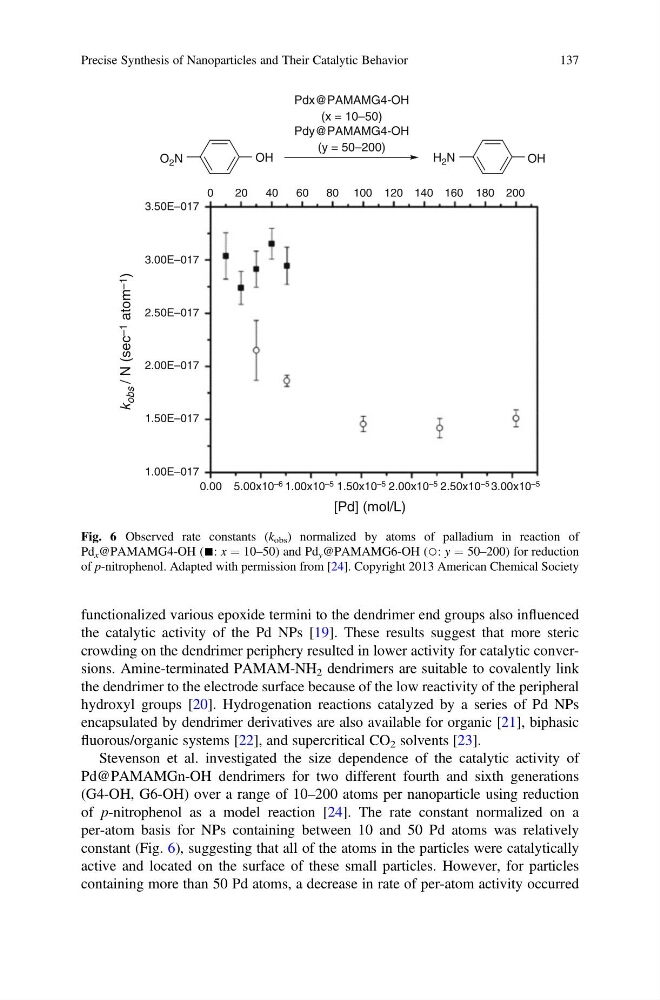
Stevenson et al. investigated the size dependence of the catalytic activity of
Pd@PAMAMGn-OH dendrimers for two different fourth and sixth generations
(G4-OH, G6-OH) over a range of 10–200 atoms per nanoparticle using reduction
of p-nitrophenol as a model reaction [24]. The rate constant normalized on a
per-atom basis for NPs containing between 10 and 50 Pd atoms was relatively
constant (Fig. 6), suggesting that all of the atoms in the particles were catalytically
active and located on the surface of these small particles. However, for particles
containing more than 50 Pd atoms, a decrease in rate of per-atom activity occurred
Pdx@PAMAMG4-OH
(x = 10–50)
Pdy@PAMAMG4-OH
(y = 50–200)
O 2 N
H 2 N
OH
OH
0
20
40
60
80 100 120 140 160 180 200
3.50E–017
3.00E–017
2.50E–017
2.00E–017
1.50E–017
1.00E–017
0.00 5.00x10 –6 1.00x10 –5 1.50x10 –5 2.00x10 –5 2.50x10 –5 3.00x10 –5
[Pd] (mol/L)
k
obs / N (sec –1
atom –1
)
Fig. 6 Observed rate constants (k obs ) normalized by atoms of palladium in reaction of
Pd x @PAMAMG4-OH (■: x ¼ 10–50) and Pd y @PAMAMG6-OH (○: y ¼ 50–200) for reduction
of p-nitrophenol. Adapted with permission from [24]. Copyright 2013 American Chemical Society
Precise Synthesis of Nanoparticles and Their Catalytic Behavior
137
the catalytic activity of the Pd NPs [19]. These results suggest that more steric
crowding on the dendrimer periphery resulted in lower activity for catalytic conversions. Amine-terminated PAMAM-NH 2 dendrimers are suitable to covalently link
the dendrimer to the electrode surface because of the low reactivity of the peripheral
hydroxyl groups [20]. Hydrogenation reactions catalyzed by a series of Pd NPs
encapsulated by dendrimer derivatives are also available for organic [21], biphasic
fluorous/organic systems [22], and supercritical CO 2 solvents [23].
Stevenson et al. investigated the size dependence of the catalytic activity of
Pd@PAMAMGn-OH dendrimers for two different fourth and sixth generations
(G4-OH, G6-OH) over a range of 10–200 atoms per nanoparticle using reduction
of p-nitrophenol as a model reaction [24]. The rate constant normalized on a
per-atom basis for NPs containing between 10 and 50 Pd atoms was relatively
constant (Fig. 6), suggesting that all of the atoms in the particles were catalytically
active and located on the surface of these small particles. However, for particles
containing more than 50 Pd atoms, a decrease in rate of per-atom activity occurred
Pdx@PAMAMG4-OH
(x = 10–50)
Pdy@PAMAMG4-OH
(y = 50–200)
O 2 N
H 2 N
OH
OH
0
20
40
60
80 100 120 140 160 180 200
3.50E–017
3.00E–017
2.50E–017
2.00E–017
1.50E–017
1.00E–017
0.00 5.00x10 –6 1.00x10 –5 1.50x10 –5 2.00x10 –5 2.50x10 –5 3.00x10 –5
[Pd] (mol/L)
k
obs / N (sec –1
atom –1
)
Fig. 6 Observed rate constants (k obs ) normalized by atoms of palladium in reaction of
Pd x @PAMAMG4-OH (■: x ¼ 10–50) and Pd y @PAMAMG6-OH (○: y ¼ 50–200) for reduction
of p-nitrophenol. Adapted with permission from [24]. Copyright 2013 American Chemical Society
Precise Synthesis of Nanoparticles and Their Catalytic Behavior
137