

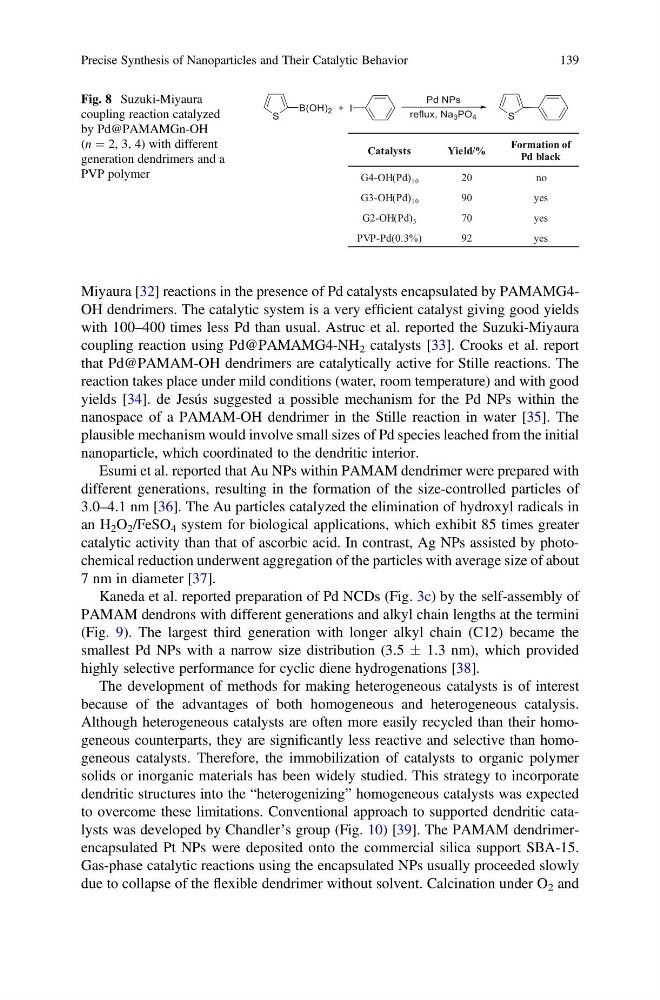
Miyaura [32] reactions in the presence of Pd catalysts encapsulated by PAMAMG4OH dendrimers. The catalytic system is a very efficient catalyst giving good yields
with 100–400 times less Pd than usual. Astruc et al. reported the Suzuki-Miyaura
coupling reaction using Pd@PAMAMG4-NH 2 catalysts [33]. Crooks et al. report
that Pd@PAMAM-OH dendrimers are catalytically active for Stille reactions. The
reaction takes place under mild conditions (water, room temperature) and with good
yields [34]. de Jesús suggested a possible mechanism for the Pd NPs within the
nanospace of a PAMAM-OH dendrimer in the Stille reaction in water [35]. The
plausible mechanism would involve small sizes of Pd species leached from the initial
nanoparticle, which coordinated to the dendritic interior.
Esumi et al. reported that Au NPs within PAMAM dendrimer were prepared with
different generations, resulting in the formation of the size-controlled particles of
3.0–4.1 nm [36]. The Au particles catalyzed the elimination of hydroxyl radicals in
an H 2 O 2 /FeSO 4 system for biological applications, which exhibit 85 times greater
catalytic activity than that of ascorbic acid. In contrast, Ag NPs assisted by photochemical reduction underwent aggregation of the particles with average size of about
7 nm in diameter [37].
Kaneda et al. reported preparation of Pd NCDs (Fig. 3c) by the self-assembly of
PAMAM dendrons with different generations and alkyl chain lengths at the termini
(Fig. 9). The largest third generation with longer alkyl chain (C12) became the
smallest Pd NPs with a narrow size distribution (3.5 Æ 1.3 nm), which provided
highly selective performance for cyclic diene hydrogenations [38].
The development of methods for making heterogeneous catalysts is of interest
because of the advantages of both homogeneous and heterogeneous catalysis.
Although heterogeneous catalysts are often more easily recycled than their homogeneous counterparts, they are significantly less reactive and selective than homogeneous catalysts. Therefore, the immobilization of catalysts to organic polymer
solids or inorganic materials has been widely studied. This strategy to incorporate
dendritic structures into the “heterogenizing” homogeneous catalysts was expected
to overcome these limitations. Conventional approach to supported dendritic catalysts was developed by Chandler’s group (Fig. 10) [39]. The PAMAM dendrimerencapsulated Pt NPs were deposited onto the commercial silica support SBA-15.
Gas-phase catalytic reactions using the encapsulated NPs usually proceeded slowly
due to collapse of the flexible dendrimer without solvent. Calcination under O 2 and
Catalysts
Yield/%
Formation of
Pd black
G4-OH(Pd) 10
20
no
G3-OH(Pd) 10
90
yes
G2-OH(Pd) 5
70
yes
PVP-Pd(0.3%)
92
yes
Fig. 8 Suzuki-Miyaura
coupling reaction catalyzed
by Pd@PAMAMGn-OH
(n ¼ 2, 3, 4) with different
generation dendrimers and a
PVP polymer
Precise Synthesis of Nanoparticles and Their Catalytic Behavior
139
with 100–400 times less Pd than usual. Astruc et al. reported the Suzuki-Miyaura
coupling reaction using Pd@PAMAMG4-NH 2 catalysts [33]. Crooks et al. report
that Pd@PAMAM-OH dendrimers are catalytically active for Stille reactions. The
reaction takes place under mild conditions (water, room temperature) and with good
yields [34]. de Jesús suggested a possible mechanism for the Pd NPs within the
nanospace of a PAMAM-OH dendrimer in the Stille reaction in water [35]. The
plausible mechanism would involve small sizes of Pd species leached from the initial
nanoparticle, which coordinated to the dendritic interior.
Esumi et al. reported that Au NPs within PAMAM dendrimer were prepared with
different generations, resulting in the formation of the size-controlled particles of
3.0–4.1 nm [36]. The Au particles catalyzed the elimination of hydroxyl radicals in
an H 2 O 2 /FeSO 4 system for biological applications, which exhibit 85 times greater
catalytic activity than that of ascorbic acid. In contrast, Ag NPs assisted by photochemical reduction underwent aggregation of the particles with average size of about
7 nm in diameter [37].
Kaneda et al. reported preparation of Pd NCDs (Fig. 3c) by the self-assembly of
PAMAM dendrons with different generations and alkyl chain lengths at the termini
(Fig. 9). The largest third generation with longer alkyl chain (C12) became the
smallest Pd NPs with a narrow size distribution (3.5 Æ 1.3 nm), which provided
highly selective performance for cyclic diene hydrogenations [38].
The development of methods for making heterogeneous catalysts is of interest
because of the advantages of both homogeneous and heterogeneous catalysis.
Although heterogeneous catalysts are often more easily recycled than their homogeneous counterparts, they are significantly less reactive and selective than homogeneous catalysts. Therefore, the immobilization of catalysts to organic polymer
solids or inorganic materials has been widely studied. This strategy to incorporate
dendritic structures into the “heterogenizing” homogeneous catalysts was expected
to overcome these limitations. Conventional approach to supported dendritic catalysts was developed by Chandler’s group (Fig. 10) [39]. The PAMAM dendrimerencapsulated Pt NPs were deposited onto the commercial silica support SBA-15.
Gas-phase catalytic reactions using the encapsulated NPs usually proceeded slowly
due to collapse of the flexible dendrimer without solvent. Calcination under O 2 and
Catalysts
Yield/%
Formation of
Pd black
G4-OH(Pd) 10
20
no
G3-OH(Pd) 10
90
yes
G2-OH(Pd) 5
70
yes
PVP-Pd(0.3%)
92
yes
Fig. 8 Suzuki-Miyaura
coupling reaction catalyzed
by Pd@PAMAMGn-OH
(n ¼ 2, 3, 4) with different
generation dendrimers and a
PVP polymer
Precise Synthesis of Nanoparticles and Their Catalytic Behavior
139