

Common methods to prepare iron oxide-based NPs rely on toxic and,
usually, reactive reductants such as NaBH 4 or hydrazine hydrate. Thus, more
environmentally sound and safe routes are important to explore. Basavegowda
et al. described a greener method for magnetite NP preparation using dried
powder derived from naturally occurring A. annua leaves. A 5 mL aqueous
filtrated infusion of the plant extract, rich in hydroxylated bioactive molecules,
was mixed with 50 mL of a 2 mM aqueous solution of iron(III) chloride (FeCl 3 ),
turning immediately into a black solution presumably forming Fe 3 O 4 NPs [123],
as the mechanism of NP formation by plant extracts remains unclear. A combination
of several phytochemicals with redox properties (polyphenols, flavonoids, tannic
acids, terpenoids, sugars, etc.) may be responsible for these reductions. Moreover,
they can also act as capping agents that stabilize the particles [124]. These magnetite
NPs have been tested in multicomponent syntheses of benzoxazinones and
benzthioxazinones, compounds of interest given the variety of their biological
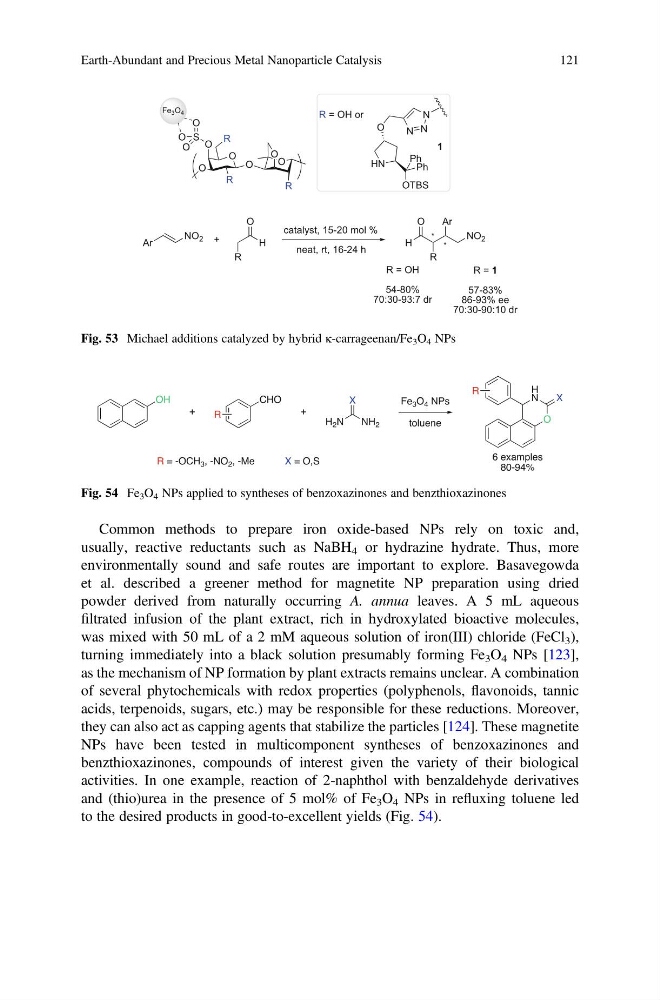
activities. In one example, reaction of 2-naphthol with benzaldehyde derivatives
and (thio)urea in the presence of 5 mol% of Fe 3 O 4 NPs in refluxing toluene led
to the desired products in good-to-excellent yields (Fig. 54).
O
R
O
O
O
O
O
R
R
S
O
O
O
R = OH or
N N
N
O
HN
OTBS
Ph
Ph
Fe 3 O 4
NO 2
Ar
O
H
R
+
neat, rt, 16-24 h
catalyst, 15-20 mol %
H
*
*
NO 2
O
R
Ar
R = 1
57-83%
86-93% ee
70:30-90:10 dr
R = OH
54-80%
70:30-93:7 dr
1
Fig. 53 Michael additions catalyzed by hybrid κ-carrageenan/Fe 3 O 4 NPs
Fig. 54 Fe 3 O 4 NPs applied to syntheses of benzoxazinones and benzthioxazinones
Earth-Abundant and Precious Metal Nanoparticle Catalysis
121
usually, reactive reductants such as NaBH 4 or hydrazine hydrate. Thus, more
environmentally sound and safe routes are important to explore. Basavegowda
et al. described a greener method for magnetite NP preparation using dried
powder derived from naturally occurring A. annua leaves. A 5 mL aqueous
filtrated infusion of the plant extract, rich in hydroxylated bioactive molecules,
was mixed with 50 mL of a 2 mM aqueous solution of iron(III) chloride (FeCl 3 ),
turning immediately into a black solution presumably forming Fe 3 O 4 NPs [123],
as the mechanism of NP formation by plant extracts remains unclear. A combination
of several phytochemicals with redox properties (polyphenols, flavonoids, tannic
acids, terpenoids, sugars, etc.) may be responsible for these reductions. Moreover,
they can also act as capping agents that stabilize the particles [124]. These magnetite
NPs have been tested in multicomponent syntheses of benzoxazinones and
benzthioxazinones, compounds of interest given the variety of their biological
activities. In one example, reaction of 2-naphthol with benzaldehyde derivatives
and (thio)urea in the presence of 5 mol% of Fe 3 O 4 NPs in refluxing toluene led
to the desired products in good-to-excellent yields (Fig. 54).
O
R
O
O
O
O
O
R
R
S
O
O
O
R = OH or
N N
N
O
HN
OTBS
Ph
Ph
Fe 3 O 4
NO 2
Ar
O
H
R
+
neat, rt, 16-24 h
catalyst, 15-20 mol %
H
*
*
NO 2
O
R
Ar
R = 1
57-83%
86-93% ee
70:30-90:10 dr
R = OH
54-80%
70:30-93:7 dr
1
Fig. 53 Michael additions catalyzed by hybrid κ-carrageenan/Fe 3 O 4 NPs
Fig. 54 Fe 3 O 4 NPs applied to syntheses of benzoxazinones and benzthioxazinones
Earth-Abundant and Precious Metal Nanoparticle Catalysis
121