

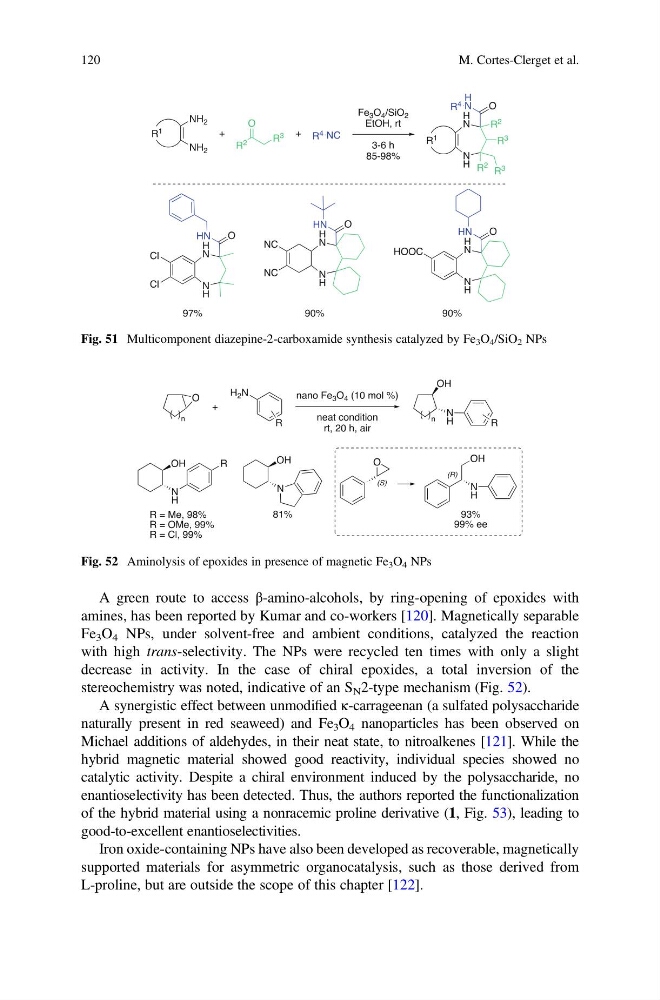
A green route to access β-amino-alcohols, by ring-opening of epoxides with
amines, has been reported by Kumar and co-workers [120]. Magnetically separable
Fe 3 O 4 NPs, under solvent-free and ambient conditions, catalyzed the reaction
with high trans-selectivity. The NPs were recycled ten times with only a slight
decrease in activity. In the case of chiral epoxides, a total inversion of the
stereochemistry was noted, indicative of an S N 2-type mechanism (Fig. 52).
A synergistic effect between unmodified κ-carrageenan (a sulfated polysaccharide
naturally present in red seaweed) and Fe 3 O 4 nanoparticles has been observed on
Michael additions of aldehydes, in their neat state, to nitroalkenes [121]. While the
hybrid magnetic material showed good reactivity, individual species showed no
catalytic activity. Despite a chiral environment induced by the polysaccharide, no
enantioselectivity has been detected. Thus, the authors reported the functionalization
of the hybrid material using a nonracemic proline derivative (1, Fig. 53), leading to
good-to-excellent enantioselectivities.
Iron oxide-containing NPs have also been developed as recoverable, magnetically
supported materials for asymmetric organocatalysis, such as those derived from
L-proline, but are outside the scope of this chapter [122].
Fig. 51 Multicomponent diazepine-2-carboxamide synthesis catalyzed by Fe 3 O 4 /SiO 2 NPs
Fig. 52 Aminolysis of epoxides in presence of magnetic Fe 3 O 4 NPs
120
M. Cortes-Clerget et al.
amines, has been reported by Kumar and co-workers [120]. Magnetically separable
Fe 3 O 4 NPs, under solvent-free and ambient conditions, catalyzed the reaction
with high trans-selectivity. The NPs were recycled ten times with only a slight
decrease in activity. In the case of chiral epoxides, a total inversion of the
stereochemistry was noted, indicative of an S N 2-type mechanism (Fig. 52).
A synergistic effect between unmodified κ-carrageenan (a sulfated polysaccharide
naturally present in red seaweed) and Fe 3 O 4 nanoparticles has been observed on
Michael additions of aldehydes, in their neat state, to nitroalkenes [121]. While the
hybrid magnetic material showed good reactivity, individual species showed no
catalytic activity. Despite a chiral environment induced by the polysaccharide, no
enantioselectivity has been detected. Thus, the authors reported the functionalization
of the hybrid material using a nonracemic proline derivative (1, Fig. 53), leading to
good-to-excellent enantioselectivities.
Iron oxide-containing NPs have also been developed as recoverable, magnetically
supported materials for asymmetric organocatalysis, such as those derived from
L-proline, but are outside the scope of this chapter [122].
Fig. 51 Multicomponent diazepine-2-carboxamide synthesis catalyzed by Fe 3 O 4 /SiO 2 NPs
Fig. 52 Aminolysis of epoxides in presence of magnetic Fe 3 O 4 NPs
120
M. Cortes-Clerget et al.