

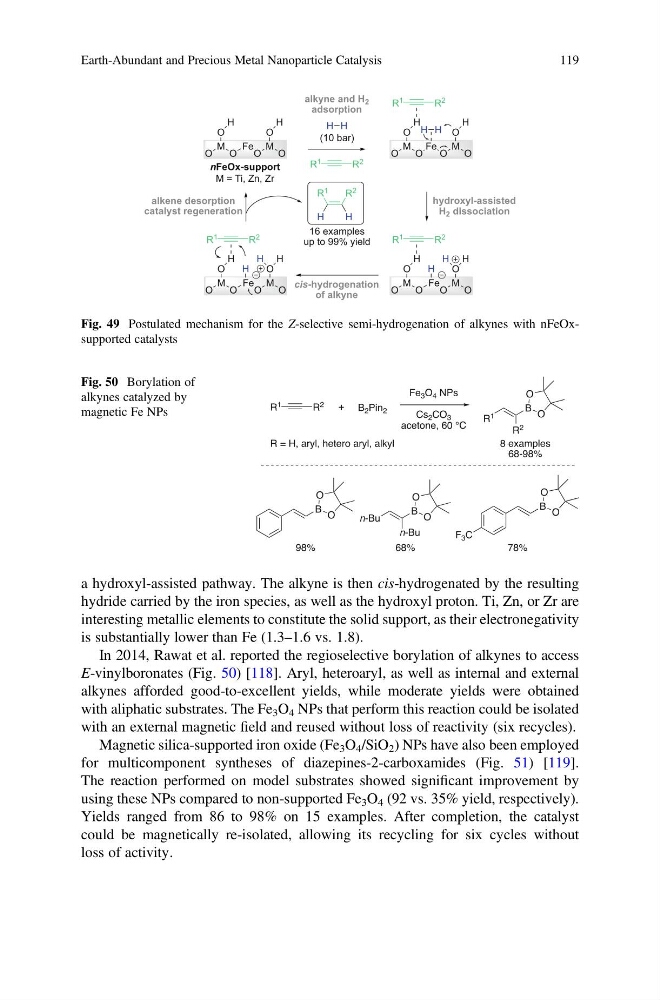
a hydroxyl-assisted pathway. The alkyne is then cis-hydrogenated by the resulting
hydride carried by the iron species, as well as the hydroxyl proton. Ti, Zn, or Zr are
interesting metallic elements to constitute the solid support, as their electronegativity
is substantially lower than Fe (1.3–1.6 vs. 1.8).
In 2014, Rawat et al. reported the regioselective borylation of alkynes to access
E-vinylboronates (Fig. 50) [118]. Aryl, heteroaryl, as well as internal and external
alkynes afforded good-to-excellent yields, while moderate yields were obtained
with aliphatic substrates. The Fe 3 O 4 NPs that perform this reaction could be isolated
with an external magnetic field and reused without loss of reactivity (six recycles).
Magnetic silica-supported iron oxide (Fe 3 O 4 /SiO 2 ) NPs have also been employed
for multicomponent syntheses of diazepines-2-carboxamides (Fig. 51) [119].
The reaction performed on model substrates showed significant improvement by
using these NPs compared to non-supported Fe 3 O 4 (92 vs. 35% yield, respectively).
Yields ranged from 86 to 98% on 15 examples. After completion, the catalyst
could be magnetically re-isolated, allowing its recycling for six cycles without
loss of activity.
O
M
O
Fe
O
M
O
O
O
H
H
nFeOx-support
H H
R 1
R 2
O
M
O
Fe
O
M
O
O
O
H
H
R 1
R 2
H H
O
M
O
Fe
O
M
O
O
O
H
H
R 1
R 2
H
H
O
M
O
Fe
O
M
O
O
O
H
H
R 1
R 2
H
H
H
R 1
R 2
H
hydroxyl-assisted
H 2 dissociation
cis-hydrogenation
of alkyne
alkene desorption
catalyst regeneration
M = Ti, Zn, Zr
(10 bar)
16 examples
up to 99% yield
alkyne and H 2
adsorption
Fig. 49 Postulated mechanism for the Z-selective semi-hydrogenation of alkynes with nFeOxsupported catalysts
Fig. 50 Borylation of
alkynes catalyzed by
magnetic Fe NPs
Earth-Abundant and Precious Metal Nanoparticle Catalysis
119
hydride carried by the iron species, as well as the hydroxyl proton. Ti, Zn, or Zr are
interesting metallic elements to constitute the solid support, as their electronegativity
is substantially lower than Fe (1.3–1.6 vs. 1.8).
In 2014, Rawat et al. reported the regioselective borylation of alkynes to access
E-vinylboronates (Fig. 50) [118]. Aryl, heteroaryl, as well as internal and external
alkynes afforded good-to-excellent yields, while moderate yields were obtained
with aliphatic substrates. The Fe 3 O 4 NPs that perform this reaction could be isolated
with an external magnetic field and reused without loss of reactivity (six recycles).
Magnetic silica-supported iron oxide (Fe 3 O 4 /SiO 2 ) NPs have also been employed
for multicomponent syntheses of diazepines-2-carboxamides (Fig. 51) [119].
The reaction performed on model substrates showed significant improvement by
using these NPs compared to non-supported Fe 3 O 4 (92 vs. 35% yield, respectively).
Yields ranged from 86 to 98% on 15 examples. After completion, the catalyst
could be magnetically re-isolated, allowing its recycling for six cycles without
loss of activity.
O
M
O
Fe
O
M
O
O
O
H
H
nFeOx-support
H H
R 1
R 2
O
M
O
Fe
O
M
O
O
O
H
H
R 1
R 2
H H
O
M
O
Fe
O
M
O
O
O
H
H
R 1
R 2
H
H
O
M
O
Fe
O
M
O
O
O
H
H
R 1
R 2
H
H
H
R 1
R 2
H
hydroxyl-assisted
H 2 dissociation
cis-hydrogenation
of alkyne
alkene desorption
catalyst regeneration
M = Ti, Zn, Zr
(10 bar)
16 examples
up to 99% yield
alkyne and H 2
adsorption
Fig. 49 Postulated mechanism for the Z-selective semi-hydrogenation of alkynes with nFeOxsupported catalysts
Fig. 50 Borylation of
alkynes catalyzed by
magnetic Fe NPs
Earth-Abundant and Precious Metal Nanoparticle Catalysis
119