

then placed into a high-pressure reactor and punctured with a short needle, and the
reactor was then sealed. The reactor was purged three times with hydrogen
and pressurized with 53 bar of H 2 , heated to 80
C by a heating jacket (resulting
pressure 60 bar) and stirred with an external magnetic stirrer for 18 h. The reactor was
then depressurized, the vial removed, the heptane phase separated by decantation,
and the catalyst phase washed 2 Â 1 mL with n-heptane. The product mixture
was analyzed by GC and proton NMR. Quantifications were done via proton
NMR vs. hexamethyldisiloxane as internal standard. For identification of E/Z stereochemistry of the resulting alkenes, the characteristic vinyl signals were
analyzed and compared with literature data.
More recently, Corma and co-workers described a biomimetic approach
using planar Fe(II)/(III) oxide nanoparticles supported on a slightly acidic material
for the same reaction [117]. The support plays the role of a donor/acceptor
entity, a functionality found in the active sites of hydrogenases. The nature of the
support and the mode of preparation of the Fe-solid assembly are crucial, as only
Fe deposed on TiO 2 , ZrO 2 , and ZnO by oxidative dispersion gave satisfactory
results. Numerous alkynes have been reduced to the corresponding Z-alkenes,
while aldehydes, with halides and nitro groups, remained unaffected. Although
this method is not as selective as Lindlar-like catalysts, it is a useful tool for
flow semi-hydrogenation of acetylene during ethylene manufacturing processes.
The mechanism (Fig. 49) is believed to start with the adsorption of H 2 in the
nFeOx catalytic sites, while adsorption of the alkyne occurs in both the Brønsted
acid and nFeOx catalytic sites. Dihydrogen then dissociates heterolytically through
R 1
R 2
R 1
R 2
R 2
R 1
5 mol % [Fe(0)]
CH 3 CN (1.0 equiv)
60 bar H 2 , 80 °C, 18 h
heptane/IL-1 (3/1)
+
r
a
l
u
c
e
l
o
m
a
r
t
n
i
r
a
l
u
c
e
l
o
m
r
e
t
n
i
mode of bifunctionality
up to 98% yield
Z/E 92/8-100/0
R = alkyls, aryls (4-OMe, 4-CO 2 Me, 4-NH 2 , 4-halide), TMS, CH 2 -phthalimide
N
N
Tf 2 N
IL-1 alone
over-reduction
C N
N
N
Tf 2 N
N
N
Tf 2 N
C
2
-
L
I
1
-
L
I
Fe
Fe
N
C
N
+
favor catalyst
separation
favor catalyst
separation
ligand for
selective
hydrogenation
ligand for
selective
hydrogenation
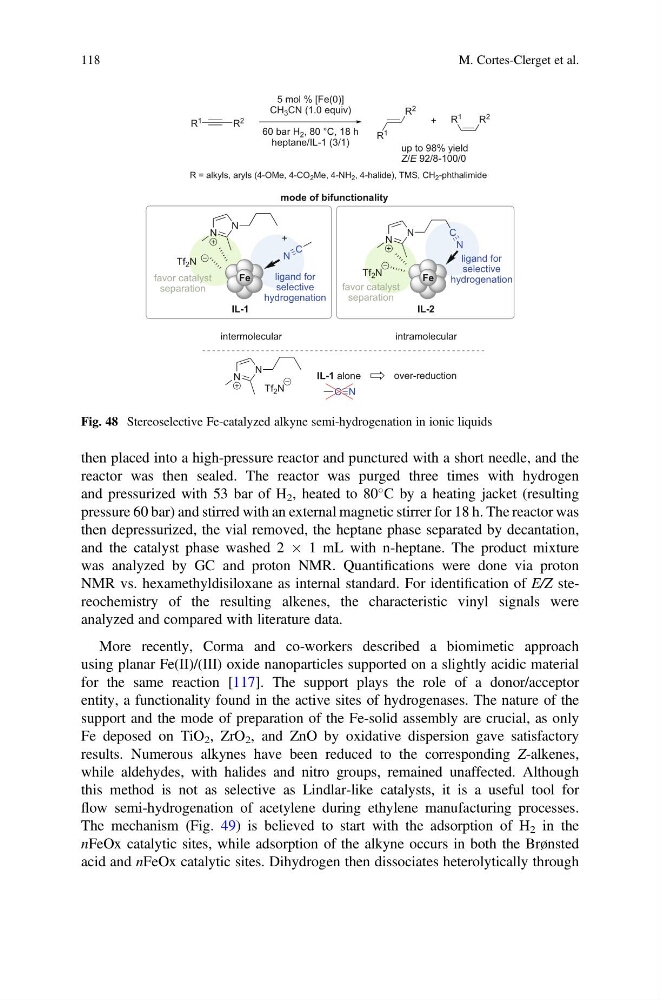
Fig. 48 Stereoselective Fe-catalyzed alkyne semi-hydrogenation in ionic liquids
118
M. Cortes-Clerget et al.
reactor was then sealed. The reactor was purged three times with hydrogen
and pressurized with 53 bar of H 2 , heated to 80
C by a heating jacket (resulting
pressure 60 bar) and stirred with an external magnetic stirrer for 18 h. The reactor was
then depressurized, the vial removed, the heptane phase separated by decantation,
and the catalyst phase washed 2 Â 1 mL with n-heptane. The product mixture
was analyzed by GC and proton NMR. Quantifications were done via proton
NMR vs. hexamethyldisiloxane as internal standard. For identification of E/Z stereochemistry of the resulting alkenes, the characteristic vinyl signals were
analyzed and compared with literature data.
More recently, Corma and co-workers described a biomimetic approach
using planar Fe(II)/(III) oxide nanoparticles supported on a slightly acidic material
for the same reaction [117]. The support plays the role of a donor/acceptor
entity, a functionality found in the active sites of hydrogenases. The nature of the
support and the mode of preparation of the Fe-solid assembly are crucial, as only
Fe deposed on TiO 2 , ZrO 2 , and ZnO by oxidative dispersion gave satisfactory
results. Numerous alkynes have been reduced to the corresponding Z-alkenes,
while aldehydes, with halides and nitro groups, remained unaffected. Although
this method is not as selective as Lindlar-like catalysts, it is a useful tool for
flow semi-hydrogenation of acetylene during ethylene manufacturing processes.
The mechanism (Fig. 49) is believed to start with the adsorption of H 2 in the
nFeOx catalytic sites, while adsorption of the alkyne occurs in both the Brønsted
acid and nFeOx catalytic sites. Dihydrogen then dissociates heterolytically through
R 1
R 2
R 1
R 2
R 2
R 1
5 mol % [Fe(0)]
CH 3 CN (1.0 equiv)
60 bar H 2 , 80 °C, 18 h
heptane/IL-1 (3/1)
+
r
a
l
u
c
e
l
o
m
a
r
t
n
i
r
a
l
u
c
e
l
o
m
r
e
t
n
i
mode of bifunctionality
up to 98% yield
Z/E 92/8-100/0
R = alkyls, aryls (4-OMe, 4-CO 2 Me, 4-NH 2 , 4-halide), TMS, CH 2 -phthalimide
N
N
Tf 2 N
IL-1 alone
over-reduction
C N
N
N
Tf 2 N
N
N
Tf 2 N
C
2
-
L
I
1
-
L
I
Fe
Fe
N
C
N
+
favor catalyst
separation
favor catalyst
separation
ligand for
selective
hydrogenation
ligand for
selective
hydrogenation
Fig. 48 Stereoselective Fe-catalyzed alkyne semi-hydrogenation in ionic liquids
118
M. Cortes-Clerget et al.