

stirred under argon for 18 h resulting in a black suspension. The NP suspension
was evaporated under reduced pressure to remove volatile by-products from the
decomposition of the organometallic precursor. The monometallic Ru NPs
in [C 1 C 1 (EG)IM]NTf 2 were prepared adapted from a literature method using a
concentration of 0.1 M precursor in the IL. The monometallic Ru NPs in
[C 2 OHMIM]NTf 2 were synthesized using 0.1 M precursor in IL suspension
at 90
C for 18 h.
Representative Hydrogenation Reaction To freshly prepared Ru NPs in an
IL was added 1.9 mmol of the N-heteroaromatic compound. Then, the vial was
placed in a stainless-steel autoclave; the reactor was sealed, charged with hydrogen,
and was then placed into a preheated aluminum heating block (600 rpm) at the
appropriate temperature. For certain compounds, mesitylene was added as cosolvent
for better solubility of the substrate. After the appropriate reaction time the reactor
was cooled to rt. For work-up, the reaction mixture was extracted with 5 Â 2 mL of
n-pentane or diethyl ether, the solvent was evaporated under reduced pressure, and
20 μL (0.01 mmol) of hexamethyldisilane as internal standard was added.
9 Cobalt
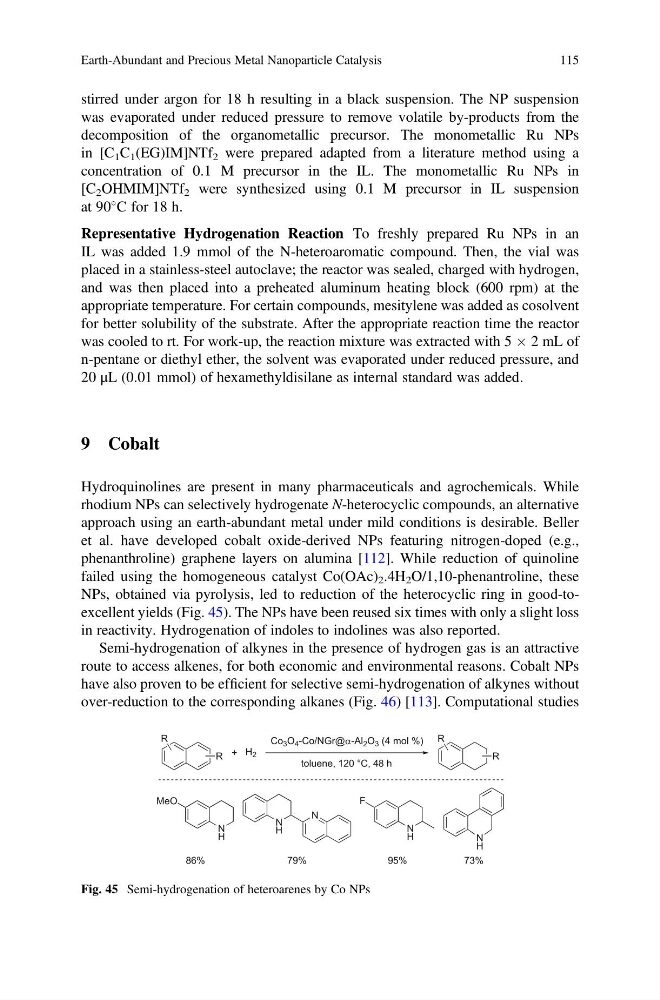
Hydroquinolines are present in many pharmaceuticals and agrochemicals. While
rhodium NPs can selectively hydrogenate N-heterocyclic compounds, an alternative
approach using an earth-abundant metal under mild conditions is desirable. Beller
et al. have developed cobalt oxide-derived NPs featuring nitrogen-doped (e.g.,
phenanthroline) graphene layers on alumina [112]. While reduction of quinoline
failed using the homogeneous catalyst Co(OAc) 2 .4H 2 O/1,10-phenantroline, these
NPs, obtained via pyrolysis, led to reduction of the heterocyclic ring in good-toexcellent yields (Fig. 45). The NPs have been reused six times with only a slight loss
in reactivity. Hydrogenation of indoles to indolines was also reported.
Semi-hydrogenation of alkynes in the presence of hydrogen gas is an attractive
route to access alkenes, for both economic and environmental reasons. Cobalt NPs
have also proven to be efficient for selective semi-hydrogenation of alkynes without
over-reduction to the corresponding alkanes (Fig. 46) [113]. Computational studies
R
R
R
R
+ H 2
Co 3 O 4 -Co/NGr@α-Al 2 O 3 (4 mol %)
toluene, 120 °C, 48 h
N
H
MeO
86%
N
H
N
79%
N
H
F
95%
N
H
73%
Fig. 45 Semi-hydrogenation of heteroarenes by Co NPs
Earth-Abundant and Precious Metal Nanoparticle Catalysis
115
was evaporated under reduced pressure to remove volatile by-products from the
decomposition of the organometallic precursor. The monometallic Ru NPs
in [C 1 C 1 (EG)IM]NTf 2 were prepared adapted from a literature method using a
concentration of 0.1 M precursor in the IL. The monometallic Ru NPs in
[C 2 OHMIM]NTf 2 were synthesized using 0.1 M precursor in IL suspension
at 90
C for 18 h.
Representative Hydrogenation Reaction To freshly prepared Ru NPs in an
IL was added 1.9 mmol of the N-heteroaromatic compound. Then, the vial was
placed in a stainless-steel autoclave; the reactor was sealed, charged with hydrogen,
and was then placed into a preheated aluminum heating block (600 rpm) at the
appropriate temperature. For certain compounds, mesitylene was added as cosolvent
for better solubility of the substrate. After the appropriate reaction time the reactor
was cooled to rt. For work-up, the reaction mixture was extracted with 5 Â 2 mL of
n-pentane or diethyl ether, the solvent was evaporated under reduced pressure, and
20 μL (0.01 mmol) of hexamethyldisilane as internal standard was added.
9 Cobalt
Hydroquinolines are present in many pharmaceuticals and agrochemicals. While
rhodium NPs can selectively hydrogenate N-heterocyclic compounds, an alternative
approach using an earth-abundant metal under mild conditions is desirable. Beller
et al. have developed cobalt oxide-derived NPs featuring nitrogen-doped (e.g.,
phenanthroline) graphene layers on alumina [112]. While reduction of quinoline
failed using the homogeneous catalyst Co(OAc) 2 .4H 2 O/1,10-phenantroline, these
NPs, obtained via pyrolysis, led to reduction of the heterocyclic ring in good-toexcellent yields (Fig. 45). The NPs have been reused six times with only a slight loss
in reactivity. Hydrogenation of indoles to indolines was also reported.
Semi-hydrogenation of alkynes in the presence of hydrogen gas is an attractive
route to access alkenes, for both economic and environmental reasons. Cobalt NPs
have also proven to be efficient for selective semi-hydrogenation of alkynes without
over-reduction to the corresponding alkanes (Fig. 46) [113]. Computational studies
R
R
R
R
+ H 2
Co 3 O 4 -Co/NGr@α-Al 2 O 3 (4 mol %)
toluene, 120 °C, 48 h
N
H
MeO
86%
N
H
N
79%
N
H
F
95%
N
H
73%
Fig. 45 Semi-hydrogenation of heteroarenes by Co NPs
Earth-Abundant and Precious Metal Nanoparticle Catalysis
115