

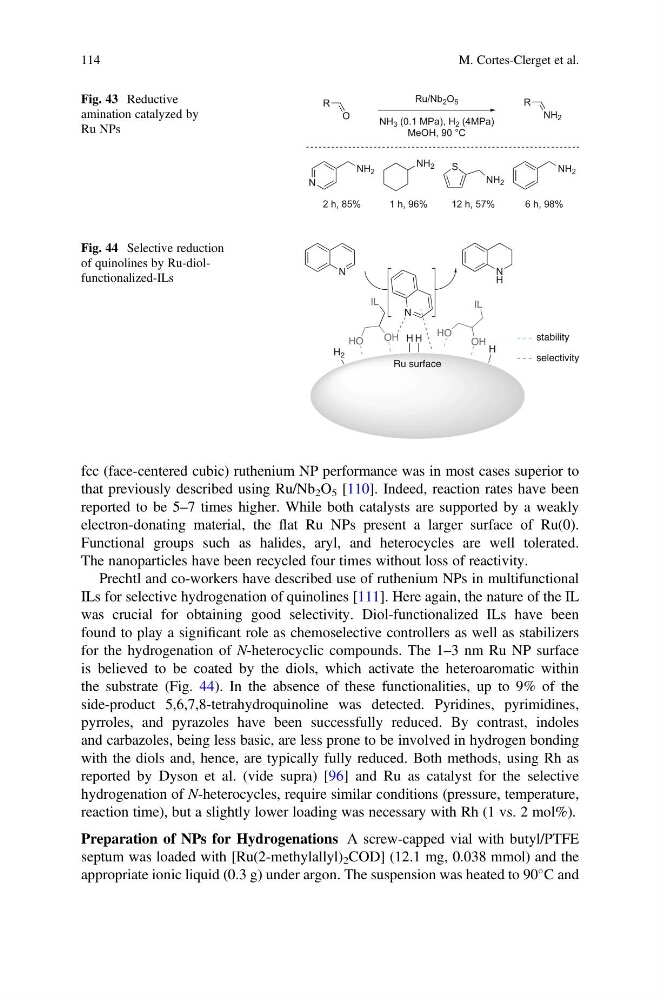
fcc (face-centered cubic) ruthenium NP performance was in most cases superior to
that previously described using Ru/Nb 2 O 5 [110]. Indeed, reaction rates have been
reported to be 5–7 times higher. While both catalysts are supported by a weakly
electron-donating material, the flat Ru NPs present a larger surface of Ru(0).
Functional groups such as halides, aryl, and heterocycles are well tolerated.
The nanoparticles have been recycled four times without loss of reactivity.
Prechtl and co-workers have described use of ruthenium NPs in multifunctional
ILs for selective hydrogenation of quinolines [111]. Here again, the nature of the IL
was crucial for obtaining good selectivity. Diol-functionalized ILs have been
found to play a significant role as chemoselective controllers as well as stabilizers
for the hydrogenation of N-heterocyclic compounds. The 1–3 nm Ru NP surface
is believed to be coated by the diols, which activate the heteroaromatic within
the substrate (Fig. 44). In the absence of these functionalities, up to 9% of the
side-product 5,6,7,8-tetrahydroquinoline was detected. Pyridines, pyrimidines,
pyrroles, and pyrazoles have been successfully reduced. By contrast, indoles
and carbazoles, being less basic, are less prone to be involved in hydrogen bonding
with the diols and, hence, are typically fully reduced. Both methods, using Rh as
reported by Dyson et al. (vide supra) [96] and Ru as catalyst for the selective
hydrogenation of N-heterocycles, require similar conditions (pressure, temperature,
reaction time), but a slightly lower loading was necessary with Rh (1 vs. 2 mol%).
Preparation of NPs for Hydrogenations A screw-capped vial with butyl/PTFE
septum was loaded with [Ru(2-methylallyl) 2 COD] (12.1 mg, 0.038 mmol) and the
appropriate ionic liquid (0.3 g) under argon. The suspension was heated to 90
C and
R
O
R
NH 2
Ru/Nb 2 O 5
NH 3 (0.1 MPa), H 2 (4MPa)
MeOH, 90 °C
N
NH 2
2 h, 85%
NH 2
1 h, 96%
S
NH 2
12 h, 57%
NH 2
6 h, 98%
Fig. 43 Reductive
amination catalyzed by
Ru NPs
Fig. 44 Selective reduction
of quinolines by Ru-diolfunctionalized-ILs
114
M. Cortes-Clerget et al.
that previously described using Ru/Nb 2 O 5 [110]. Indeed, reaction rates have been
reported to be 5–7 times higher. While both catalysts are supported by a weakly
electron-donating material, the flat Ru NPs present a larger surface of Ru(0).
Functional groups such as halides, aryl, and heterocycles are well tolerated.
The nanoparticles have been recycled four times without loss of reactivity.
Prechtl and co-workers have described use of ruthenium NPs in multifunctional
ILs for selective hydrogenation of quinolines [111]. Here again, the nature of the IL
was crucial for obtaining good selectivity. Diol-functionalized ILs have been
found to play a significant role as chemoselective controllers as well as stabilizers
for the hydrogenation of N-heterocyclic compounds. The 1–3 nm Ru NP surface
is believed to be coated by the diols, which activate the heteroaromatic within
the substrate (Fig. 44). In the absence of these functionalities, up to 9% of the
side-product 5,6,7,8-tetrahydroquinoline was detected. Pyridines, pyrimidines,
pyrroles, and pyrazoles have been successfully reduced. By contrast, indoles
and carbazoles, being less basic, are less prone to be involved in hydrogen bonding
with the diols and, hence, are typically fully reduced. Both methods, using Rh as
reported by Dyson et al. (vide supra) [96] and Ru as catalyst for the selective
hydrogenation of N-heterocycles, require similar conditions (pressure, temperature,
reaction time), but a slightly lower loading was necessary with Rh (1 vs. 2 mol%).
Preparation of NPs for Hydrogenations A screw-capped vial with butyl/PTFE
septum was loaded with [Ru(2-methylallyl) 2 COD] (12.1 mg, 0.038 mmol) and the
appropriate ionic liquid (0.3 g) under argon. The suspension was heated to 90
C and
R
O
R
NH 2
Ru/Nb 2 O 5
NH 3 (0.1 MPa), H 2 (4MPa)
MeOH, 90 °C
N
NH 2
2 h, 85%
NH 2
1 h, 96%
S
NH 2
12 h, 57%
NH 2
6 h, 98%
Fig. 43 Reductive
amination catalyzed by
Ru NPs
Fig. 44 Selective reduction
of quinolines by Ru-diolfunctionalized-ILs
114
M. Cortes-Clerget et al.