

THF in the presence of flame-dried charcoal for 12 h, followed by filtration and
then drying. As determined by ICP-AES, the ratios of Co:Rh were 1.09:1 and 2.93:1,
respectively [105].
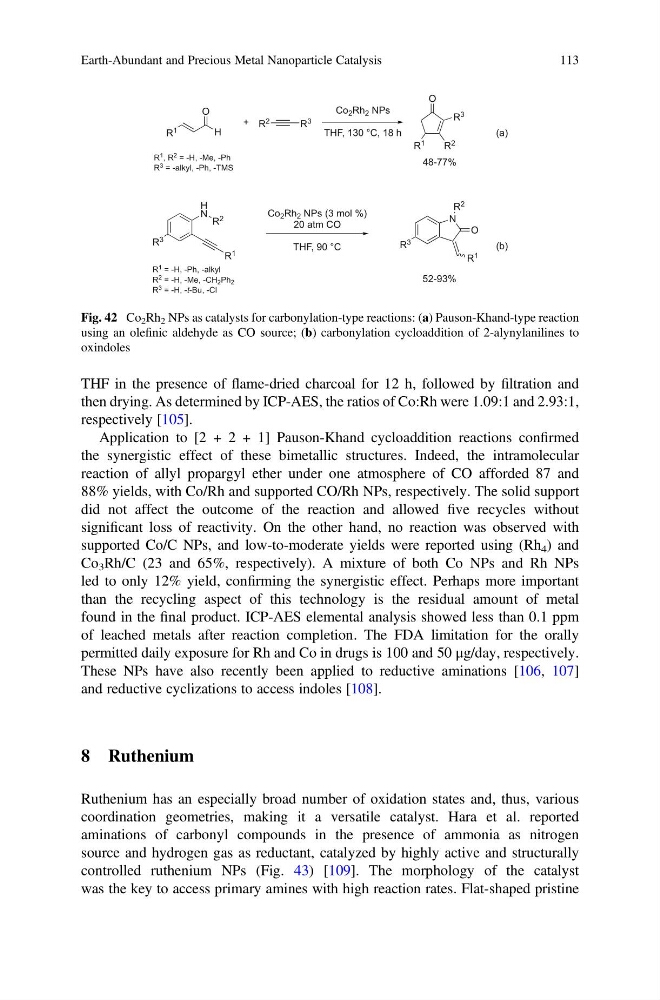
Application to [2 + 2 + 1] Pauson-Khand cycloaddition reactions confirmed
the synergistic effect of these bimetallic structures. Indeed, the intramolecular
reaction of allyl propargyl ether under one atmosphere of CO afforded 87 and
88% yields, with Co/Rh and supported CO/Rh NPs, respectively. The solid support
did not affect the outcome of the reaction and allowed five recycles without
significant loss of reactivity. On the other hand, no reaction was observed with
supported Co/C NPs, and low-to-moderate yields were reported using (Rh 4 ) and
Co 3 Rh/C (23 and 65%, respectively). A mixture of both Co NPs and Rh NPs
led to only 12% yield, confirming the synergistic effect. Perhaps more important
than the recycling aspect of this technology is the residual amount of metal
found in the final product. ICP-AES elemental analysis showed less than 0.1 ppm
of leached metals after reaction completion. The FDA limitation for the orally
permitted daily exposure for Rh and Co in drugs is 100 and 50 μg/day, respectively.
These NPs have also recently been applied to reductive aminations [106, 107]
and reductive cyclizations to access indoles [108].
8 Ruthenium
Ruthenium has an especially broad number of oxidation states and, thus, various
coordination geometries, making it a versatile catalyst. Hara et al. reported
aminations of carbonyl compounds in the presence of ammonia as nitrogen
source and hydrogen gas as reductant, catalyzed by highly active and structurally
controlled ruthenium NPs (Fig. 43) [109]. The morphology of the catalyst
was the key to access primary amines with high reaction rates. Flat-shaped pristine
R 1
H
O
R 2
R 3
+
Co 2 Rh 2 NPs
THF, 130 °C, 18 h
O
R 1
R 2
R 3
48-77%
R 1 , R 2 = -H, -Me, -Ph
R 3 = -alkyl, -Ph, -TMS
(a)
R 3
H
N
R 2
R 1
R 3
N
O
R 2
R 1
Co 2 Rh 2 NPs (3 mol %)
20 atm CO
THF, 90 °C
52-93%
R 1 = -H, -Ph, -alkyl
R 2 = -H, -Me, -CH 2 Ph 2
R 3 = -H, -t-Bu, -Cl
(b)
Fig. 42 Co 2 Rh 2 NPs as catalysts for carbonylation-type reactions: (a) Pauson-Khand-type reaction
using an olefinic aldehyde as CO source; (b) carbonylation cycloaddition of 2-alynylanilines to
oxindoles
Earth-Abundant and Precious Metal Nanoparticle Catalysis
113
then drying. As determined by ICP-AES, the ratios of Co:Rh were 1.09:1 and 2.93:1,
respectively [105].
Application to [2 + 2 + 1] Pauson-Khand cycloaddition reactions confirmed
the synergistic effect of these bimetallic structures. Indeed, the intramolecular
reaction of allyl propargyl ether under one atmosphere of CO afforded 87 and
88% yields, with Co/Rh and supported CO/Rh NPs, respectively. The solid support
did not affect the outcome of the reaction and allowed five recycles without
significant loss of reactivity. On the other hand, no reaction was observed with
supported Co/C NPs, and low-to-moderate yields were reported using (Rh 4 ) and
Co 3 Rh/C (23 and 65%, respectively). A mixture of both Co NPs and Rh NPs
led to only 12% yield, confirming the synergistic effect. Perhaps more important
than the recycling aspect of this technology is the residual amount of metal
found in the final product. ICP-AES elemental analysis showed less than 0.1 ppm
of leached metals after reaction completion. The FDA limitation for the orally
permitted daily exposure for Rh and Co in drugs is 100 and 50 μg/day, respectively.
These NPs have also recently been applied to reductive aminations [106, 107]
and reductive cyclizations to access indoles [108].
8 Ruthenium
Ruthenium has an especially broad number of oxidation states and, thus, various
coordination geometries, making it a versatile catalyst. Hara et al. reported
aminations of carbonyl compounds in the presence of ammonia as nitrogen
source and hydrogen gas as reductant, catalyzed by highly active and structurally
controlled ruthenium NPs (Fig. 43) [109]. The morphology of the catalyst
was the key to access primary amines with high reaction rates. Flat-shaped pristine
R 1
H
O
R 2
R 3
+
Co 2 Rh 2 NPs
THF, 130 °C, 18 h
O
R 1
R 2
R 3
48-77%
R 1 , R 2 = -H, -Me, -Ph
R 3 = -alkyl, -Ph, -TMS
(a)
R 3
H
N
R 2
R 1
R 3
N
O
R 2
R 1
Co 2 Rh 2 NPs (3 mol %)
20 atm CO
THF, 90 °C
52-93%
R 1 = -H, -Ph, -alkyl
R 2 = -H, -Me, -CH 2 Ph 2
R 3 = -H, -t-Bu, -Cl
(b)
Fig. 42 Co 2 Rh 2 NPs as catalysts for carbonylation-type reactions: (a) Pauson-Khand-type reaction
using an olefinic aldehyde as CO source; (b) carbonylation cycloaddition of 2-alynylanilines to
oxindoles
Earth-Abundant and Precious Metal Nanoparticle Catalysis
113