

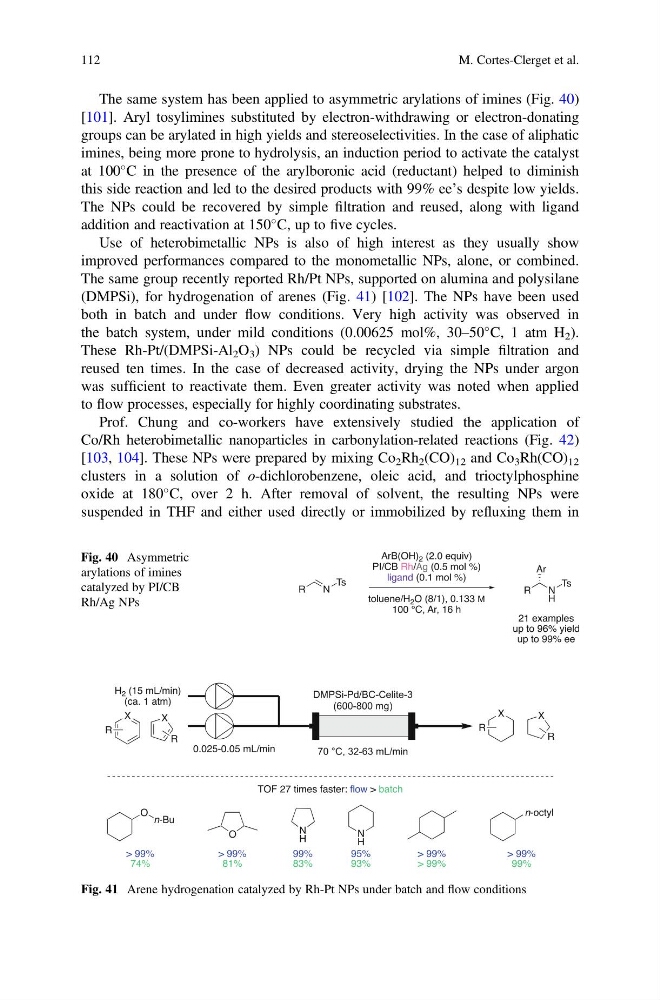
The same system has been applied to asymmetric arylations of imines (Fig. 40)
[101]. Aryl tosylimines substituted by electron-withdrawing or electron-donating
groups can be arylated in high yields and stereoselectivities. In the case of aliphatic
imines, being more prone to hydrolysis, an induction period to activate the catalyst
at 100
C in the presence of the arylboronic acid (reductant) helped to diminish
this side reaction and led to the desired products with 99% ee’s despite low yields.
The NPs could be recovered by simple filtration and reused, along with ligand
addition and reactivation at 150
C, up to five cycles.
Use of heterobimetallic NPs is also of high interest as they usually show
improved performances compared to the monometallic NPs, alone, or combined.
The same group recently reported Rh/Pt NPs, supported on alumina and polysilane
(DMPSi), for hydrogenation of arenes (Fig. 41) [102]. The NPs have been used
both in batch and under flow conditions. Very high activity was observed in
the batch system, under mild conditions (0.00625 mol%, 30–50
C, 1 atm H 2 ).
These Rh-Pt/(DMPSi-Al 2 O 3 ) NPs could be recycled via simple filtration and
reused ten times. In the case of decreased activity, drying the NPs under argon
was sufficient to reactivate them. Even greater activity was noted when applied
to flow processes, especially for highly coordinating substrates.
Prof. Chung and co-workers have extensively studied the application of
Co/Rh heterobimetallic nanoparticles in carbonylation-related reactions (Fig. 42)
[103, 104]. These NPs were prepared by mixing Co 2 Rh 2 (CO) 12 and Co 3 Rh(CO) 12
clusters in a solution of o-dichlorobenzene, oleic acid, and trioctylphosphine
oxide at 180
C, over 2 h. After removal of solvent, the resulting NPs were
suspended in THF and either used directly or immobilized by refluxing them in
Fig. 40 Asymmetric
arylations of imines
catalyzed by PI/CB
Rh/Ag NPs
Fig. 41 Arene hydrogenation catalyzed by Rh-Pt NPs under batch and flow conditions
112
M. Cortes-Clerget et al.
[101]. Aryl tosylimines substituted by electron-withdrawing or electron-donating
groups can be arylated in high yields and stereoselectivities. In the case of aliphatic
imines, being more prone to hydrolysis, an induction period to activate the catalyst
at 100
C in the presence of the arylboronic acid (reductant) helped to diminish
this side reaction and led to the desired products with 99% ee’s despite low yields.
The NPs could be recovered by simple filtration and reused, along with ligand
addition and reactivation at 150
C, up to five cycles.
Use of heterobimetallic NPs is also of high interest as they usually show
improved performances compared to the monometallic NPs, alone, or combined.
The same group recently reported Rh/Pt NPs, supported on alumina and polysilane
(DMPSi), for hydrogenation of arenes (Fig. 41) [102]. The NPs have been used
both in batch and under flow conditions. Very high activity was observed in
the batch system, under mild conditions (0.00625 mol%, 30–50
C, 1 atm H 2 ).
These Rh-Pt/(DMPSi-Al 2 O 3 ) NPs could be recycled via simple filtration and
reused ten times. In the case of decreased activity, drying the NPs under argon
was sufficient to reactivate them. Even greater activity was noted when applied
to flow processes, especially for highly coordinating substrates.
Prof. Chung and co-workers have extensively studied the application of
Co/Rh heterobimetallic nanoparticles in carbonylation-related reactions (Fig. 42)
[103, 104]. These NPs were prepared by mixing Co 2 Rh 2 (CO) 12 and Co 3 Rh(CO) 12
clusters in a solution of o-dichlorobenzene, oleic acid, and trioctylphosphine
oxide at 180
C, over 2 h. After removal of solvent, the resulting NPs were
suspended in THF and either used directly or immobilized by refluxing them in
Fig. 40 Asymmetric
arylations of imines
catalyzed by PI/CB
Rh/Ag NPs
Fig. 41 Arene hydrogenation catalyzed by Rh-Pt NPs under batch and flow conditions
112
M. Cortes-Clerget et al.