

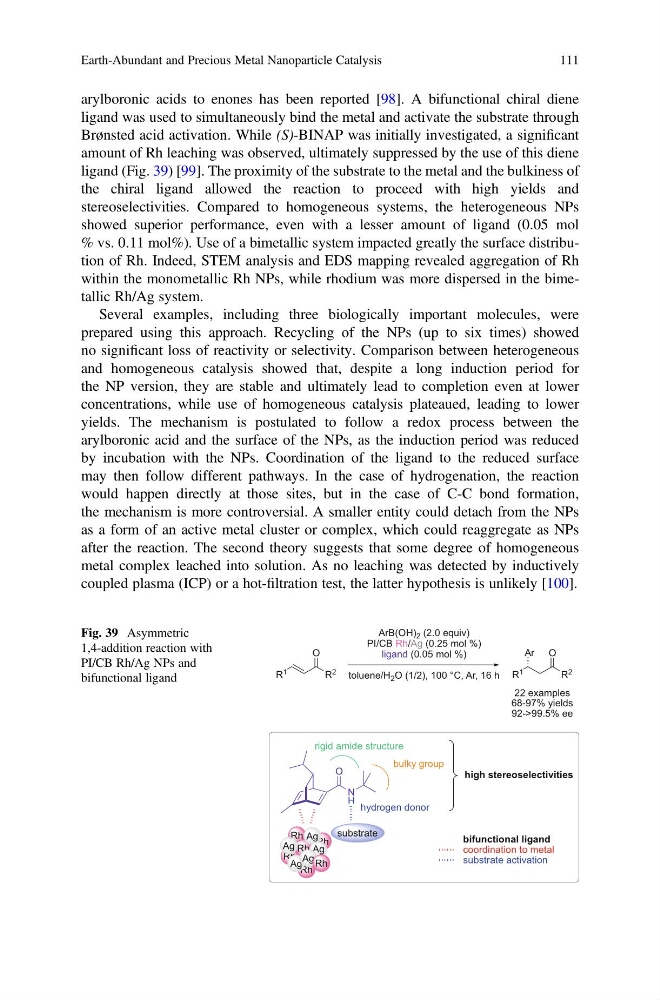
arylboronic acids to enones has been reported [98]. A bifunctional chiral diene
ligand was used to simultaneously bind the metal and activate the substrate through
Brønsted acid activation. While (S)-BINAP was initially investigated, a significant
amount of Rh leaching was observed, ultimately suppressed by the use of this diene
ligand (Fig. 39) [99]. The proximity of the substrate to the metal and the bulkiness of
the chiral ligand allowed the reaction to proceed with high yields and
stereoselectivities. Compared to homogeneous systems, the heterogeneous NPs
showed superior performance, even with a lesser amount of ligand (0.05 mol
% vs. 0.11 mol%). Use of a bimetallic system impacted greatly the surface distribution of Rh. Indeed, STEM analysis and EDS mapping revealed aggregation of Rh
within the monometallic Rh NPs, while rhodium was more dispersed in the bimetallic Rh/Ag system.
Several examples, including three biologically important molecules, were
prepared using this approach. Recycling of the NPs (up to six times) showed
no significant loss of reactivity or selectivity. Comparison between heterogeneous
and homogeneous catalysis showed that, despite a long induction period for
the NP version, they are stable and ultimately lead to completion even at lower
concentrations, while use of homogeneous catalysis plateaued, leading to lower
yields. The mechanism is postulated to follow a redox process between the
arylboronic acid and the surface of the NPs, as the induction period was reduced
by incubation with the NPs. Coordination of the ligand to the reduced surface
may then follow different pathways. In the case of hydrogenation, the reaction
would happen directly at those sites, but in the case of C-C bond formation,
the mechanism is more controversial. A smaller entity could detach from the NPs
as a form of an active metal cluster or complex, which could reaggregate as NPs
after the reaction. The second theory suggests that some degree of homogeneous
metal complex leached into solution. As no leaching was detected by inductively
coupled plasma (ICP) or a hot-filtration test, the latter hypothesis is unlikely [100].
Rh
Rh
N
H
O
R 1
R 2
O
R 1
R 2
O
Ar
Rh
Rh
Rh
Ag
Ag
Ag
Ag
Ag Rh
substrate
bulky group
hydrogen donor
rigid amide structure
high stereoselectivities
bifunctional ligand
coordination to metal
substrate activation
ArB(OH) 2 (2.0 equiv)
PI/CB Rh/Ag (0.25 mol %)
ligand (0.05 mol %)
toluene/H 2 O (1/2), 100 °C, Ar, 16 h
22 examples
68-97% yields
92->99.5% ee
Fig. 39 Asymmetric
1,4-addition reaction with
PI/CB Rh/Ag NPs and
bifunctional ligand
Earth-Abundant and Precious Metal Nanoparticle Catalysis
111
ligand was used to simultaneously bind the metal and activate the substrate through
Brønsted acid activation. While (S)-BINAP was initially investigated, a significant
amount of Rh leaching was observed, ultimately suppressed by the use of this diene
ligand (Fig. 39) [99]. The proximity of the substrate to the metal and the bulkiness of
the chiral ligand allowed the reaction to proceed with high yields and
stereoselectivities. Compared to homogeneous systems, the heterogeneous NPs
showed superior performance, even with a lesser amount of ligand (0.05 mol
% vs. 0.11 mol%). Use of a bimetallic system impacted greatly the surface distribution of Rh. Indeed, STEM analysis and EDS mapping revealed aggregation of Rh
within the monometallic Rh NPs, while rhodium was more dispersed in the bimetallic Rh/Ag system.
Several examples, including three biologically important molecules, were
prepared using this approach. Recycling of the NPs (up to six times) showed
no significant loss of reactivity or selectivity. Comparison between heterogeneous
and homogeneous catalysis showed that, despite a long induction period for
the NP version, they are stable and ultimately lead to completion even at lower
concentrations, while use of homogeneous catalysis plateaued, leading to lower
yields. The mechanism is postulated to follow a redox process between the
arylboronic acid and the surface of the NPs, as the induction period was reduced
by incubation with the NPs. Coordination of the ligand to the reduced surface
may then follow different pathways. In the case of hydrogenation, the reaction
would happen directly at those sites, but in the case of C-C bond formation,
the mechanism is more controversial. A smaller entity could detach from the NPs
as a form of an active metal cluster or complex, which could reaggregate as NPs
after the reaction. The second theory suggests that some degree of homogeneous
metal complex leached into solution. As no leaching was detected by inductively
coupled plasma (ICP) or a hot-filtration test, the latter hypothesis is unlikely [100].
Rh
Rh
N
H
O
R 1
R 2
O
R 1
R 2
O
Ar
Rh
Rh
Rh
Ag
Ag
Ag
Ag
Ag Rh
substrate
bulky group
hydrogen donor
rigid amide structure
high stereoselectivities
bifunctional ligand
coordination to metal
substrate activation
ArB(OH) 2 (2.0 equiv)
PI/CB Rh/Ag (0.25 mol %)
ligand (0.05 mol %)
toluene/H 2 O (1/2), 100 °C, Ar, 16 h
22 examples
68-97% yields
92->99.5% ee
Fig. 39 Asymmetric
1,4-addition reaction with
PI/CB Rh/Ag NPs and
bifunctional ligand
Earth-Abundant and Precious Metal Nanoparticle Catalysis
111