

7 Rhodium
Given that rhodium is among the rarest and most expensive precious metals, use of
heterogeneous Rh NPs as highly reactive, robust, and reusable platforms can be
especially attractive, perhaps most notably in the pharmaceutical industry where
the residual contamination by Rh is limited to <100 μg/day (oral PDE) [92].
While Suzuki-Miyaura and Sonogashira cross-couplings are dominated
by Pd-catalyzed processes, some examples mediated by Rh have been reported
[93–95], illustrating the versatility of rhodium NPs. Most applications described,
however, involve hydrogenation and hydroformylation reactions.
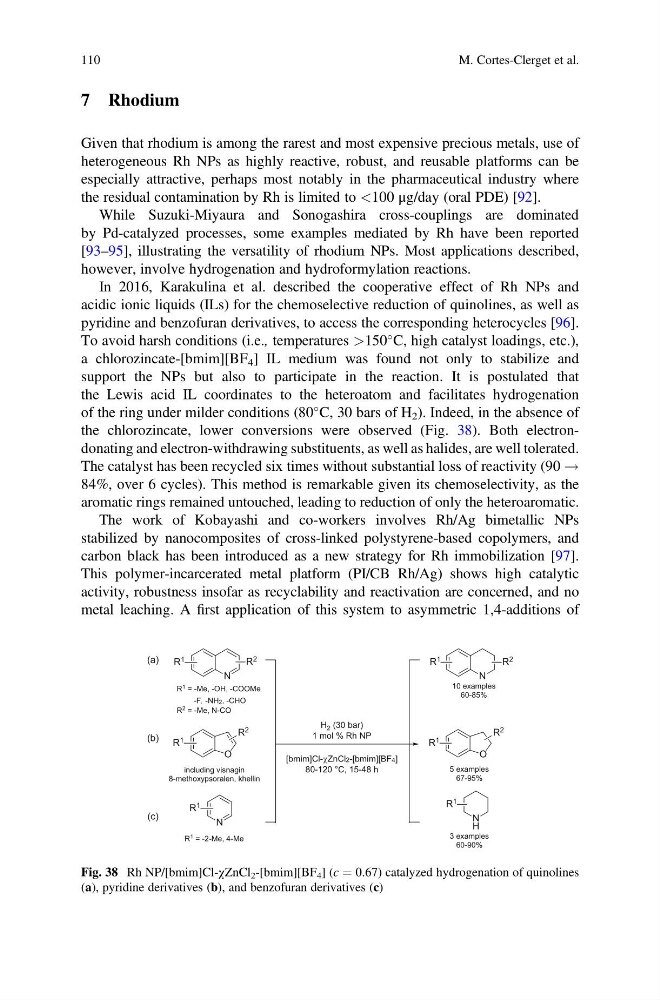
In 2016, Karakulina et al. described the cooperative effect of Rh NPs and
acidic ionic liquids (ILs) for the chemoselective reduction of quinolines, as well as
pyridine and benzofuran derivatives, to access the corresponding heterocycles [96].
To avoid harsh conditions (i.e., temperatures >150
C, high catalyst loadings, etc.),
a chlorozincate-[bmim][BF 4 ] IL medium was found not only to stabilize and
support the NPs but also to participate in the reaction. It is postulated that
the Lewis acid IL coordinates to the heteroatom and facilitates hydrogenation
of the ring under milder conditions (80
C, 30 bars of H 2 ). Indeed, in the absence of
the chlorozincate, lower conversions were observed (Fig. 38). Both electrondonating and electron-withdrawing substituents, as well as halides, are well tolerated.
The catalyst has been recycled six times without substantial loss of reactivity (90 !
84%, over 6 cycles). This method is remarkable given its chemoselectivity, as the
aromatic rings remained untouched, leading to reduction of only the heteroaromatic.
The work of Kobayashi and co-workers involves Rh/Ag bimetallic NPs
stabilized by nanocomposites of cross-linked polystyrene-based copolymers, and
carbon black has been introduced as a new strategy for Rh immobilization [97].
This polymer-incarcerated metal platform (PI/CB Rh/Ag) shows high catalytic
activity, robustness insofar as recyclability and reactivation are concerned, and no
metal leaching. A first application of this system to asymmetric 1,4-additions of
N
N
R 1
R 1
R 2
R 2
H 2 (30 bar)
1 mol % Rh NP
[bmim]Cl-χZnCl2-[bmim][BF4]
80-120 °C, 15-48 h
R 1
O
R 2
R 1
O
R 2
N
R 1
N
H
R 1
10 examples
60-85%
R 1 = -Me, -OH, -COOMe
-F, -NH2, -CHO
R 2 = -Me, N-CO
5 examples
67-95%
including visnagin
8-methoxypsoralen, khellin
R 1 = -2-Me, 4-Me
3 examples
60-90%
(a)
(b)
(c)
Fig. 38 Rh NP/[bmim]Cl-χZnCl 2 -[bmim][BF 4 ] (c ¼ 0.67) catalyzed hydrogenation of quinolines
(a), pyridine derivatives (b), and benzofuran derivatives (c)
110
M. Cortes-Clerget et al.
Given that rhodium is among the rarest and most expensive precious metals, use of
heterogeneous Rh NPs as highly reactive, robust, and reusable platforms can be
especially attractive, perhaps most notably in the pharmaceutical industry where
the residual contamination by Rh is limited to <100 μg/day (oral PDE) [92].
While Suzuki-Miyaura and Sonogashira cross-couplings are dominated
by Pd-catalyzed processes, some examples mediated by Rh have been reported
[93–95], illustrating the versatility of rhodium NPs. Most applications described,
however, involve hydrogenation and hydroformylation reactions.
In 2016, Karakulina et al. described the cooperative effect of Rh NPs and
acidic ionic liquids (ILs) for the chemoselective reduction of quinolines, as well as
pyridine and benzofuran derivatives, to access the corresponding heterocycles [96].
To avoid harsh conditions (i.e., temperatures >150
C, high catalyst loadings, etc.),
a chlorozincate-[bmim][BF 4 ] IL medium was found not only to stabilize and
support the NPs but also to participate in the reaction. It is postulated that
the Lewis acid IL coordinates to the heteroatom and facilitates hydrogenation
of the ring under milder conditions (80
C, 30 bars of H 2 ). Indeed, in the absence of
the chlorozincate, lower conversions were observed (Fig. 38). Both electrondonating and electron-withdrawing substituents, as well as halides, are well tolerated.
The catalyst has been recycled six times without substantial loss of reactivity (90 !
84%, over 6 cycles). This method is remarkable given its chemoselectivity, as the
aromatic rings remained untouched, leading to reduction of only the heteroaromatic.
The work of Kobayashi and co-workers involves Rh/Ag bimetallic NPs
stabilized by nanocomposites of cross-linked polystyrene-based copolymers, and
carbon black has been introduced as a new strategy for Rh immobilization [97].
This polymer-incarcerated metal platform (PI/CB Rh/Ag) shows high catalytic
activity, robustness insofar as recyclability and reactivation are concerned, and no
metal leaching. A first application of this system to asymmetric 1,4-additions of
N
N
R 1
R 1
R 2
R 2
H 2 (30 bar)
1 mol % Rh NP
[bmim]Cl-χZnCl2-[bmim][BF4]
80-120 °C, 15-48 h
R 1
O
R 2
R 1
O
R 2
N
R 1
N
H
R 1
10 examples
60-85%
R 1 = -Me, -OH, -COOMe
-F, -NH2, -CHO
R 2 = -Me, N-CO
5 examples
67-95%
including visnagin
8-methoxypsoralen, khellin
R 1 = -2-Me, 4-Me
3 examples
60-90%
(a)
(b)
(c)
Fig. 38 Rh NP/[bmim]Cl-χZnCl 2 -[bmim][BF 4 ] (c ¼ 0.67) catalyzed hydrogenation of quinolines
(a), pyridine derivatives (b), and benzofuran derivatives (c)
110
M. Cortes-Clerget et al.