

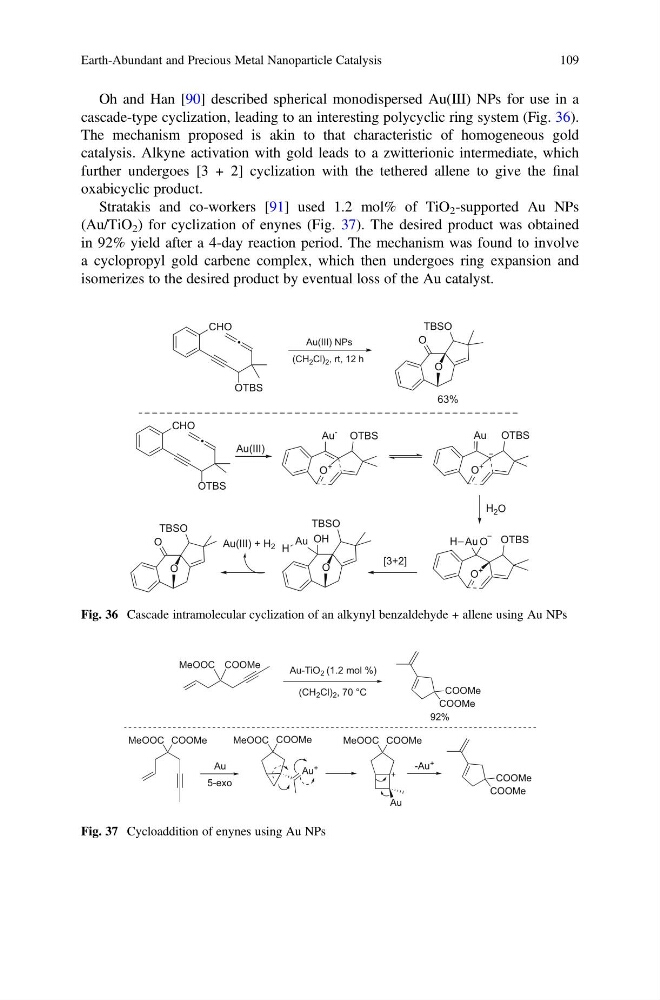
Oh and Han [90] described spherical monodispersed Au(III) NPs for use in a
cascade-type cyclization, leading to an interesting polycyclic ring system (Fig. 36).
The mechanism proposed is akin to that characteristic of homogeneous gold
catalysis. Alkyne activation with gold leads to a zwitterionic intermediate, which
further undergoes [3 + 2] cyclization with the tethered allene to give the final
oxabicyclic product.
Stratakis and co-workers [91] used 1.2 mol% of TiO 2 -supported Au NPs
(Au/TiO 2 ) for cyclization of enynes (Fig. 37). The desired product was obtained
in 92% yield after a 4-day reaction period. The mechanism was found to involve
a cyclopropyl gold carbene complex, which then undergoes ring expansion and
isomerizes to the desired product by eventual loss of the Au catalyst.
CHO
OTBS
•
Au(III) NPs
(CH 2 Cl) 2 , rt, 12 h
O
O
TBSO
63%
CHO
OTBS
•
Au
-
OTBS
O
+
Au OTBS
O
+
Au
OTBS
O
+
H
O
OH
O
TBSO
Au
H
O
O
TBSO
Au(III) + H 2
Au(III)
[3+2]
H 2 O
Fig. 36 Cascade intramolecular cyclization of an alkynyl benzaldehyde + allene using Au NPs
COOMe
MeOOC
COOMe
COOMe
Au-TiO 2 (1.2 mol %)
(CH 2 Cl) 2 , 70 °C
92%
COOMe
MeOOC
Au
5-exo
Au +
COOMe
MeOOC
COOMe
MeOOC
Au
-Au +
COOMe
COOMe
Fig. 37 Cycloaddition of enynes using Au NPs
Earth-Abundant and Precious Metal Nanoparticle Catalysis
109
cascade-type cyclization, leading to an interesting polycyclic ring system (Fig. 36).
The mechanism proposed is akin to that characteristic of homogeneous gold
catalysis. Alkyne activation with gold leads to a zwitterionic intermediate, which
further undergoes [3 + 2] cyclization with the tethered allene to give the final
oxabicyclic product.
Stratakis and co-workers [91] used 1.2 mol% of TiO 2 -supported Au NPs
(Au/TiO 2 ) for cyclization of enynes (Fig. 37). The desired product was obtained
in 92% yield after a 4-day reaction period. The mechanism was found to involve
a cyclopropyl gold carbene complex, which then undergoes ring expansion and
isomerizes to the desired product by eventual loss of the Au catalyst.
CHO
OTBS
•
Au(III) NPs
(CH 2 Cl) 2 , rt, 12 h
O
O
TBSO
63%
CHO
OTBS
•
Au
-
OTBS
O
+
Au OTBS
O
+
Au
OTBS
O
+
H
O
OH
O
TBSO
Au
H
O
O
TBSO
Au(III) + H 2
Au(III)
[3+2]
H 2 O
Fig. 36 Cascade intramolecular cyclization of an alkynyl benzaldehyde + allene using Au NPs
COOMe
MeOOC
COOMe
COOMe
Au-TiO 2 (1.2 mol %)
(CH 2 Cl) 2 , 70 °C
92%
COOMe
MeOOC
Au
5-exo
Au +
COOMe
MeOOC
COOMe
MeOOC
Au
-Au +
COOMe
COOMe
Fig. 37 Cycloaddition of enynes using Au NPs
Earth-Abundant and Precious Metal Nanoparticle Catalysis
109