

Although the mechanism is not fully established, considerable research has
been done in this regard on heterogeneous gold catalysts following the first
report by Kidwai and co-workers [85]. In this work, gold NPs of varying sizes
(10–70 nm) were prepared. It was then observed that Au NPs of size 10 nm
showed the best activity. The only drawback anticipated was the need for excessive
amounts of these NPs (10 mol%), used in methanol at 75–80
C. Nevertheless,
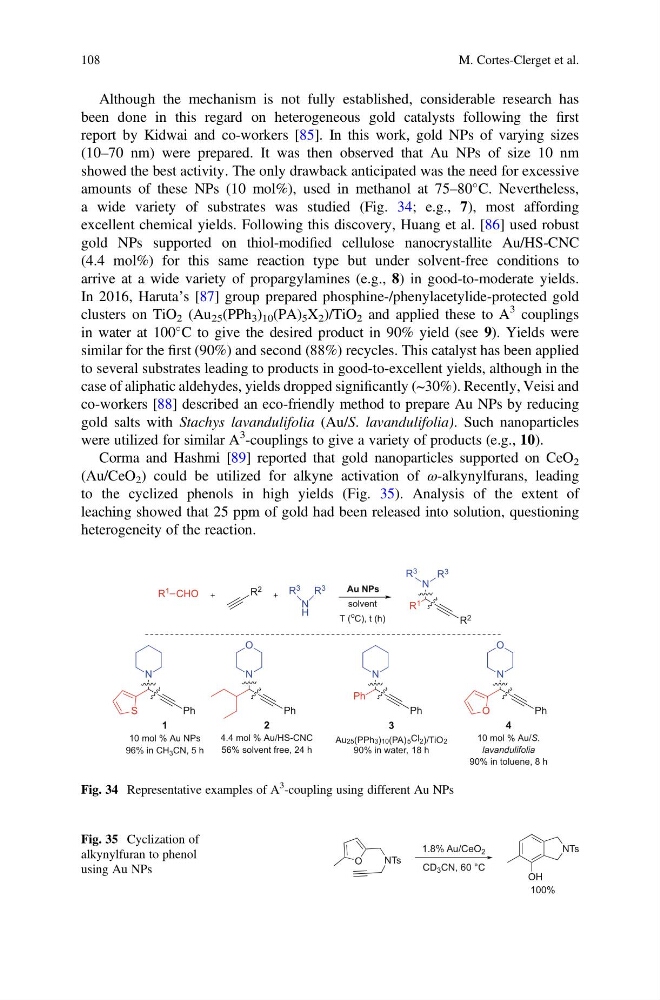
a wide variety of substrates was studied (Fig. 34; e.g., 7), most affording
excellent chemical yields. Following this discovery, Huang et al. [86] used robust
gold NPs supported on thiol-modified cellulose nanocrystallite Au/HS-CNC
(4.4 mol%) for this same reaction type but under solvent-free conditions to
arrive at a wide variety of propargylamines (e.g., 8) in good-to-moderate yields.
In 2016, Haruta’s [87] group prepared phosphine-/phenylacetylide-protected gold
clusters on TiO 2 (Au 25 (PPh 3 ) 10 (PA) 5 X 2 )/TiO 2 and applied these to A
3 couplings
in water at 100
C to give the desired product in 90% yield (see 9). Yields were
similar for the first (90%) and second (88%) recycles. This catalyst has been applied
to several substrates leading to products in good-to-excellent yields, although in the
case of aliphatic aldehydes, yields dropped significantly (~30%). Recently, Veisi and
co-workers [88] described an eco-friendly method to prepare Au NPs by reducing
gold salts with Stachys lavandulifolia (Au/S. lavandulifolia). Such nanoparticles
were utilized for similar A
3 -couplings to give a variety of products (e.g., 10).
Corma and Hashmi [89] reported that gold nanoparticles supported on CeO 2
(Au/CeO 2 ) could be utilized for alkyne activation of ω-alkynylfurans, leading
to the cyclized phenols in high yields (Fig. 35). Analysis of the extent of
leaching showed that 25 ppm of gold had been released into solution, questioning
heterogeneity of the reaction.
R 1 CHO
Au NPs
solvent
T (
o
C), t (h)
R 2
N
H
R 3
R 3
R 1
N
R 3
R 3
R 2
Ph
N
Ph
3
Au25(PPh3)10(PA)5 Cl 2)/TiO2
90% in water, 18 h
N
Ph
1
10 mol % Au NPs
96% in CH 3 CN, 5 h
S
N
Ph
O
4
10 mol % Au/S.
lavandulifolia
90% in toluene, 8 h
O
N
Ph
O
2
4.4 mol % Au/HS-CNC
56% solvent free, 24 h
Fig. 34 Representative examples of A
3
-coupling using different Au NPs
O
NTs
NTs
OH
1.8% Au/CeO 2
CD 3 CN, 60 °C
100%
Fig. 35 Cyclization of
alkynylfuran to phenol
using Au NPs
108
M. Cortes-Clerget et al.
been done in this regard on heterogeneous gold catalysts following the first
report by Kidwai and co-workers [85]. In this work, gold NPs of varying sizes
(10–70 nm) were prepared. It was then observed that Au NPs of size 10 nm
showed the best activity. The only drawback anticipated was the need for excessive
amounts of these NPs (10 mol%), used in methanol at 75–80
C. Nevertheless,
a wide variety of substrates was studied (Fig. 34; e.g., 7), most affording
excellent chemical yields. Following this discovery, Huang et al. [86] used robust
gold NPs supported on thiol-modified cellulose nanocrystallite Au/HS-CNC
(4.4 mol%) for this same reaction type but under solvent-free conditions to
arrive at a wide variety of propargylamines (e.g., 8) in good-to-moderate yields.
In 2016, Haruta’s [87] group prepared phosphine-/phenylacetylide-protected gold
clusters on TiO 2 (Au 25 (PPh 3 ) 10 (PA) 5 X 2 )/TiO 2 and applied these to A
3 couplings
in water at 100
C to give the desired product in 90% yield (see 9). Yields were
similar for the first (90%) and second (88%) recycles. This catalyst has been applied
to several substrates leading to products in good-to-excellent yields, although in the
case of aliphatic aldehydes, yields dropped significantly (~30%). Recently, Veisi and
co-workers [88] described an eco-friendly method to prepare Au NPs by reducing
gold salts with Stachys lavandulifolia (Au/S. lavandulifolia). Such nanoparticles
were utilized for similar A
3 -couplings to give a variety of products (e.g., 10).
Corma and Hashmi [89] reported that gold nanoparticles supported on CeO 2
(Au/CeO 2 ) could be utilized for alkyne activation of ω-alkynylfurans, leading
to the cyclized phenols in high yields (Fig. 35). Analysis of the extent of
leaching showed that 25 ppm of gold had been released into solution, questioning
heterogeneity of the reaction.
R 1 CHO
Au NPs
solvent
T (
o
C), t (h)
R 2
N
H
R 3
R 3
R 1
N
R 3
R 3
R 2
Ph
N
Ph
3
Au25(PPh3)10(PA)5 Cl 2)/TiO2
90% in water, 18 h
N
Ph
1
10 mol % Au NPs
96% in CH 3 CN, 5 h
S
N
Ph
O
4
10 mol % Au/S.
lavandulifolia
90% in toluene, 8 h
O
N
Ph
O
2
4.4 mol % Au/HS-CNC
56% solvent free, 24 h
Fig. 34 Representative examples of A
3
-coupling using different Au NPs
O
NTs
NTs
OH
1.8% Au/CeO 2
CD 3 CN, 60 °C
100%
Fig. 35 Cyclization of
alkynylfuran to phenol
using Au NPs
108
M. Cortes-Clerget et al.