

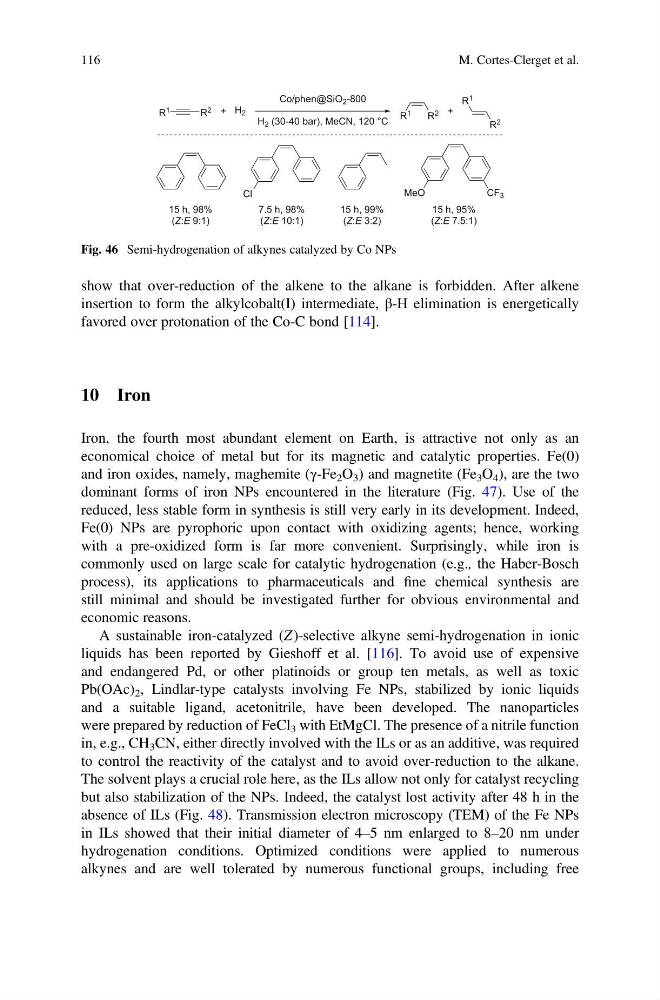
show that over-reduction of the alkene to the alkane is forbidden. After alkene
insertion to form the alkylcobalt(I) intermediate, β-H elimination is energetically
favored over protonation of the Co-C bond [114].
10 Iron
Iron, the fourth most abundant element on Earth, is attractive not only as an
economical choice of metal but for its magnetic and catalytic properties. Fe(0)
and iron oxides, namely, maghemite (γ-Fe 2 O 3 ) and magnetite (Fe 3 O 4 ), are the two
dominant forms of iron NPs encountered in the literature (Fig. 47). Use of the
reduced, less stable form in synthesis is still very early in its development. Indeed,
Fe(0) NPs are pyrophoric upon contact with oxidizing agents; hence, working
with a pre-oxidized form is far more convenient. Surprisingly, while iron is
commonly used on large scale for catalytic hydrogenation (e.g., the Haber-Bosch
process), its applications to pharmaceuticals and fine chemical synthesis are
still minimal and should be investigated further for obvious environmental and
economic reasons.
A sustainable iron-catalyzed (Z )-selective alkyne semi-hydrogenation in ionic
liquids has been reported by Gieshoff et al. [116]. To avoid use of expensive
and endangered Pd, or other platinoids or group ten metals, as well as toxic
Pb(OAc) 2 , Lindlar-type catalysts involving Fe NPs, stabilized by ionic liquids
and a suitable ligand, acetonitrile, have been developed. The nanoparticles
were prepared by reduction of FeCl 3 with EtMgCl. The presence of a nitrile function
in, e.g., CH 3 CN, either directly involved with the ILs or as an additive, was required
to control the reactivity of the catalyst and to avoid over-reduction to the alkane.
The solvent plays a crucial role here, as the ILs allow not only for catalyst recycling
but also stabilization of the NPs. Indeed, the catalyst lost activity after 48 h in the
absence of ILs (Fig. 48). Transmission electron microscopy (TEM) of the Fe NPs
in ILs showed that their initial diameter of 4–5 nm enlarged to 8–20 nm under
hydrogenation conditions. Optimized conditions were applied to numerous
alkynes and are well tolerated by numerous functional groups, including free
R 1
R 2 + H 2
R 1
R 2
R 2
R 1
+
Co/phen@SiO 2 -800
H 2 (30-40 bar), MeCN, 120 °C
15 h, 98%
(Z:E 9:1)
7.5 h, 98%
(Z:E 10:1)
Cl
15 h, 99%
(Z:E 3:2)
15 h, 95%
(Z:E 7.5:1)
MeO
CF 3
Fig. 46 Semi-hydrogenation of alkynes catalyzed by Co NPs
116
M. Cortes-Clerget et al.
insertion to form the alkylcobalt(I) intermediate, β-H elimination is energetically
favored over protonation of the Co-C bond [114].
10 Iron
Iron, the fourth most abundant element on Earth, is attractive not only as an
economical choice of metal but for its magnetic and catalytic properties. Fe(0)
and iron oxides, namely, maghemite (γ-Fe 2 O 3 ) and magnetite (Fe 3 O 4 ), are the two
dominant forms of iron NPs encountered in the literature (Fig. 47). Use of the
reduced, less stable form in synthesis is still very early in its development. Indeed,
Fe(0) NPs are pyrophoric upon contact with oxidizing agents; hence, working
with a pre-oxidized form is far more convenient. Surprisingly, while iron is
commonly used on large scale for catalytic hydrogenation (e.g., the Haber-Bosch
process), its applications to pharmaceuticals and fine chemical synthesis are
still minimal and should be investigated further for obvious environmental and
economic reasons.
A sustainable iron-catalyzed (Z )-selective alkyne semi-hydrogenation in ionic
liquids has been reported by Gieshoff et al. [116]. To avoid use of expensive
and endangered Pd, or other platinoids or group ten metals, as well as toxic
Pb(OAc) 2 , Lindlar-type catalysts involving Fe NPs, stabilized by ionic liquids
and a suitable ligand, acetonitrile, have been developed. The nanoparticles
were prepared by reduction of FeCl 3 with EtMgCl. The presence of a nitrile function
in, e.g., CH 3 CN, either directly involved with the ILs or as an additive, was required
to control the reactivity of the catalyst and to avoid over-reduction to the alkane.
The solvent plays a crucial role here, as the ILs allow not only for catalyst recycling
but also stabilization of the NPs. Indeed, the catalyst lost activity after 48 h in the
absence of ILs (Fig. 48). Transmission electron microscopy (TEM) of the Fe NPs
in ILs showed that their initial diameter of 4–5 nm enlarged to 8–20 nm under
hydrogenation conditions. Optimized conditions were applied to numerous
alkynes and are well tolerated by numerous functional groups, including free
R 1
R 2 + H 2
R 1
R 2
R 2
R 1
+
Co/phen@SiO 2 -800
H 2 (30-40 bar), MeCN, 120 °C
15 h, 98%
(Z:E 9:1)
7.5 h, 98%
(Z:E 10:1)
Cl
15 h, 99%
(Z:E 3:2)
15 h, 95%
(Z:E 7.5:1)
MeO
CF 3
Fig. 46 Semi-hydrogenation of alkynes catalyzed by Co NPs
116
M. Cortes-Clerget et al.