

In principle, the catalytic performance of Au NPs is determined by the kind of
supports and the size of Au NPs. We classified the supports as the following:
(1) reducible MO x , (2) non-reducible MO x , (3) non-oxides (metal hydroxides,
phosphates, and carbonates), (4) inorganic-organic hybrids (MOF), and (5) carbons
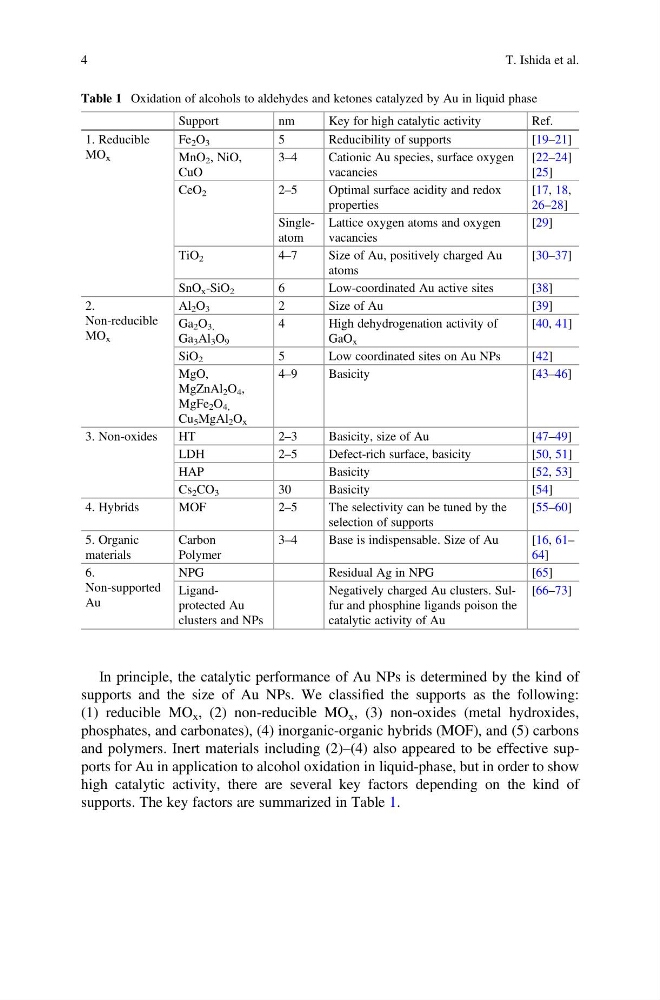
and polymers. Inert materials including (2)–(4) also appeared to be effective supports for Au in application to alcohol oxidation in liquid-phase, but in order to show
high catalytic activity, there are several key factors depending on the kind of
supports. The key factors are summarized in Table 1.
Table 1 Oxidation of alcohols to aldehydes and ketones catalyzed by Au in liquid phase
Support
nm
Key for high catalytic activity
Ref.
1. Reducible
MO x
Fe 2 O 3
5
Reducibility of supports
[19–21]
MnO 2 , NiO,
CuO
3–4
Cationic Au species, surface oxygen
vacancies
[22–24]
[25]
CeO 2
2–5
Optimal surface acidity and redox
properties
[17, 18,
26–28]
Singleatom
Lattice oxygen atoms and oxygen
vacancies
[29]
TiO 2
4–7
Size of Au, positively charged Au
atoms
[30–37]
SnO x -SiO 2
6
Low-coordinated Au active sites
[38]
2.
Non-reducible
MO x
Al 2 O 3
2
Size of Au
[39]
Ga 2 O 3,
Ga 3 Al 3 O 9
4
High dehydrogenation activity of
GaO x
[40, 41]
SiO 2
5
Low coordinated sites on Au NPs
[42]
MgO,
MgZnAl 2 O 4 ,
MgFe 2 O 4,
Cu 5 MgAl 2 O x
4–9
Basicity
[43–46]
3. Non-oxides
HT
2–3
Basicity, size of Au
[47–49]
LDH
2–5
Defect-rich surface, basicity
[50, 51]
HAP
Basicity
[52, 53]
Cs 2 CO 3
30
Basicity
[54]
4. Hybrids
MOF
2–5
The selectivity can be tuned by the
selection of supports
[55–60]
5. Organic
materials
Carbon
Polymer
3–4
Base is indispensable. Size of Au
[16, 61–
64]
6.
Non-supported
Au
NPG
Residual Ag in NPG
[65]
Ligandprotected Au
clusters and NPs
Negatively charged Au clusters. Sulfur and phosphine ligands poison the
catalytic activity of Au
[66–73]
4
T. Ishida et al.
supports and the size of Au NPs. We classified the supports as the following:
(1) reducible MO x , (2) non-reducible MO x , (3) non-oxides (metal hydroxides,
phosphates, and carbonates), (4) inorganic-organic hybrids (MOF), and (5) carbons
and polymers. Inert materials including (2)–(4) also appeared to be effective supports for Au in application to alcohol oxidation in liquid-phase, but in order to show
high catalytic activity, there are several key factors depending on the kind of
supports. The key factors are summarized in Table 1.
Table 1 Oxidation of alcohols to aldehydes and ketones catalyzed by Au in liquid phase
Support
nm
Key for high catalytic activity
Ref.
1. Reducible
MO x
Fe 2 O 3
5
Reducibility of supports
[19–21]
MnO 2 , NiO,
CuO
3–4
Cationic Au species, surface oxygen
vacancies
[22–24]
[25]
CeO 2
2–5
Optimal surface acidity and redox
properties
[17, 18,
26–28]
Singleatom
Lattice oxygen atoms and oxygen
vacancies
[29]
TiO 2
4–7
Size of Au, positively charged Au
atoms
[30–37]
SnO x -SiO 2
6
Low-coordinated Au active sites
[38]
2.
Non-reducible
MO x
Al 2 O 3
2
Size of Au
[39]
Ga 2 O 3,
Ga 3 Al 3 O 9
4
High dehydrogenation activity of
GaO x
[40, 41]
SiO 2
5
Low coordinated sites on Au NPs
[42]
MgO,
MgZnAl 2 O 4 ,
MgFe 2 O 4,
Cu 5 MgAl 2 O x
4–9
Basicity
[43–46]
3. Non-oxides
HT
2–3
Basicity, size of Au
[47–49]
LDH
2–5
Defect-rich surface, basicity
[50, 51]
HAP
Basicity
[52, 53]
Cs 2 CO 3
30
Basicity
[54]
4. Hybrids
MOF
2–5
The selectivity can be tuned by the
selection of supports
[55–60]
5. Organic
materials
Carbon
Polymer
3–4
Base is indispensable. Size of Au
[16, 61–
64]
6.
Non-supported
Au
NPG
Residual Ag in NPG
[65]
Ligandprotected Au
clusters and NPs
Negatively charged Au clusters. Sulfur and phosphine ligands poison the
catalytic activity of Au
[66–73]
4
T. Ishida et al.