

2.1 Reducible MO x
2.1.1 Role of Supports
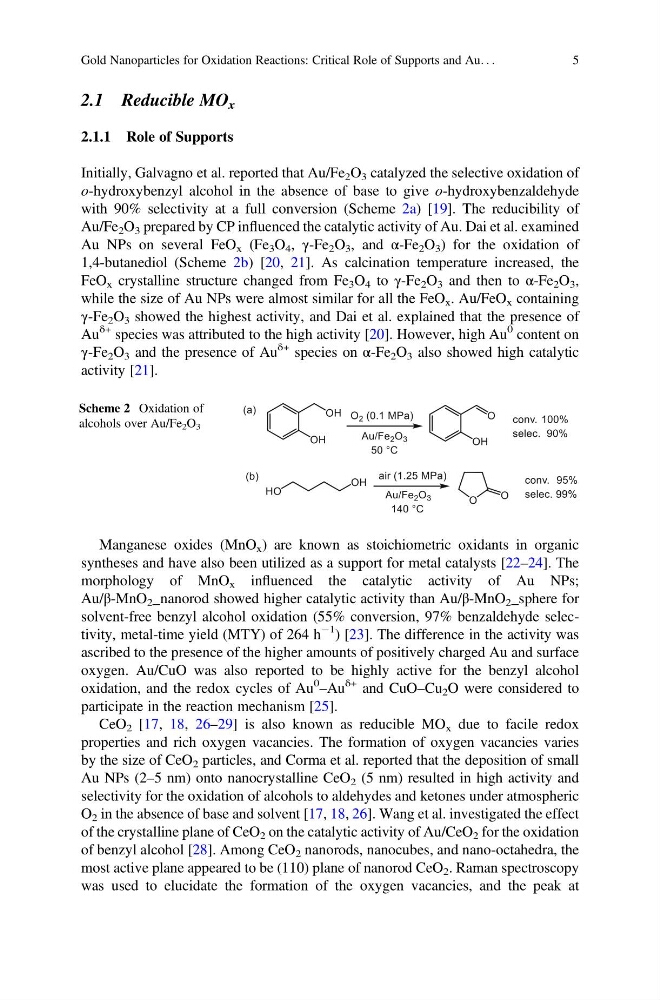
Initially, Galvagno et al. reported that Au/Fe 2 O 3 catalyzed the selective oxidation of
o-hydroxybenzyl alcohol in the absence of base to give o-hydroxybenzaldehyde
with 90% selectivity at a full conversion (Scheme 2a) [19]. The reducibility of
Au/Fe 2 O 3 prepared by CP influenced the catalytic activity of Au. Dai et al. examined
Au NPs on several FeO x (Fe 3 O 4 , γ-Fe 2 O 3 , and α-Fe 2 O 3 ) for the oxidation of
1,4-butanediol (Scheme 2b) [20, 21]. As calcination temperature increased, the
FeO x crystalline structure changed from Fe 3 O 4 to γ-Fe 2 O 3 and then to α-Fe 2 O 3 ,
while the size of Au NPs were almost similar for all the FeO x . Au/FeO x containing
γ-Fe 2 O 3 showed the highest activity, and Dai et al. explained that the presence of
Au
δ+ species was attributed to the high activity [20]. However, high Au
0 content on
γ-Fe 2 O 3 and the presence of Au
δ+ species on α-Fe 2 O 3 also showed high catalytic
activity [21].
Manganese oxides (MnO x ) are known as stoichiometric oxidants in organic
syntheses and have also been utilized as a support for metal catalysts [22–24]. The
morphology of MnO x influenced the catalytic activity of Au NPs;
Au/β-MnO 2 _nanorod showed higher catalytic activity than Au/β-MnO 2 _sphere for
solvent-free benzyl alcohol oxidation (55% conversion, 97% benzaldehyde selectivity, metal-time yield (MTY) of 264 h
À1 ) [23]. The difference in the activity was
ascribed to the presence of the higher amounts of positively charged Au and surface
oxygen. Au/CuO was also reported to be highly active for the benzyl alcohol
oxidation, and the redox cycles of Au
0
–Au
δ+ and CuO–Cu 2 O were considered to
participate in the reaction mechanism [25].
CeO 2 [17, 18, 26–29] is also known as reducible MO x due to facile redox
properties and rich oxygen vacancies. The formation of oxygen vacancies varies
by the size of CeO 2 particles, and Corma et al. reported that the deposition of small
Au NPs (2–5 nm) onto nanocrystalline CeO 2 (5 nm) resulted in high activity and
selectivity for the oxidation of alcohols to aldehydes and ketones under atmospheric
O 2 in the absence of base and solvent [17, 18, 26]. Wang et al. investigated the effect
of the crystalline plane of CeO 2 on the catalytic activity of Au/CeO 2 for the oxidation
of benzyl alcohol [28]. Among CeO 2 nanorods, nanocubes, and nano-octahedra, the
most active plane appeared to be (110) plane of nanorod CeO 2 . Raman spectroscopy
was used to elucidate the formation of the oxygen vacancies, and the peak at
Scheme 2 Oxidation of
alcohols over Au/Fe 2 O 3
Gold Nanoparticles for Oxidation Reactions: Critical Role of Supports and Au. . .
5
2.1.1 Role of Supports
Initially, Galvagno et al. reported that Au/Fe 2 O 3 catalyzed the selective oxidation of
o-hydroxybenzyl alcohol in the absence of base to give o-hydroxybenzaldehyde
with 90% selectivity at a full conversion (Scheme 2a) [19]. The reducibility of
Au/Fe 2 O 3 prepared by CP influenced the catalytic activity of Au. Dai et al. examined
Au NPs on several FeO x (Fe 3 O 4 , γ-Fe 2 O 3 , and α-Fe 2 O 3 ) for the oxidation of
1,4-butanediol (Scheme 2b) [20, 21]. As calcination temperature increased, the
FeO x crystalline structure changed from Fe 3 O 4 to γ-Fe 2 O 3 and then to α-Fe 2 O 3 ,
while the size of Au NPs were almost similar for all the FeO x . Au/FeO x containing
γ-Fe 2 O 3 showed the highest activity, and Dai et al. explained that the presence of
Au
δ+ species was attributed to the high activity [20]. However, high Au
0 content on
γ-Fe 2 O 3 and the presence of Au
δ+ species on α-Fe 2 O 3 also showed high catalytic
activity [21].
Manganese oxides (MnO x ) are known as stoichiometric oxidants in organic
syntheses and have also been utilized as a support for metal catalysts [22–24]. The
morphology of MnO x influenced the catalytic activity of Au NPs;
Au/β-MnO 2 _nanorod showed higher catalytic activity than Au/β-MnO 2 _sphere for
solvent-free benzyl alcohol oxidation (55% conversion, 97% benzaldehyde selectivity, metal-time yield (MTY) of 264 h
À1 ) [23]. The difference in the activity was
ascribed to the presence of the higher amounts of positively charged Au and surface
oxygen. Au/CuO was also reported to be highly active for the benzyl alcohol
oxidation, and the redox cycles of Au
0
–Au
δ+ and CuO–Cu 2 O were considered to
participate in the reaction mechanism [25].
CeO 2 [17, 18, 26–29] is also known as reducible MO x due to facile redox
properties and rich oxygen vacancies. The formation of oxygen vacancies varies
by the size of CeO 2 particles, and Corma et al. reported that the deposition of small
Au NPs (2–5 nm) onto nanocrystalline CeO 2 (5 nm) resulted in high activity and
selectivity for the oxidation of alcohols to aldehydes and ketones under atmospheric
O 2 in the absence of base and solvent [17, 18, 26]. Wang et al. investigated the effect
of the crystalline plane of CeO 2 on the catalytic activity of Au/CeO 2 for the oxidation
of benzyl alcohol [28]. Among CeO 2 nanorods, nanocubes, and nano-octahedra, the
most active plane appeared to be (110) plane of nanorod CeO 2 . Raman spectroscopy
was used to elucidate the formation of the oxygen vacancies, and the peak at
Scheme 2 Oxidation of
alcohols over Au/Fe 2 O 3
Gold Nanoparticles for Oxidation Reactions: Critical Role of Supports and Au. . .
5