

generally show superior catalytic activity to Au on non-reducible (inert) supports for
CO oxidation. In addition, the perimeter length of Au NPs is proportional to 1/r
2 (r:
radius of Au particle), while the number of the surface Au atom is proportional to
1/r. Thus, the size of Au NPs markedly influences the catalytic activity of Au for CO
oxidation that takes place at the perimeter interface between Au and the supports. Au
on inert supports that do not have the oxygen vacancies is less reactive and requires
high reaction temperature. However, the presence of H 2 O in the reaction gas remarkably enhances the CO oxidation over Au on inert supports due to the fact that H 2 O can
assist the O 2 activation [9, 10]. It means that the key factors to show high catalytic
activity vary by the kind of supports.
In 1998, Prati and Rossi reported that supported Au NP catalysts could catalyze
alcohol oxidation in liquid phase [11]. Since then, the selective oxidation for
production of organic compounds in liquid phase has been intensively studied
because of unique catalytic features. As observed in Au-catalyzed gas-phase reactions such as CO oxidation, Au-catalyzed reactions in liquid phase are markedly
influenced by the kind of supports, the size of Au NPs, and the oxidation states in
some cases. In this chapter, we chose several important oxidation reactions catalyzed
by Au and focused on the role of supports and size specificity of Au.
2 Oxidation of Alcohols to Aldehydes and Ketones
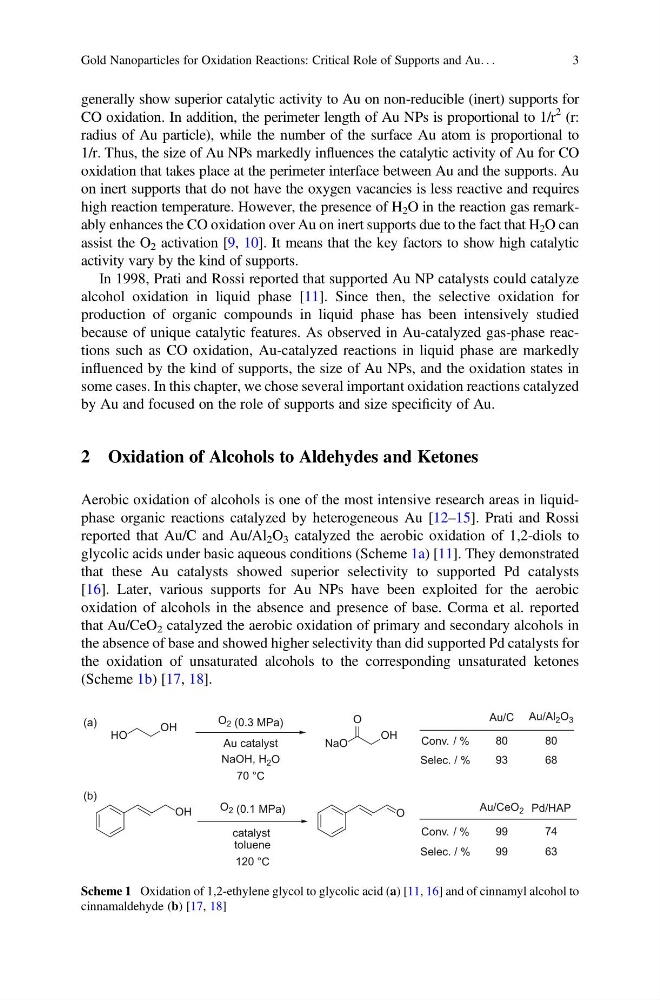
Aerobic oxidation of alcohols is one of the most intensive research areas in liquidphase organic reactions catalyzed by heterogeneous Au [12–15]. Prati and Rossi
reported that Au/C and Au/Al 2 O 3 catalyzed the aerobic oxidation of 1,2-diols to
glycolic acids under basic aqueous conditions (Scheme 1a) [11]. They demonstrated
that these Au catalysts showed superior selectivity to supported Pd catalysts
[16]. Later, various supports for Au NPs have been exploited for the aerobic
oxidation of alcohols in the absence and presence of base. Corma et al. reported
that Au/CeO 2 catalyzed the aerobic oxidation of primary and secondary alcohols in
the absence of base and showed higher selectivity than did supported Pd catalysts for
the oxidation of unsaturated alcohols to the corresponding unsaturated ketones
(Scheme 1b) [17, 18].
HO
OH
NaO
OH
O
O 2 (0.3 MPa)
Au catalyst
NaOH, H 2 O
70 °C
Au/C
Conv. / %
Selec. / %
Au/Al 2 O 3
80
93
80
68
OH
O
O 2 (0.1 MPa)
catalyst
toluene
120 °C
Au/CeO 2
Conv. / %
Selec. / %
Pd/HAP
99
99
74
63
(a)
(b)
Scheme 1 Oxidation of 1,2-ethylene glycol to glycolic acid (a) [11, 16] and of cinnamyl alcohol to
cinnamaldehyde (b) [17, 18]
Gold Nanoparticles for Oxidation Reactions: Critical Role of Supports and Au. . .
3
CO oxidation. In addition, the perimeter length of Au NPs is proportional to 1/r
2 (r:
radius of Au particle), while the number of the surface Au atom is proportional to
1/r. Thus, the size of Au NPs markedly influences the catalytic activity of Au for CO
oxidation that takes place at the perimeter interface between Au and the supports. Au
on inert supports that do not have the oxygen vacancies is less reactive and requires
high reaction temperature. However, the presence of H 2 O in the reaction gas remarkably enhances the CO oxidation over Au on inert supports due to the fact that H 2 O can
assist the O 2 activation [9, 10]. It means that the key factors to show high catalytic
activity vary by the kind of supports.
In 1998, Prati and Rossi reported that supported Au NP catalysts could catalyze
alcohol oxidation in liquid phase [11]. Since then, the selective oxidation for
production of organic compounds in liquid phase has been intensively studied
because of unique catalytic features. As observed in Au-catalyzed gas-phase reactions such as CO oxidation, Au-catalyzed reactions in liquid phase are markedly
influenced by the kind of supports, the size of Au NPs, and the oxidation states in
some cases. In this chapter, we chose several important oxidation reactions catalyzed
by Au and focused on the role of supports and size specificity of Au.
2 Oxidation of Alcohols to Aldehydes and Ketones
Aerobic oxidation of alcohols is one of the most intensive research areas in liquidphase organic reactions catalyzed by heterogeneous Au [12–15]. Prati and Rossi
reported that Au/C and Au/Al 2 O 3 catalyzed the aerobic oxidation of 1,2-diols to
glycolic acids under basic aqueous conditions (Scheme 1a) [11]. They demonstrated
that these Au catalysts showed superior selectivity to supported Pd catalysts
[16]. Later, various supports for Au NPs have been exploited for the aerobic
oxidation of alcohols in the absence and presence of base. Corma et al. reported
that Au/CeO 2 catalyzed the aerobic oxidation of primary and secondary alcohols in
the absence of base and showed higher selectivity than did supported Pd catalysts for
the oxidation of unsaturated alcohols to the corresponding unsaturated ketones
(Scheme 1b) [17, 18].
HO
OH
NaO
OH
O
O 2 (0.3 MPa)
Au catalyst
NaOH, H 2 O
70 °C
Au/C
Conv. / %
Selec. / %
Au/Al 2 O 3
80
93
80
68
OH
O
O 2 (0.1 MPa)
catalyst
toluene
120 °C
Au/CeO 2
Conv. / %
Selec. / %
Pd/HAP
99
99
74
63
(a)
(b)
Scheme 1 Oxidation of 1,2-ethylene glycol to glycolic acid (a) [11, 16] and of cinnamyl alcohol to
cinnamaldehyde (b) [17, 18]
Gold Nanoparticles for Oxidation Reactions: Critical Role of Supports and Au. . .
3