

Further advancement of related NP technology has been pursued by Liu et al.
recently using magnetic, iron-supported cupric oxide nanoparticles for rearrangements
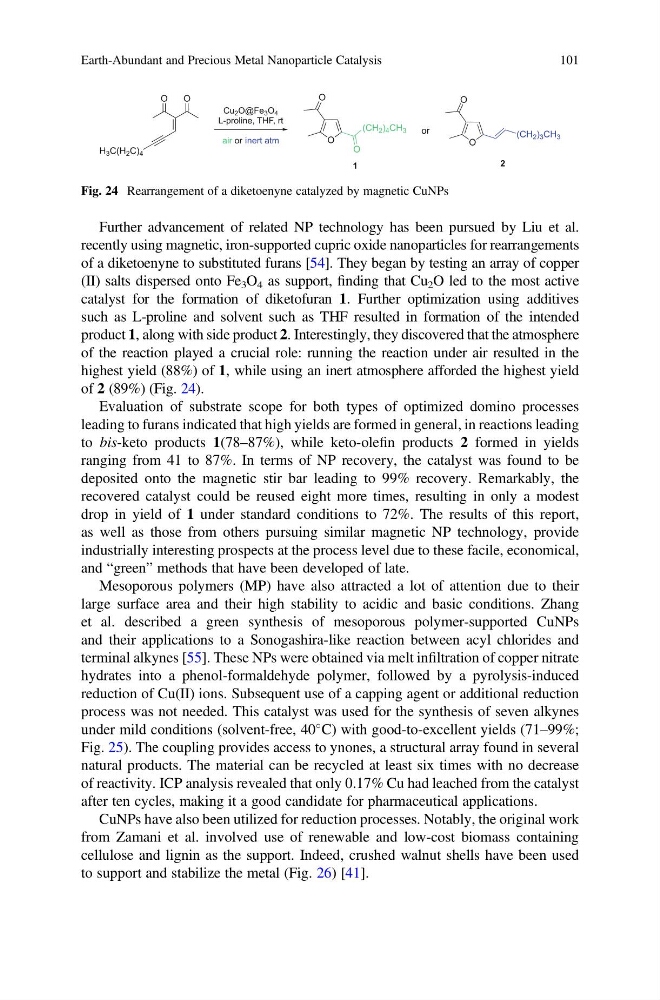
of a diketoenyne to substituted furans [54]. They began by testing an array of copper
(II) salts dispersed onto Fe 3 O 4 as support, finding that Cu 2 O led to the most active
catalyst for the formation of diketofuran 1. Further optimization using additives
such as L-proline and solvent such as THF resulted in formation of the intended
product 1, along with side product 2. Interestingly, they discovered that the atmosphere
of the reaction played a crucial role: running the reaction under air resulted in the
highest yield (88%) of 1, while using an inert atmosphere afforded the highest yield
of 2 (89%) (Fig. 24).
Evaluation of substrate scope for both types of optimized domino processes
leading to furans indicated that high yields are formed in general, in reactions leading
to bis-keto products 1(78–87%), while keto-olefin products 2 formed in yields
ranging from 41 to 87%. In terms of NP recovery, the catalyst was found to be
deposited onto the magnetic stir bar leading to 99% recovery. Remarkably, the
recovered catalyst could be reused eight more times, resulting in only a modest
drop in yield of 1 under standard conditions to 72%. The results of this report,
as well as those from others pursuing similar magnetic NP technology, provide
industrially interesting prospects at the process level due to these facile, economical,
and “green” methods that have been developed of late.
Mesoporous polymers (MP) have also attracted a lot of attention due to their
large surface area and their high stability to acidic and basic conditions. Zhang
et al. described a green synthesis of mesoporous polymer-supported CuNPs
and their applications to a Sonogashira-like reaction between acyl chlorides and
terminal alkynes [55]. These NPs were obtained via melt infiltration of copper nitrate
hydrates into a phenol-formaldehyde polymer, followed by a pyrolysis-induced
reduction of Cu(II) ions. Subsequent use of a capping agent or additional reduction
process was not needed. This catalyst was used for the synthesis of seven alkynes
under mild conditions (solvent-free, 40
C) with good-to-excellent yields (71–99%;
Fig. 25). The coupling provides access to ynones, a structural array found in several
natural products. The material can be recycled at least six times with no decrease
of reactivity. ICP analysis revealed that only 0.17% Cu had leached from the catalyst
after ten cycles, making it a good candidate for pharmaceutical applications.
CuNPs have also been utilized for reduction processes. Notably, the original work
from Zamani et al. involved use of renewable and low-cost biomass containing
cellulose and lignin as the support. Indeed, crushed walnut shells have been used
to support and stabilize the metal (Fig. 26) [41].
Fig. 24 Rearrangement of a diketoenyne catalyzed by magnetic CuNPs
Earth-Abundant and Precious Metal Nanoparticle Catalysis
101
recently using magnetic, iron-supported cupric oxide nanoparticles for rearrangements
of a diketoenyne to substituted furans [54]. They began by testing an array of copper
(II) salts dispersed onto Fe 3 O 4 as support, finding that Cu 2 O led to the most active
catalyst for the formation of diketofuran 1. Further optimization using additives
such as L-proline and solvent such as THF resulted in formation of the intended
product 1, along with side product 2. Interestingly, they discovered that the atmosphere
of the reaction played a crucial role: running the reaction under air resulted in the
highest yield (88%) of 1, while using an inert atmosphere afforded the highest yield
of 2 (89%) (Fig. 24).
Evaluation of substrate scope for both types of optimized domino processes
leading to furans indicated that high yields are formed in general, in reactions leading
to bis-keto products 1(78–87%), while keto-olefin products 2 formed in yields
ranging from 41 to 87%. In terms of NP recovery, the catalyst was found to be
deposited onto the magnetic stir bar leading to 99% recovery. Remarkably, the
recovered catalyst could be reused eight more times, resulting in only a modest
drop in yield of 1 under standard conditions to 72%. The results of this report,
as well as those from others pursuing similar magnetic NP technology, provide
industrially interesting prospects at the process level due to these facile, economical,
and “green” methods that have been developed of late.
Mesoporous polymers (MP) have also attracted a lot of attention due to their
large surface area and their high stability to acidic and basic conditions. Zhang
et al. described a green synthesis of mesoporous polymer-supported CuNPs
and their applications to a Sonogashira-like reaction between acyl chlorides and
terminal alkynes [55]. These NPs were obtained via melt infiltration of copper nitrate
hydrates into a phenol-formaldehyde polymer, followed by a pyrolysis-induced
reduction of Cu(II) ions. Subsequent use of a capping agent or additional reduction
process was not needed. This catalyst was used for the synthesis of seven alkynes
under mild conditions (solvent-free, 40
C) with good-to-excellent yields (71–99%;
Fig. 25). The coupling provides access to ynones, a structural array found in several
natural products. The material can be recycled at least six times with no decrease
of reactivity. ICP analysis revealed that only 0.17% Cu had leached from the catalyst
after ten cycles, making it a good candidate for pharmaceutical applications.
CuNPs have also been utilized for reduction processes. Notably, the original work
from Zamani et al. involved use of renewable and low-cost biomass containing
cellulose and lignin as the support. Indeed, crushed walnut shells have been used
to support and stabilize the metal (Fig. 26) [41].
Fig. 24 Rearrangement of a diketoenyne catalyzed by magnetic CuNPs
Earth-Abundant and Precious Metal Nanoparticle Catalysis
101