

and backfilled with argon three times. Dry THF (0.7 mL) and CuOAc in
THF (0.061 mL, 1,000 ppm; 1 g/L) were added to the vial, and the mixture was
stirred for 10 min at rt., after which MeMgCl in THF (0.75 mL, 7.5 mol%; 0.5 M)
was added to the reaction mixture. While maintaining an inert atmosphere,
THF was evaporated under reduced pressure. An aqueous solution of 2 wt%
TPGS-750-M (1.0 mL) was then added to the vial followed by sequential addition
of alkyne (0.5 mmol), azide (0.6 mmol, 1.2 equiv), and triethylamine (0.0349 mL,
0.25 mmol, 0.5 equiv). The mixture was stirred vigorously at rt. After complete
consumption of starting material, as monitored by TLC or GC-MS, EtOAc (1 mL)
was added to the reaction mixture, which was then stirred gently for 5 min
(NOTE: vigorous stirring or shaking in the reaction flask or in a separatory
funnel during the extraction process resulted in the formation of an intractable
emulsion with consequent reductions in isolated yields). Stirring was stopped,
and the organic layer was separated with the aid of a centrifuge. The organic
layer was removed, and the extraction process was repeated two additional times.
The combined organic layers were dried over anhydrous magnesium or sodium
sulfate or flushed through a plug of dried silica gel. The solvent was then evacuated
under reduced pressure to obtain crude material which was purified by flash
chromatography over silica gel using EtOAc/hexanes as eluent.
Among the virtues associated with supported NPs is their assumed re-isolation
and reuse once a reaction is complete, indicative of a greener and potentially
sustainable process. However, their small size may, upon filtration, block the filter
pores or may not be retained at all. Magnetic separation of an active core catalyst
dispersed onto a ferromagnetic surface may solve this problem. In this scenario,
the nanoparticle catalyst would be simply retained on a magnet, while the bulk
product mixture is separated from the system.
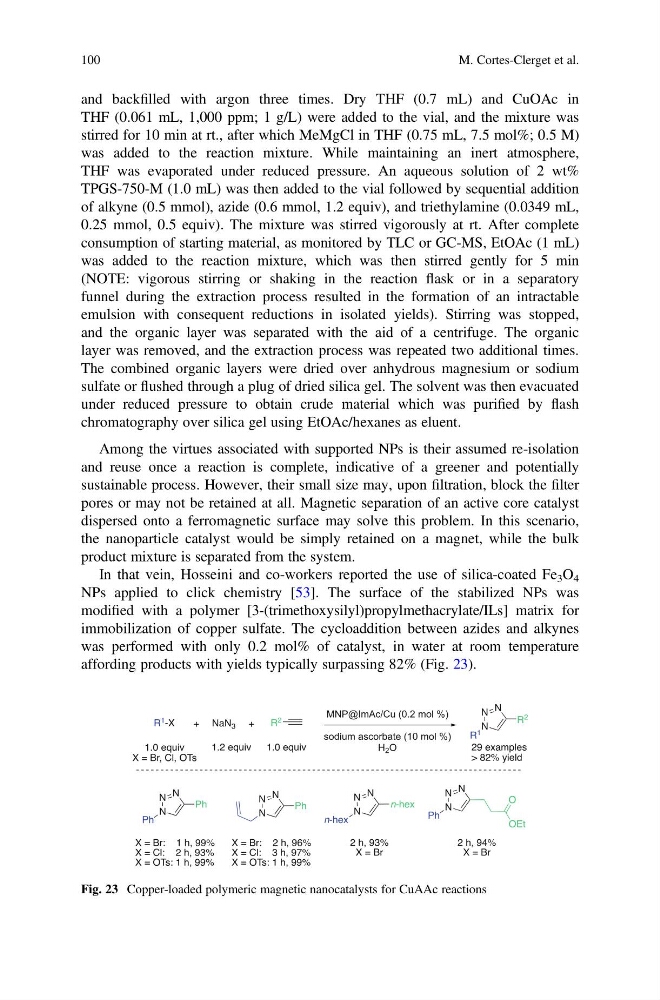
In that vein, Hosseini and co-workers reported the use of silica-coated Fe 3 O 4
NPs applied to click chemistry [53]. The surface of the stabilized NPs was
modified with a polymer [3-(trimethoxysilyl)propylmethacrylate/ILs] matrix for
immobilization of copper sulfate. The cycloaddition between azides and alkynes
was performed with only 0.2 mol% of catalyst, in water at room temperature
affording products with yields typically surpassing 82% (Fig. 23).
Fig. 23 Copper-loaded polymeric magnetic nanocatalysts for CuAAc reactions
100
M. Cortes-Clerget et al.
THF (0.061 mL, 1,000 ppm; 1 g/L) were added to the vial, and the mixture was
stirred for 10 min at rt., after which MeMgCl in THF (0.75 mL, 7.5 mol%; 0.5 M)
was added to the reaction mixture. While maintaining an inert atmosphere,
THF was evaporated under reduced pressure. An aqueous solution of 2 wt%
TPGS-750-M (1.0 mL) was then added to the vial followed by sequential addition
of alkyne (0.5 mmol), azide (0.6 mmol, 1.2 equiv), and triethylamine (0.0349 mL,
0.25 mmol, 0.5 equiv). The mixture was stirred vigorously at rt. After complete
consumption of starting material, as monitored by TLC or GC-MS, EtOAc (1 mL)
was added to the reaction mixture, which was then stirred gently for 5 min
(NOTE: vigorous stirring or shaking in the reaction flask or in a separatory
funnel during the extraction process resulted in the formation of an intractable
emulsion with consequent reductions in isolated yields). Stirring was stopped,
and the organic layer was separated with the aid of a centrifuge. The organic
layer was removed, and the extraction process was repeated two additional times.
The combined organic layers were dried over anhydrous magnesium or sodium
sulfate or flushed through a plug of dried silica gel. The solvent was then evacuated
under reduced pressure to obtain crude material which was purified by flash
chromatography over silica gel using EtOAc/hexanes as eluent.
Among the virtues associated with supported NPs is their assumed re-isolation
and reuse once a reaction is complete, indicative of a greener and potentially
sustainable process. However, their small size may, upon filtration, block the filter
pores or may not be retained at all. Magnetic separation of an active core catalyst
dispersed onto a ferromagnetic surface may solve this problem. In this scenario,
the nanoparticle catalyst would be simply retained on a magnet, while the bulk
product mixture is separated from the system.
In that vein, Hosseini and co-workers reported the use of silica-coated Fe 3 O 4
NPs applied to click chemistry [53]. The surface of the stabilized NPs was
modified with a polymer [3-(trimethoxysilyl)propylmethacrylate/ILs] matrix for
immobilization of copper sulfate. The cycloaddition between azides and alkynes
was performed with only 0.2 mol% of catalyst, in water at room temperature
affording products with yields typically surpassing 82% (Fig. 23).
Fig. 23 Copper-loaded polymeric magnetic nanocatalysts for CuAAc reactions
100
M. Cortes-Clerget et al.