

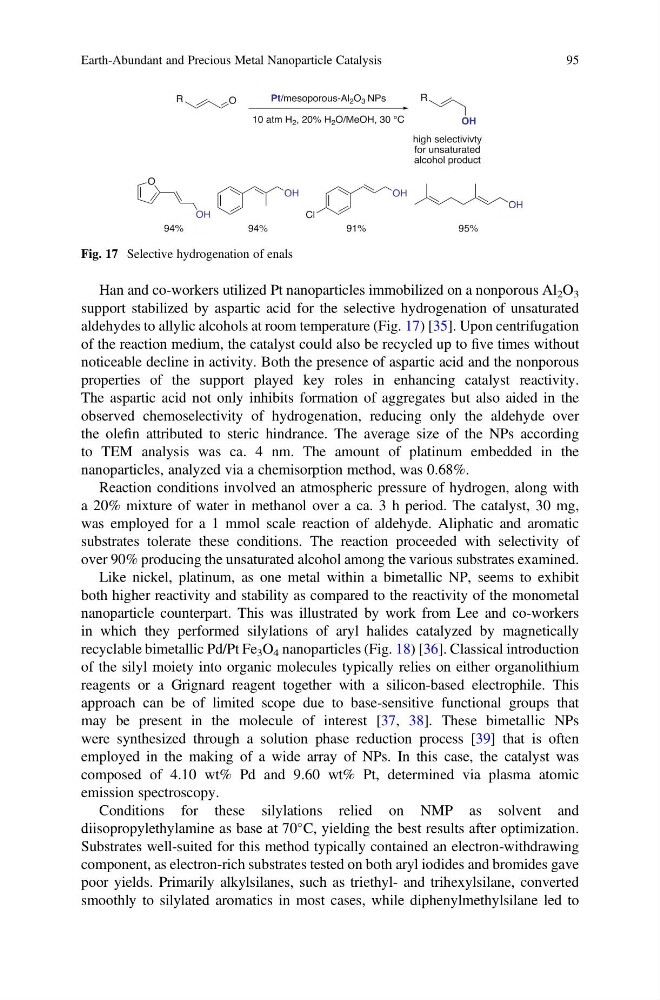
Han and co-workers utilized Pt nanoparticles immobilized on a nonporous Al 2 O 3
support stabilized by aspartic acid for the selective hydrogenation of unsaturated
aldehydes to allylic alcohols at room temperature (Fig. 17) [35]. Upon centrifugation
of the reaction medium, the catalyst could also be recycled up to five times without
noticeable decline in activity. Both the presence of aspartic acid and the nonporous
properties of the support played key roles in enhancing catalyst reactivity.
The aspartic acid not only inhibits formation of aggregates but also aided in the
observed chemoselectivity of hydrogenation, reducing only the aldehyde over
the olefin attributed to steric hindrance. The average size of the NPs according
to TEM analysis was ca. 4 nm. The amount of platinum embedded in the
nanoparticles, analyzed via a chemisorption method, was 0.68%.
Reaction conditions involved an atmospheric pressure of hydrogen, along with
a 20% mixture of water in methanol over a ca. 3 h period. The catalyst, 30 mg,
was employed for a 1 mmol scale reaction of aldehyde. Aliphatic and aromatic
substrates tolerate these conditions. The reaction proceeded with selectivity of
over 90% producing the unsaturated alcohol among the various substrates examined.
Like nickel, platinum, as one metal within a bimetallic NP, seems to exhibit
both higher reactivity and stability as compared to the reactivity of the monometal
nanoparticle counterpart. This was illustrated by work from Lee and co-workers
in which they performed silylations of aryl halides catalyzed by magnetically
recyclable bimetallic Pd/Pt Fe 3 O 4 nanoparticles (Fig. 18) [36]. Classical introduction
of the silyl moiety into organic molecules typically relies on either organolithium
reagents or a Grignard reagent together with a silicon-based electrophile. This
approach can be of limited scope due to base-sensitive functional groups that
may be present in the molecule of interest [37, 38]. These bimetallic NPs
were synthesized through a solution phase reduction process [39] that is often
employed in the making of a wide array of NPs. In this case, the catalyst was
composed of 4.10 wt% Pd and 9.60 wt% Pt, determined via plasma atomic
emission spectroscopy.
Conditions for these silylations relied on NMP as solvent and
diisopropylethylamine as base at 70
C, yielding the best results after optimization.
Substrates well-suited for this method typically contained an electron-withdrawing
component, as electron-rich substrates tested on both aryl iodides and bromides gave
poor yields. Primarily alkylsilanes, such as triethyl- and trihexylsilane, converted
smoothly to silylated aromatics in most cases, while diphenylmethylsilane led to
Fig. 17 Selective hydrogenation of enals
Earth-Abundant and Precious Metal Nanoparticle Catalysis
95
support stabilized by aspartic acid for the selective hydrogenation of unsaturated
aldehydes to allylic alcohols at room temperature (Fig. 17) [35]. Upon centrifugation
of the reaction medium, the catalyst could also be recycled up to five times without
noticeable decline in activity. Both the presence of aspartic acid and the nonporous
properties of the support played key roles in enhancing catalyst reactivity.
The aspartic acid not only inhibits formation of aggregates but also aided in the
observed chemoselectivity of hydrogenation, reducing only the aldehyde over
the olefin attributed to steric hindrance. The average size of the NPs according
to TEM analysis was ca. 4 nm. The amount of platinum embedded in the
nanoparticles, analyzed via a chemisorption method, was 0.68%.
Reaction conditions involved an atmospheric pressure of hydrogen, along with
a 20% mixture of water in methanol over a ca. 3 h period. The catalyst, 30 mg,
was employed for a 1 mmol scale reaction of aldehyde. Aliphatic and aromatic
substrates tolerate these conditions. The reaction proceeded with selectivity of
over 90% producing the unsaturated alcohol among the various substrates examined.
Like nickel, platinum, as one metal within a bimetallic NP, seems to exhibit
both higher reactivity and stability as compared to the reactivity of the monometal
nanoparticle counterpart. This was illustrated by work from Lee and co-workers
in which they performed silylations of aryl halides catalyzed by magnetically
recyclable bimetallic Pd/Pt Fe 3 O 4 nanoparticles (Fig. 18) [36]. Classical introduction
of the silyl moiety into organic molecules typically relies on either organolithium
reagents or a Grignard reagent together with a silicon-based electrophile. This
approach can be of limited scope due to base-sensitive functional groups that
may be present in the molecule of interest [37, 38]. These bimetallic NPs
were synthesized through a solution phase reduction process [39] that is often
employed in the making of a wide array of NPs. In this case, the catalyst was
composed of 4.10 wt% Pd and 9.60 wt% Pt, determined via plasma atomic
emission spectroscopy.
Conditions for these silylations relied on NMP as solvent and
diisopropylethylamine as base at 70
C, yielding the best results after optimization.
Substrates well-suited for this method typically contained an electron-withdrawing
component, as electron-rich substrates tested on both aryl iodides and bromides gave
poor yields. Primarily alkylsilanes, such as triethyl- and trihexylsilane, converted
smoothly to silylated aromatics in most cases, while diphenylmethylsilane led to
Fig. 17 Selective hydrogenation of enals
Earth-Abundant and Precious Metal Nanoparticle Catalysis
95