

each type of nanoparticle, where the nanomicelles delivered relatively high local
concentrations of educt to the metal NP catalyst. Counterintuitively, arylboronic
esters (Bpin) were more reactive, only requiring 22
C vs 45
C for the corresponding
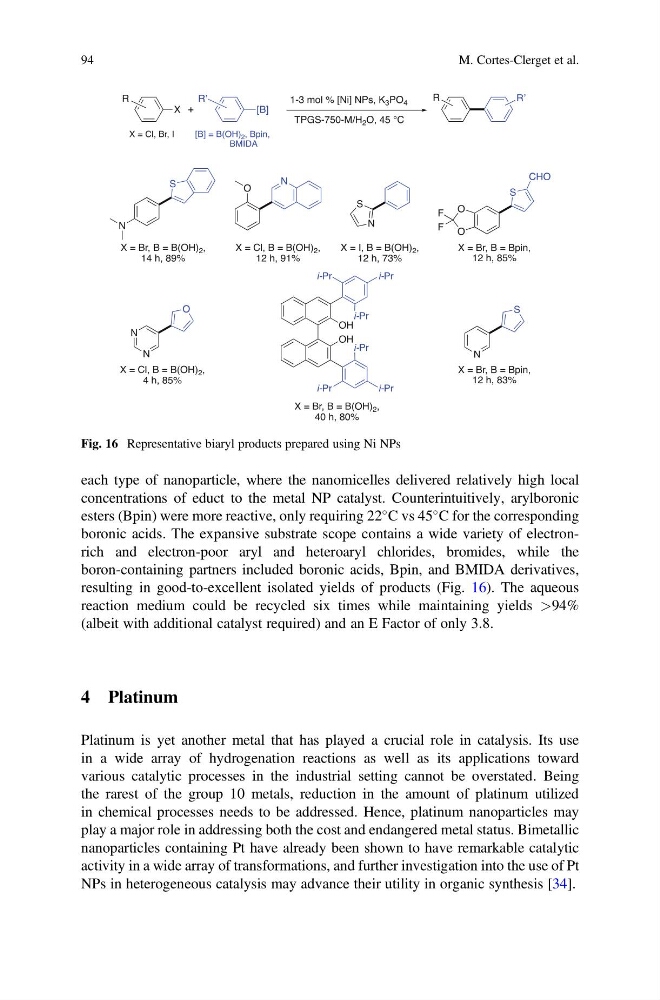
boronic acids. The expansive substrate scope contains a wide variety of electronrich and electron-poor aryl and heteroaryl chlorides, bromides, while the
boron-containing partners included boronic acids, Bpin, and BMIDA derivatives,
resulting in good-to-excellent isolated yields of products (Fig. 16). The aqueous
reaction medium could be recycled six times while maintaining yields >94%
(albeit with additional catalyst required) and an E Factor of only 3.8.
4 Platinum
Platinum is yet another metal that has played a crucial role in catalysis. Its use
in a wide array of hydrogenation reactions as well as its applications toward
various catalytic processes in the industrial setting cannot be overstated. Being
the rarest of the group 10 metals, reduction in the amount of platinum utilized
in chemical processes needs to be addressed. Hence, platinum nanoparticles may
play a major role in addressing both the cost and endangered metal status. Bimetallic
nanoparticles containing Pt have already been shown to have remarkable catalytic
activity in a wide array of transformations, and further investigation into the use of Pt
NPs in heterogeneous catalysis may advance their utility in organic synthesis [34].
Fig. 16 Representative biaryl products prepared using Ni NPs
94
M. Cortes-Clerget et al.
concentrations of educt to the metal NP catalyst. Counterintuitively, arylboronic
esters (Bpin) were more reactive, only requiring 22
C vs 45
C for the corresponding
boronic acids. The expansive substrate scope contains a wide variety of electronrich and electron-poor aryl and heteroaryl chlorides, bromides, while the
boron-containing partners included boronic acids, Bpin, and BMIDA derivatives,
resulting in good-to-excellent isolated yields of products (Fig. 16). The aqueous
reaction medium could be recycled six times while maintaining yields >94%
(albeit with additional catalyst required) and an E Factor of only 3.8.
4 Platinum
Platinum is yet another metal that has played a crucial role in catalysis. Its use
in a wide array of hydrogenation reactions as well as its applications toward
various catalytic processes in the industrial setting cannot be overstated. Being
the rarest of the group 10 metals, reduction in the amount of platinum utilized
in chemical processes needs to be addressed. Hence, platinum nanoparticles may
play a major role in addressing both the cost and endangered metal status. Bimetallic
nanoparticles containing Pt have already been shown to have remarkable catalytic
activity in a wide array of transformations, and further investigation into the use of Pt
NPs in heterogeneous catalysis may advance their utility in organic synthesis [34].
Fig. 16 Representative biaryl products prepared using Ni NPs
94
M. Cortes-Clerget et al.