

Silica coating over these MNPs was achieved via a sol-gel approach. A dispersed
solution of 5.0 g of activated MNPs with 0.1 M HCl (2.2 mL) in 200 mL of ethanol
and 50 mL of water was obtained via sonication. Then, 5 mL of 25% NH 4 OH
solution was added to the suspension at rt., followed by the addition of 1 mL
of TEOS, and the solution was kept under constant stirring at 60
C for 6 h.
The obtained SMNPs were magnetically separated, washed with ethanol, and
dried under vacuum. The obtained SMNPs were further functionalized using
APTES to afford ASMNPs. This was done by adding APTES to a dispersed
solution of 0.1 g of SMNP in 100 mL of ethanol under sonication, and the resulting
mixture was stirred at 50
C for 6 h. For covalent grafting of the ligand on SMNPs,
1 g of ASMNP was refluxed with TC in dried methanol along with molecular
sieves at 70
C for 3 h. The obtained product was washed with methanol and
dried under vacuum. Finally, 1 g of grafted TC@ASMNPs was stirred with a
solution of 4 mmol of NiCl 2 Á6H 2 O in methanol for 3 h. The resulting
Ni-TC@ASMNPs were separated magnetically and thoroughly washed with
deionized water and dried under vacuum.
Representative Procedure for Cross-Couplings Catalyst Ni-TC@ASMNP
(15 mg) was placed into an oven-dried round-bottom flask, and PPh 3 (20 mol%),
aryl halide (0.5 mmol), and phenylboronic acid (0.6 mmol) were added. After
this, K 3 PO 4 (0.75 mmol) was added, followed by the addition of 1 mL of dioxane.
The reaction mixture was kept under a N 2 atmosphere and was stirred at 100
C until
completion of the reaction. The catalyst was recovered using a permanent magnet.
The reaction was monitored by TLC, and the products were extracted using EtOAc,
dried over sodium sulfate, concentrated under reduced pressure, and analyzed by
GC-MS.
In 2015, Lipshutz et al. introduced a new nickel nanoparticle catalyst for
mild and efficient Suzuki-Miyaura couplings in micellar media. This catalyst
was formed by the addition of one equivalent of MeMgBr to NiCl 2 ligated by
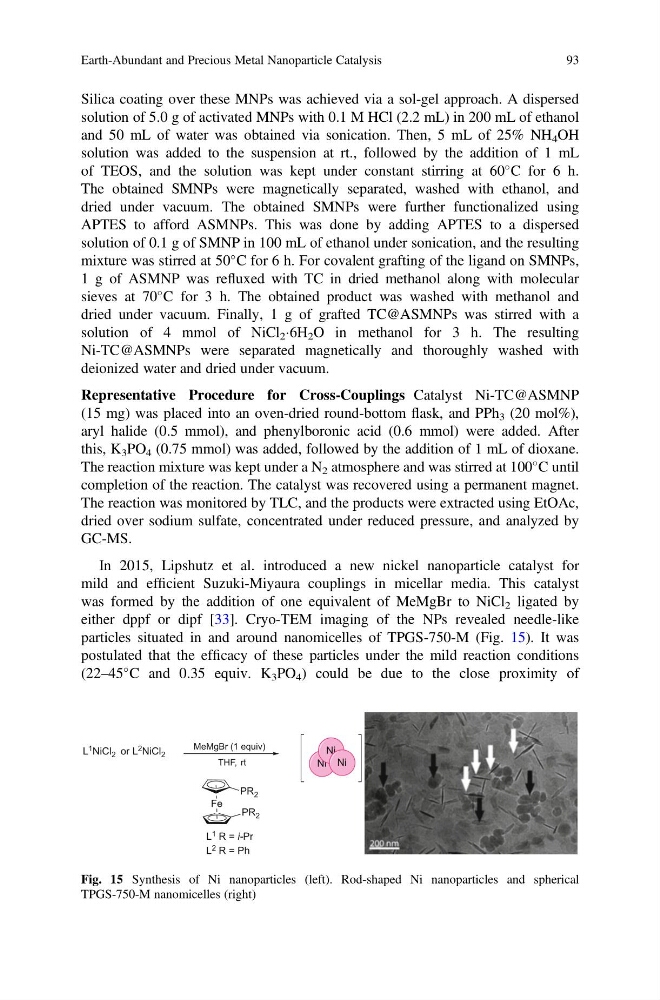
either dppf or dipf [33]. Cryo-TEM imaging of the NPs revealed needle-like
particles situated in and around nanomicelles of TPGS-750-M (Fig. 15). It was
postulated that the efficacy of these particles under the mild reaction conditions
(22–45
C and 0.35 equiv. K 3 PO 4 ) could be due to the close proximity of
L 1 NiCl 2 or L 2 NiCl 2
MeMgBr (1 equiv)
THF, rt
Ni
Ni
Ni
Fe
PR 2
PR 2
L 1 R = i-Pr
L 2 R = Ph
Fig. 15 Synthesis of Ni nanoparticles (left). Rod-shaped Ni nanoparticles and spherical
TPGS-750-M nanomicelles (right)
Earth-Abundant and Precious Metal Nanoparticle Catalysis
93
solution of 5.0 g of activated MNPs with 0.1 M HCl (2.2 mL) in 200 mL of ethanol
and 50 mL of water was obtained via sonication. Then, 5 mL of 25% NH 4 OH
solution was added to the suspension at rt., followed by the addition of 1 mL
of TEOS, and the solution was kept under constant stirring at 60
C for 6 h.
The obtained SMNPs were magnetically separated, washed with ethanol, and
dried under vacuum. The obtained SMNPs were further functionalized using
APTES to afford ASMNPs. This was done by adding APTES to a dispersed
solution of 0.1 g of SMNP in 100 mL of ethanol under sonication, and the resulting
mixture was stirred at 50
C for 6 h. For covalent grafting of the ligand on SMNPs,
1 g of ASMNP was refluxed with TC in dried methanol along with molecular
sieves at 70
C for 3 h. The obtained product was washed with methanol and
dried under vacuum. Finally, 1 g of grafted TC@ASMNPs was stirred with a
solution of 4 mmol of NiCl 2 Á6H 2 O in methanol for 3 h. The resulting
Ni-TC@ASMNPs were separated magnetically and thoroughly washed with
deionized water and dried under vacuum.
Representative Procedure for Cross-Couplings Catalyst Ni-TC@ASMNP
(15 mg) was placed into an oven-dried round-bottom flask, and PPh 3 (20 mol%),
aryl halide (0.5 mmol), and phenylboronic acid (0.6 mmol) were added. After
this, K 3 PO 4 (0.75 mmol) was added, followed by the addition of 1 mL of dioxane.
The reaction mixture was kept under a N 2 atmosphere and was stirred at 100
C until
completion of the reaction. The catalyst was recovered using a permanent magnet.
The reaction was monitored by TLC, and the products were extracted using EtOAc,
dried over sodium sulfate, concentrated under reduced pressure, and analyzed by
GC-MS.
In 2015, Lipshutz et al. introduced a new nickel nanoparticle catalyst for
mild and efficient Suzuki-Miyaura couplings in micellar media. This catalyst
was formed by the addition of one equivalent of MeMgBr to NiCl 2 ligated by
either dppf or dipf [33]. Cryo-TEM imaging of the NPs revealed needle-like
particles situated in and around nanomicelles of TPGS-750-M (Fig. 15). It was
postulated that the efficacy of these particles under the mild reaction conditions
(22–45
C and 0.35 equiv. K 3 PO 4 ) could be due to the close proximity of
L 1 NiCl 2 or L 2 NiCl 2
MeMgBr (1 equiv)
THF, rt
Ni
Ni
Ni
Fe
PR 2
PR 2
L 1 R = i-Pr
L 2 R = Ph
Fig. 15 Synthesis of Ni nanoparticles (left). Rod-shaped Ni nanoparticles and spherical
TPGS-750-M nanomicelles (right)
Earth-Abundant and Precious Metal Nanoparticle Catalysis
93