

somewhat lower yields. With the use of a magnet, the nanoparticles could be
recovered and recycled up to 20 times. It was estimated that an average of only
0.03% Pd and 0.08% Pt was lost with each recycle. Control studies with the
Pd-Fe 3 O 4 and Pt-Fe 3 O 4 NPs showed a dramatic decrease in the rates of these
reactions, as well as the amount of metal lost after each recycle (0.26% Pd and
0.55% Pt liberated), indicating the increased stability and reactivity of this bimetallic
system.
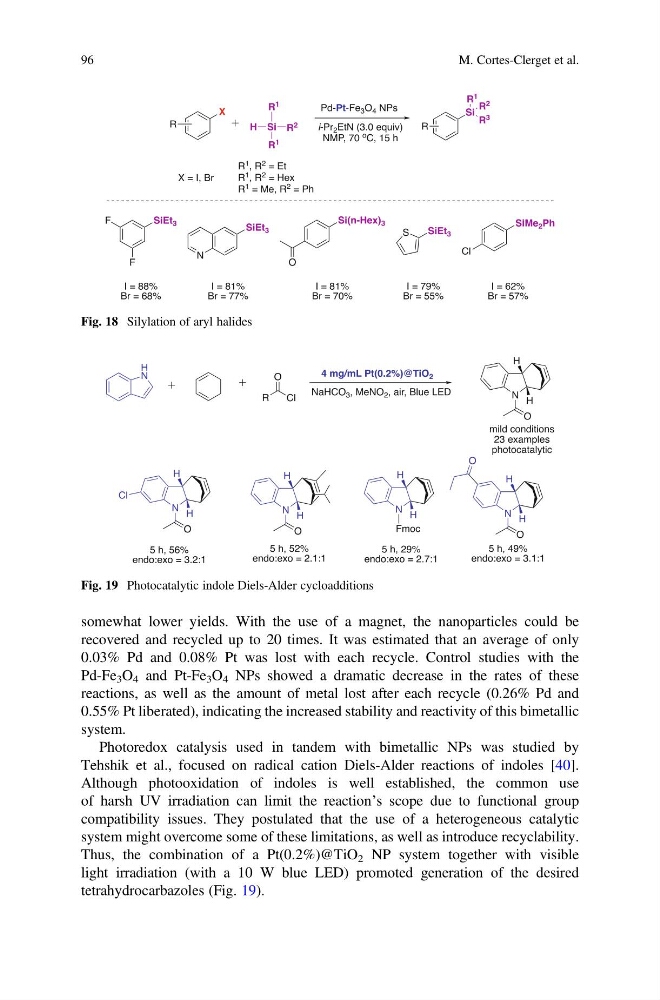
Photoredox catalysis used in tandem with bimetallic NPs was studied by
Tehshik et al., focused on radical cation Diels-Alder reactions of indoles [40].
Although photooxidation of indoles is well established, the common use
of harsh UV irradiation can limit the reaction’s scope due to functional group
compatibility issues. They postulated that the use of a heterogeneous catalytic
system might overcome some of these limitations, as well as introduce recyclability.
Thus, the combination of a Pt(0.2%)@TiO 2 NP system together with visible
light irradiation (with a 10 W blue LED) promoted generation of the desired
tetrahydrocarbazoles (Fig. 19).
Fig. 19 Photocatalytic indole Diels-Alder cycloadditions
Fig. 18 Silylation of aryl halides
96
M. Cortes-Clerget et al.
recovered and recycled up to 20 times. It was estimated that an average of only
0.03% Pd and 0.08% Pt was lost with each recycle. Control studies with the
Pd-Fe 3 O 4 and Pt-Fe 3 O 4 NPs showed a dramatic decrease in the rates of these
reactions, as well as the amount of metal lost after each recycle (0.26% Pd and
0.55% Pt liberated), indicating the increased stability and reactivity of this bimetallic
system.
Photoredox catalysis used in tandem with bimetallic NPs was studied by
Tehshik et al., focused on radical cation Diels-Alder reactions of indoles [40].
Although photooxidation of indoles is well established, the common use
of harsh UV irradiation can limit the reaction’s scope due to functional group
compatibility issues. They postulated that the use of a heterogeneous catalytic
system might overcome some of these limitations, as well as introduce recyclability.
Thus, the combination of a Pt(0.2%)@TiO 2 NP system together with visible
light irradiation (with a 10 W blue LED) promoted generation of the desired
tetrahydrocarbazoles (Fig. 19).
Fig. 19 Photocatalytic indole Diels-Alder cycloadditions
Fig. 18 Silylation of aryl halides
96
M. Cortes-Clerget et al.