

26
3 Conclusion and Perspectives
3.3 -Amination
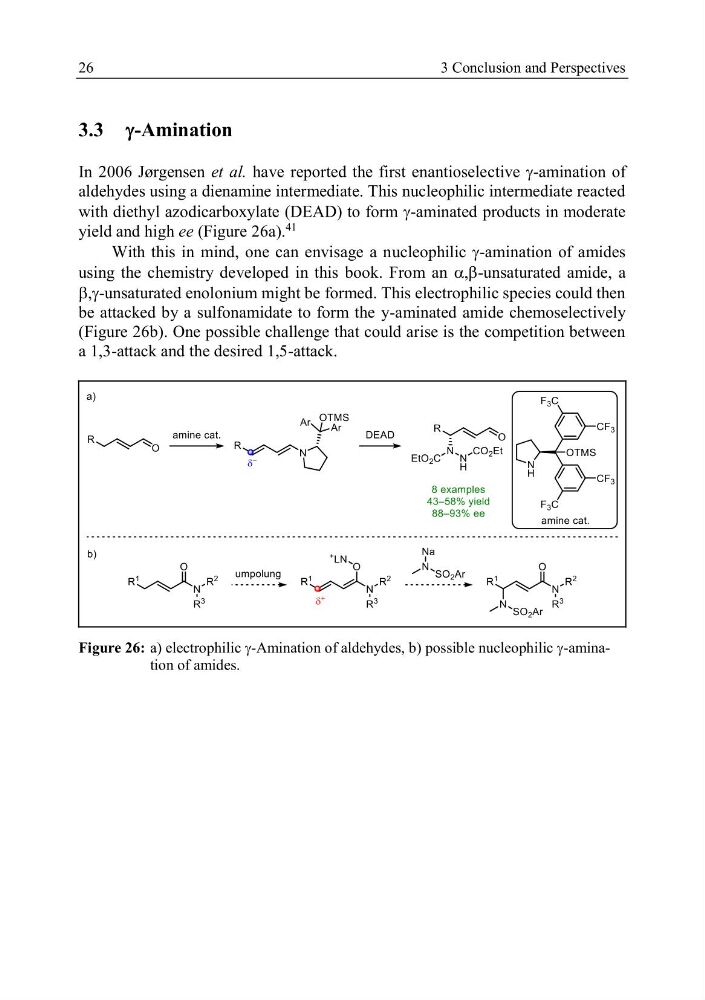
In 2006 Jørgensen et al. have reported the first enantioselective -amination of
aldehydes using a dienamine intermediate. This nucleophilic intermediate reacted
with diethyl azodicarboxylate (DEAD) to form -aminated products in moderate
yield and high ee (Figure 26a).
41
With this in mind, one can envisage a nucleophilic -amination of amides
using the chemistry developed in this book. From an ,-unsaturated amide, a
,-unsaturated enolonium might be formed. This electrophilic species could then
be attacked by a sulfonamidate to form the y-aminated amide chemoselectively
(Figure 26b). One possible challenge that could arise is the competition between
a 1,3-attack and the desired 1,5-attack.
Figure 26: a) electrophilic -Amination of aldehydes, b) possible nucleophilic -amination of amides.
3 Conclusion and Perspectives
3.3 -Amination
In 2006 Jørgensen et al. have reported the first enantioselective -amination of
aldehydes using a dienamine intermediate. This nucleophilic intermediate reacted
with diethyl azodicarboxylate (DEAD) to form -aminated products in moderate
yield and high ee (Figure 26a).
41
With this in mind, one can envisage a nucleophilic -amination of amides
using the chemistry developed in this book. From an ,-unsaturated amide, a
,-unsaturated enolonium might be formed. This electrophilic species could then
be attacked by a sulfonamidate to form the y-aminated amide chemoselectively
(Figure 26b). One possible challenge that could arise is the competition between
a 1,3-attack and the desired 1,5-attack.
Figure 26: a) electrophilic -Amination of aldehydes, b) possible nucleophilic -amination of amides.