

3 Conclusion and Perspectives
3.1 Conclusion
In this study, a novel concept for the -functionalisation of amides was further
developed. The Umpolung of amides enables a nucleophilic -amination with several sulfonamide derivatives. This method reliably affords good yields and shows
a high functional group tolerance. Additionally, -oxygenation was achieved using similar conditions.
The products were further derivatised through an atom-economical Smiles
rearrangement to yield densely functionalised amino acid derivatives.
3.2 Enantioselective -Amination
The amide Umpolung method developed over the last two years is now a wellestablished concept. One challenge that still needs to be addressed is enantioselectivity. All of the enolonium-mediated transformations described in this work yield
racemic mixtures of products. It has been previously shown that a chiral
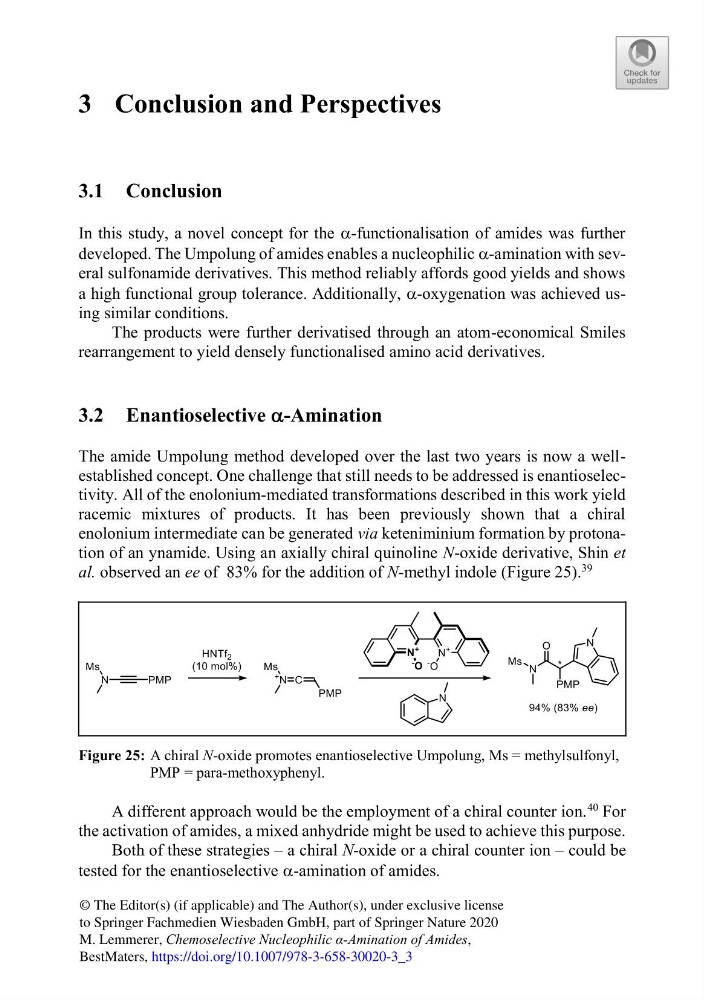
enolonium intermediate can be generated via keteniminium formation by protonation of an ynamide. Using an axially chiral quinoline N-oxide derivative, Shin et
al. observed an ee of 83% for the addition of N-methyl indole (Figure 25).
39
Figure 25: A chiral N-oxide promotes enantioselective Umpolung, Ms = methylsulfonyl,
PMP = para-methoxyphenyl.
A different approach would be the employment of a chiral counter ion.
40
For
the activation of amides, a mixed anhydride might be used to achieve this purpose.
Both of these strategies – a chiral N-oxide or a chiral counter ion – could be
tested for the enantioselective -amination of amides.
© The Editor(s) (if applicable) and The Author(s), under exclusive license
to Springer Fachmedien Wiesbaden GmbH, part of Springer Nature 2020
M. Lemmerer, Chemoselective Nucleophilic α-Amination of Amides,
BestMaters, https://doi.org/10.1007/978-3-658-30020-3_3
3.1 Conclusion
In this study, a novel concept for the -functionalisation of amides was further
developed. The Umpolung of amides enables a nucleophilic -amination with several sulfonamide derivatives. This method reliably affords good yields and shows
a high functional group tolerance. Additionally, -oxygenation was achieved using similar conditions.
The products were further derivatised through an atom-economical Smiles
rearrangement to yield densely functionalised amino acid derivatives.
3.2 Enantioselective -Amination
The amide Umpolung method developed over the last two years is now a wellestablished concept. One challenge that still needs to be addressed is enantioselectivity. All of the enolonium-mediated transformations described in this work yield
racemic mixtures of products. It has been previously shown that a chiral
enolonium intermediate can be generated via keteniminium formation by protonation of an ynamide. Using an axially chiral quinoline N-oxide derivative, Shin et
al. observed an ee of 83% for the addition of N-methyl indole (Figure 25).
39
Figure 25: A chiral N-oxide promotes enantioselective Umpolung, Ms = methylsulfonyl,
PMP = para-methoxyphenyl.
A different approach would be the employment of a chiral counter ion.
40
For
the activation of amides, a mixed anhydride might be used to achieve this purpose.
Both of these strategies – a chiral N-oxide or a chiral counter ion – could be
tested for the enantioselective -amination of amides.
© The Editor(s) (if applicable) and The Author(s), under exclusive license
to Springer Fachmedien Wiesbaden GmbH, part of Springer Nature 2020
M. Lemmerer, Chemoselective Nucleophilic α-Amination of Amides,
BestMaters, https://doi.org/10.1007/978-3-658-30020-3_3