

2.2 Arylation via a Smiles rearrangement
21
entry
solvent
base
base
eq.
additive
T
(°C)
NMR
Yield
12
H2O
Pr4NOH
2
-
r.t.
0
13
dioxane/DMF
(1/1)
Pr4NOH
2
-
r.t.
44
14
MeCN/DMF (1/1) Pr4NOH
2
-
r.t.
34
15
DCM/MeCN (1/1) Pr4NOH
2
-
r.t.
34
16
H2O/MeCN (1/9) Pr4NOH
2
-
r.t.
0
17
H2O/MeCN (1/9)
DBU
2
-
r.t.
0
18
MeCN (0.5 M)
Pr4NOH
2
-
r.t.
50
19
MeCN (0.01 M)
Pr4NOH
2
-
r.t.
20
20
MeCN
Pr4NOH
2
-
r.t.
(1 h)
35
21
MeCN
Pr4NOH
2
-
0
53
22
MeCN
Me4NOH
5
-
r.t.
22
23
MeCN
Bu4NOH
5
-
r.t.
42
24
MeCN
Bu4NOH
2
-
r.t.
45
25
MeCN
NaNH2
5
-
r.t.
8
26
MeCN
NEt3
2
-
r.t.
0
27
MeCN
LHMDS
2
-
r.t.
0
28
MeCN
KHMDS
2
-
r.t.
0
29
MeCN
Proton-sponge
2
-
r.t.
0
30
MeCN
TBAF
2
-
r.t.
0
31
MeCN
KOH
2
TBAB
r.t.
7
32
MeCN
KOH (50% aq.)
20
TBAB
r.t.
29
33
MeCN
KOH (50% aq.)
20
TEBnAC
r.t.
44
34
MeCN
K2CO3
2
TBAB
r.t.
0
35
MeCN
K2CO3
5
18-crown-6
r.t.
0
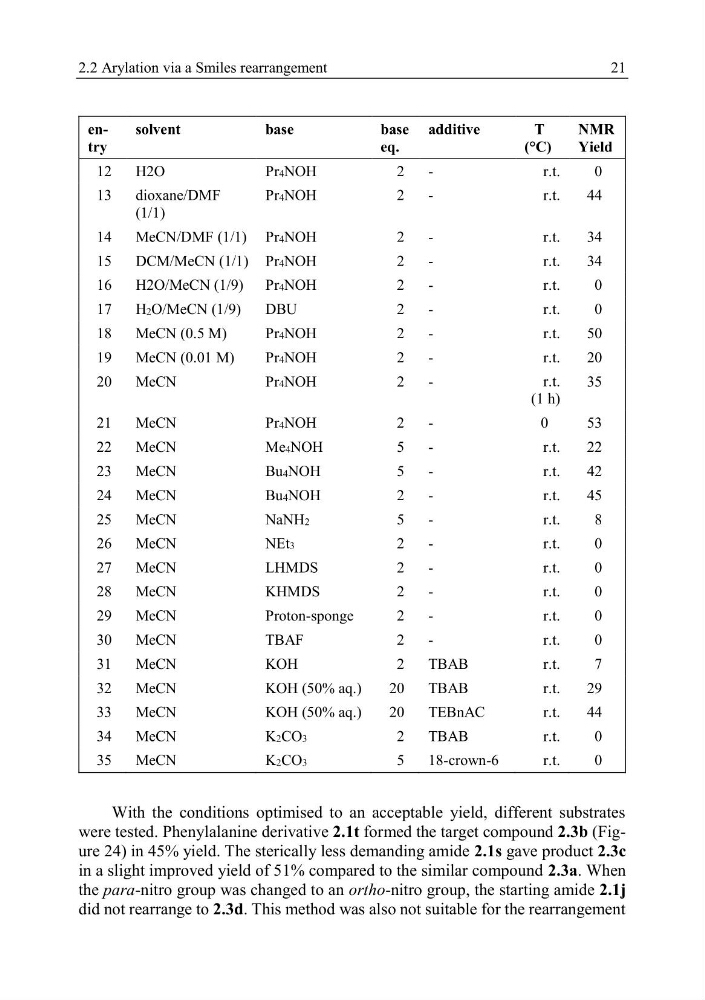
With the conditions optimised to an acceptable yield, different substrates
were tested. Phenylalanine derivative 2.1t formed the target compound 2.3b (Figure 24) in 45% yield. The sterically less demanding amide 2.1s gave product 2.3c
in a slight improved yield of 51% compared to the similar compound 2.3a. When
the para-nitro group was changed to an ortho-nitro group, the starting amide 2.1j
did not rearrange to 2.3d. This method was also not suitable for the rearrangement
21
entry
solvent
base
base
eq.
additive
T
(°C)
NMR
Yield
12
H2O
Pr4NOH
2
-
r.t.
0
13
dioxane/DMF
(1/1)
Pr4NOH
2
-
r.t.
44
14
MeCN/DMF (1/1) Pr4NOH
2
-
r.t.
34
15
DCM/MeCN (1/1) Pr4NOH
2
-
r.t.
34
16
H2O/MeCN (1/9) Pr4NOH
2
-
r.t.
0
17
H2O/MeCN (1/9)
DBU
2
-
r.t.
0
18
MeCN (0.5 M)
Pr4NOH
2
-
r.t.
50
19
MeCN (0.01 M)
Pr4NOH
2
-
r.t.
20
20
MeCN
Pr4NOH
2
-
r.t.
(1 h)
35
21
MeCN
Pr4NOH
2
-
0
53
22
MeCN
Me4NOH
5
-
r.t.
22
23
MeCN
Bu4NOH
5
-
r.t.
42
24
MeCN
Bu4NOH
2
-
r.t.
45
25
MeCN
NaNH2
5
-
r.t.
8
26
MeCN
NEt3
2
-
r.t.
0
27
MeCN
LHMDS
2
-
r.t.
0
28
MeCN
KHMDS
2
-
r.t.
0
29
MeCN
Proton-sponge
2
-
r.t.
0
30
MeCN
TBAF
2
-
r.t.
0
31
MeCN
KOH
2
TBAB
r.t.
7
32
MeCN
KOH (50% aq.)
20
TBAB
r.t.
29
33
MeCN
KOH (50% aq.)
20
TEBnAC
r.t.
44
34
MeCN
K2CO3
2
TBAB
r.t.
0
35
MeCN
K2CO3
5
18-crown-6
r.t.
0
With the conditions optimised to an acceptable yield, different substrates
were tested. Phenylalanine derivative 2.1t formed the target compound 2.3b (Figure 24) in 45% yield. The sterically less demanding amide 2.1s gave product 2.3c
in a slight improved yield of 51% compared to the similar compound 2.3a. When
the para-nitro group was changed to an ortho-nitro group, the starting amide 2.1j
did not rearrange to 2.3d. This method was also not suitable for the rearrangement