

20
2 Results and Discussion
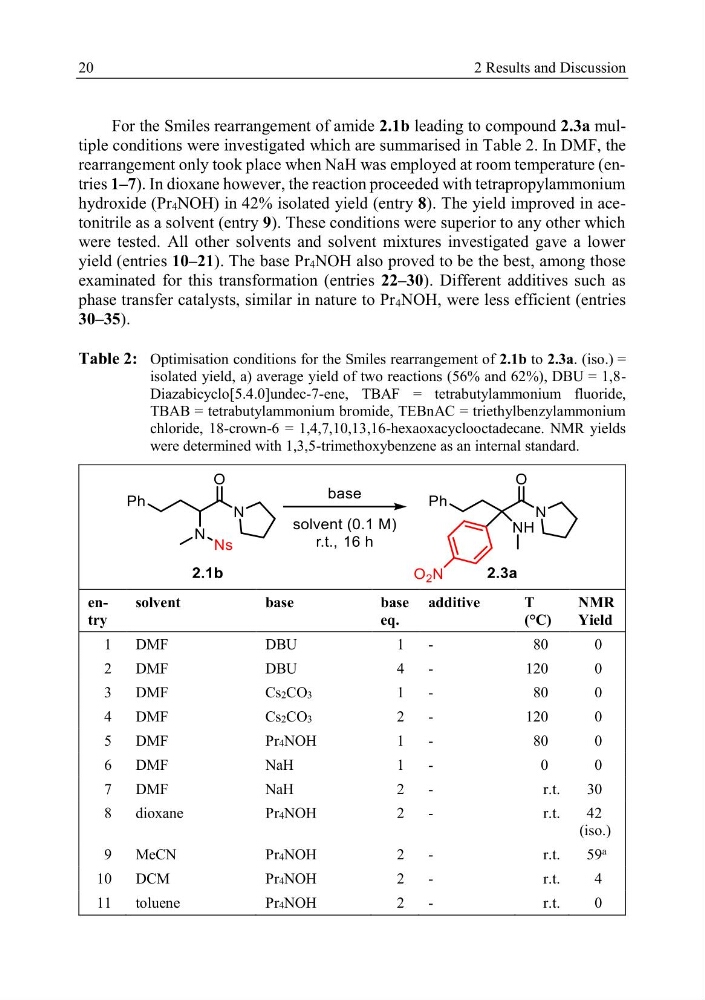
For the Smiles rearrangement of amide 2.1b leading to compound 2.3a multiple conditions were investigated which are summarised in Table 2. In DMF, the
rearrangement only took place when NaH was employed at room temperature (entries 1–7). In dioxane however, the reaction proceeded with tetrapropylammonium
hydroxide (Pr4NOH) in 42% isolated yield (entry 8). The yield improved in acetonitrile as a solvent (entry 9). These conditions were superior to any other which
were tested. All other solvents and solvent mixtures investigated gave a lower
yield (entries 10–21). The base Pr4NOH also proved to be the best, among those
examinated for this transformation (entries 22–30). Different additives such as
phase transfer catalysts, similar in nature to Pr4NOH, were less efficient (entries
30–35).
Table 2: Optimisation conditions for the Smiles rearrangement of 2.1b to 2.3a. (iso.) =
isolated yield, a) average yield of two reactions (56% and 62%), DBU = 1,8Diazabicyclo[5.4.0]undec-7-ene, TBAF = tetrabutylammonium fluoride,
TBAB = tetrabutylammonium bromide, TEBnAC = triethylbenzylammonium
chloride, 18-crown-6 = 1,4,7,10,13,16-hexaoxacyclooctadecane. NMR yields
were determined with 1,3,5-trimethoxybenzene as an internal standard.
entry
solvent
base
base
eq.
additive
T
(°C)
NMR
Yield
1
DMF
DBU
1
-
80
0
2
DMF
DBU
4
-
120
0
3
DMF
Cs2CO3
1
-
80
0
4
DMF
Cs2CO3
2
-
120
0
5
DMF
Pr4NOH
1
-
80
0
6
DMF
NaH
1
-
0
0
7
DMF
NaH
2
-
r.t.
30
8
dioxane
Pr4NOH
2
-
r.t.
42
(iso.)
9
MeCN
Pr4NOH
2
-
r.t.
59
a
10
DCM
Pr4NOH
2
-
r.t.
4
11
toluene
Pr4NOH
2
-
r.t.
0
2 Results and Discussion
For the Smiles rearrangement of amide 2.1b leading to compound 2.3a multiple conditions were investigated which are summarised in Table 2. In DMF, the
rearrangement only took place when NaH was employed at room temperature (entries 1–7). In dioxane however, the reaction proceeded with tetrapropylammonium
hydroxide (Pr4NOH) in 42% isolated yield (entry 8). The yield improved in acetonitrile as a solvent (entry 9). These conditions were superior to any other which
were tested. All other solvents and solvent mixtures investigated gave a lower
yield (entries 10–21). The base Pr4NOH also proved to be the best, among those
examinated for this transformation (entries 22–30). Different additives such as
phase transfer catalysts, similar in nature to Pr4NOH, were less efficient (entries
30–35).
Table 2: Optimisation conditions for the Smiles rearrangement of 2.1b to 2.3a. (iso.) =
isolated yield, a) average yield of two reactions (56% and 62%), DBU = 1,8Diazabicyclo[5.4.0]undec-7-ene, TBAF = tetrabutylammonium fluoride,
TBAB = tetrabutylammonium bromide, TEBnAC = triethylbenzylammonium
chloride, 18-crown-6 = 1,4,7,10,13,16-hexaoxacyclooctadecane. NMR yields
were determined with 1,3,5-trimethoxybenzene as an internal standard.
entry
solvent
base
base
eq.
additive
T
(°C)
NMR
Yield
1
DMF
DBU
1
-
80
0
2
DMF
DBU
4
-
120
0
3
DMF
Cs2CO3
1
-
80
0
4
DMF
Cs2CO3
2
-
120
0
5
DMF
Pr4NOH
1
-
80
0
6
DMF
NaH
1
-
0
0
7
DMF
NaH
2
-
r.t.
30
8
dioxane
Pr4NOH
2
-
r.t.
42
(iso.)
9
MeCN
Pr4NOH
2
-
r.t.
59
a
10
DCM
Pr4NOH
2
-
r.t.
4
11
toluene
Pr4NOH
2
-
r.t.
0