

2.1 Nucleophilic α-Functionalisation of Amides
17
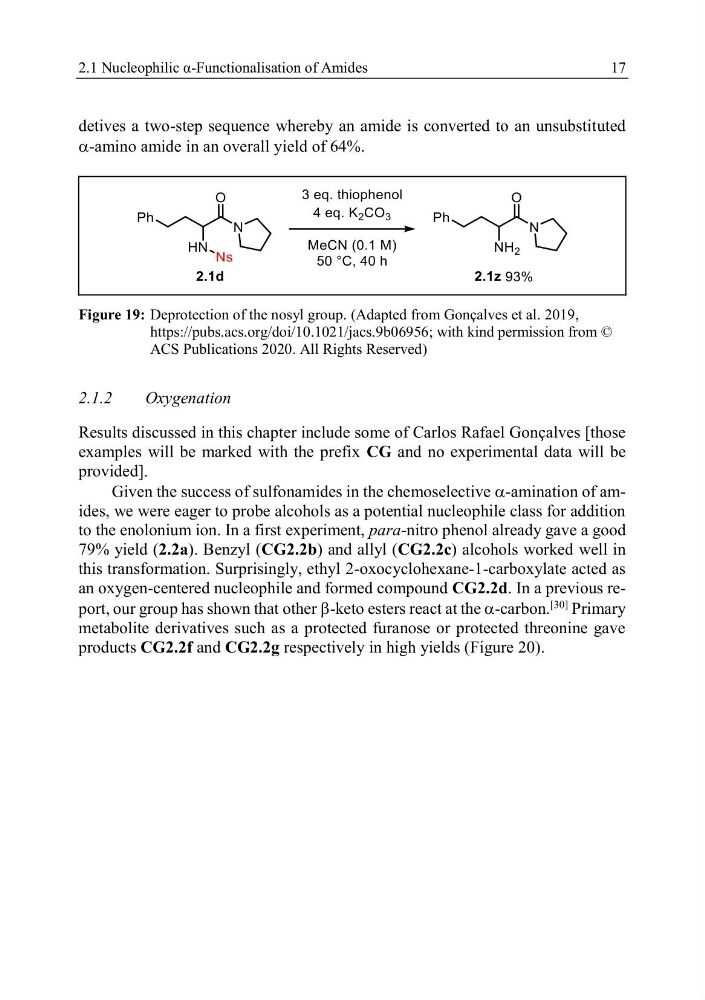
detives a two-step sequence whereby an amide is converted to an unsubstituted
-amino amide in an overall yield of 64%.
Figure 19: Deprotection of the nosyl group. (Adapted from Gonçalves et al. 2019,
https://pubs.acs.org/doi/10.1021/jacs.9b06956; with kind permission from ©
ACS Publications 2020. All Rights Reserved)
2.1.2
Oxygenation
Results discussed in this chapter include some of Carlos Rafael Gonçalves [those
examples will be marked with the prefix CG and no experimental data will be
provided].
Given the success of sulfonamides in the chemoselective -amination of amides, we were eager to probe alcohols as a potential nucleophile class for addition
to the enolonium ion. In a first experiment, para-nitro phenol already gave a good
79% yield (2.2a). Benzyl (CG2.2b) and allyl (CG2.2c) alcohols worked well in
this transformation. Surprisingly, ethyl 2-oxocyclohexane-1-carboxylate acted as
an oxygen-centered nucleophile and formed compound CG2.2d. In a previous report, our group has shown that other -keto esters react at the -carbon.
[30]
Primary
metabolite derivatives such as a protected furanose or protected threonine gave
products CG2.2f and CG2.2g respectively in high yields (Figure 20).
17
detives a two-step sequence whereby an amide is converted to an unsubstituted
-amino amide in an overall yield of 64%.
Figure 19: Deprotection of the nosyl group. (Adapted from Gonçalves et al. 2019,
https://pubs.acs.org/doi/10.1021/jacs.9b06956; with kind permission from ©
ACS Publications 2020. All Rights Reserved)
2.1.2
Oxygenation
Results discussed in this chapter include some of Carlos Rafael Gonçalves [those
examples will be marked with the prefix CG and no experimental data will be
provided].
Given the success of sulfonamides in the chemoselective -amination of amides, we were eager to probe alcohols as a potential nucleophile class for addition
to the enolonium ion. In a first experiment, para-nitro phenol already gave a good
79% yield (2.2a). Benzyl (CG2.2b) and allyl (CG2.2c) alcohols worked well in
this transformation. Surprisingly, ethyl 2-oxocyclohexane-1-carboxylate acted as
an oxygen-centered nucleophile and formed compound CG2.2d. In a previous report, our group has shown that other -keto esters react at the -carbon.
[30]
Primary
metabolite derivatives such as a protected furanose or protected threonine gave
products CG2.2f and CG2.2g respectively in high yields (Figure 20).