

3.5 Other Small-Pore Zeolites and Zeotypes
Zukal et al. have investigated the effects of pore size on the CO 2 adsorption
properties of the family of zeolites IM-12 (UTL), IPC-2, IPC-4 (PCR), IPC-6
(*PCS), and IPC-7 at 273–333 K and 0–1.0 bar [49]. This series of isoreticular
zeolites, which were prepared from the extra-large-pore germanosilicate material
IM-12 using the assembly-disassembly-organization-reassembly strategy (Fig. 7),
possess the same structure of individual layers but gradually reduced average
channel size: 9.5 Â 7.1 (14-ring; IM-12 and IPC-7), 8.5 Â 5.5 (12-ring; IM-12
and IPC-7), 6.6 Â 6.2 (12-ring; IPC-7, IPC-2, and IPC-6), 5.4 Â 5.3 (10-ring; IPC-7,
IPC-2, and IPC-6), 5.8 Â 3.8 (10 ring; IPC-6 and IPC-4), and 4.5 Â 3.6 (8-ring;
IPC-6 and IPC-4) Å [50]. As expected from their average channel size, Zukal et al.
found that the CO 2 capacity at low pressures increases in the order IM-12 < IPC7 < IPC-2 < IPC-6 < IPC-4), although a different capacity order was observed at
higher pressures (IPC-4 < IPC-2 < IPC-6 ~ IM-12 < IPC-7). This is interesting in
that the isosteric heat of adsorption increases with decreasing average channel size:
IM-12 (23 kJ mol
À1 ) < IPC-7 (25 kJ mol
À1 ) < IPC-2 (27 kJ mol
À1 ) ~ IPC-6
(27 kJ mol
À1 ) < IPC-4 (29 kJ mol
À1 ). Given that the zeolites under study are puresilica in framework composition, except IM-12, it is most likely that CO 2 adsorption
is mainly influenced by dispersion interactions [51].
SAPO-34 with CHA topology is the most widely studied silicoaluminophosphate
(SAPO) molecular sieve in gas adsorption known to date. Bellatreche et al. examined the CO 2 adsorption properties of various alkali metal ion-exchanged forms of
SAPO-34 at 273 K and 1.0 bar and reported that the adsorption capacity increases in
the order K-SAPO-34 ~ Cs-SAPO-34 < Li-SAPO-34 ~ Na-SAPO-34, suggesting a
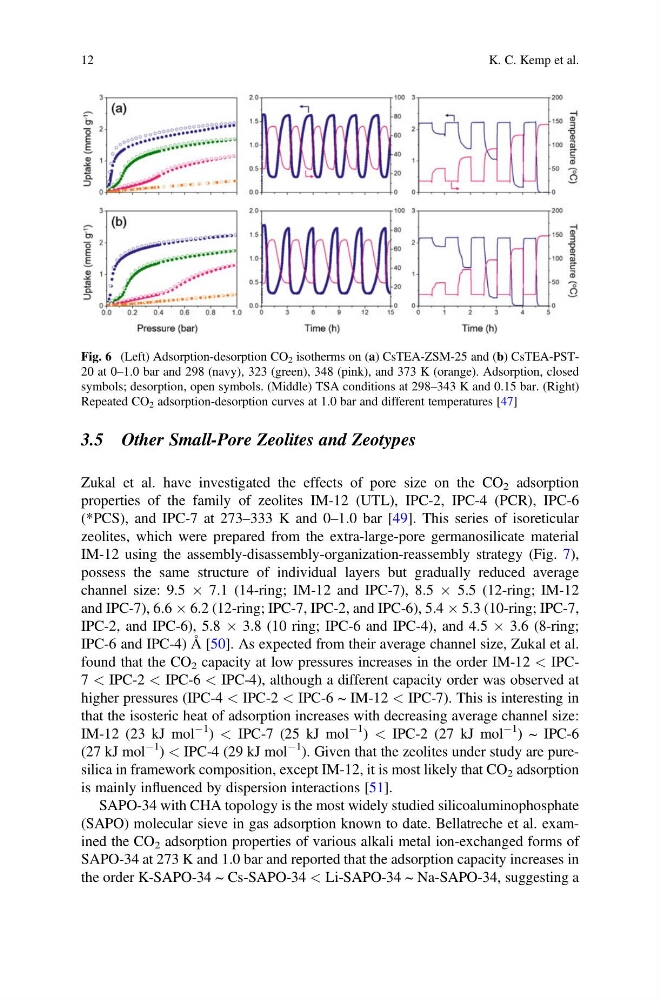
Fig. 6 (Left) Adsorption-desorption CO 2 isotherms on (a) CsTEA-ZSM-25 and (b) CsTEA-PST20 at 0–1.0 bar and 298 (navy), 323 (green), 348 (pink), and 373 K (orange). Adsorption, closed
symbols; desorption, open symbols. (Middle) TSA conditions at 298–343 K and 0.15 bar. (Right)
Repeated CO 2 adsorption-desorption curves at 1.0 bar and different temperatures [47]
12
K. C. Kemp et al.
Zukal et al. have investigated the effects of pore size on the CO 2 adsorption
properties of the family of zeolites IM-12 (UTL), IPC-2, IPC-4 (PCR), IPC-6
(*PCS), and IPC-7 at 273–333 K and 0–1.0 bar [49]. This series of isoreticular
zeolites, which were prepared from the extra-large-pore germanosilicate material
IM-12 using the assembly-disassembly-organization-reassembly strategy (Fig. 7),
possess the same structure of individual layers but gradually reduced average
channel size: 9.5 Â 7.1 (14-ring; IM-12 and IPC-7), 8.5 Â 5.5 (12-ring; IM-12
and IPC-7), 6.6 Â 6.2 (12-ring; IPC-7, IPC-2, and IPC-6), 5.4 Â 5.3 (10-ring; IPC-7,
IPC-2, and IPC-6), 5.8 Â 3.8 (10 ring; IPC-6 and IPC-4), and 4.5 Â 3.6 (8-ring;
IPC-6 and IPC-4) Å [50]. As expected from their average channel size, Zukal et al.
found that the CO 2 capacity at low pressures increases in the order IM-12 < IPC7 < IPC-2 < IPC-6 < IPC-4), although a different capacity order was observed at
higher pressures (IPC-4 < IPC-2 < IPC-6 ~ IM-12 < IPC-7). This is interesting in
that the isosteric heat of adsorption increases with decreasing average channel size:
IM-12 (23 kJ mol
À1 ) < IPC-7 (25 kJ mol
À1 ) < IPC-2 (27 kJ mol
À1 ) ~ IPC-6
(27 kJ mol
À1 ) < IPC-4 (29 kJ mol
À1 ). Given that the zeolites under study are puresilica in framework composition, except IM-12, it is most likely that CO 2 adsorption
is mainly influenced by dispersion interactions [51].
SAPO-34 with CHA topology is the most widely studied silicoaluminophosphate
(SAPO) molecular sieve in gas adsorption known to date. Bellatreche et al. examined the CO 2 adsorption properties of various alkali metal ion-exchanged forms of
SAPO-34 at 273 K and 1.0 bar and reported that the adsorption capacity increases in
the order K-SAPO-34 ~ Cs-SAPO-34 < Li-SAPO-34 ~ Na-SAPO-34, suggesting a
Fig. 6 (Left) Adsorption-desorption CO 2 isotherms on (a) CsTEA-ZSM-25 and (b) CsTEA-PST20 at 0–1.0 bar and 298 (navy), 323 (green), 348 (pink), and 373 K (orange). Adsorption, closed
symbols; desorption, open symbols. (Middle) TSA conditions at 298–343 K and 0.15 bar. (Right)
Repeated CO 2 adsorption-desorption curves at 1.0 bar and different temperatures [47]
12
K. C. Kemp et al.