

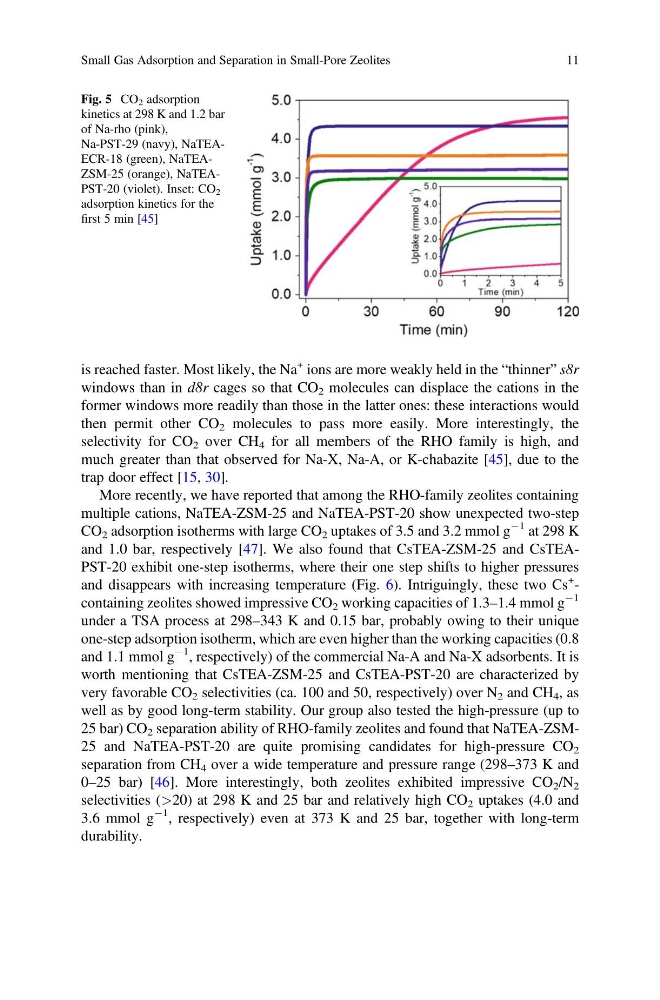
is reached faster. Most likely, the Na
+ ions are more weakly held in the “thinner” s8r
windows than in d8r cages so that CO 2 molecules can displace the cations in the
former windows more readily than those in the latter ones: these interactions would
then permit other CO 2 molecules to pass more easily. More interestingly, the
selectivity for CO 2 over CH 4 for all members of the RHO family is high, and
much greater than that observed for Na-X, Na-A, or K-chabazite [45], due to the
trap door effect [15, 30].
More recently, we have reported that among the RHO-family zeolites containing
multiple cations, NaTEA-ZSM-25 and NaTEA-PST-20 show unexpected two-step
CO 2 adsorption isotherms with large CO 2 uptakes of 3.5 and 3.2 mmol g
À1 at 298 K
and 1.0 bar, respectively [47]. We also found that CsTEA-ZSM-25 and CsTEAPST-20 exhibit one-step isotherms, where their one step shifts to higher pressures
and disappears with increasing temperature (Fig. 6). Intriguingly, these two Cs
+
-
containing zeolites showed impressive CO 2 working capacities of 1.3–1.4 mmol g
À1
under a TSA process at 298–343 K and 0.15 bar, probably owing to their unique
one-step adsorption isotherm, which are even higher than the working capacities (0.8
and 1.1 mmol g
À1 , respectively) of the commercial Na-A and Na-X adsorbents. It is
worth mentioning that CsTEA-ZSM-25 and CsTEA-PST-20 are characterized by
very favorable CO 2 selectivities (ca. 100 and 50, respectively) over N 2 and CH 4 , as
well as by good long-term stability. Our group also tested the high-pressure (up to
25 bar) CO 2 separation ability of RHO-family zeolites and found that NaTEA-ZSM25 and NaTEA-PST-20 are quite promising candidates for high-pressure CO 2
separation from CH 4 over a wide temperature and pressure range (298–373 K and
0–25 bar) [46]. More interestingly, both zeolites exhibited impressive CO 2 /N 2
selectivities (>20) at 298 K and 25 bar and relatively high CO 2 uptakes (4.0 and
3.6 mmol g
À1 , respectively) even at 373 K and 25 bar, together with long-term
durability.
Fig. 5 CO 2 adsorption
kinetics at 298 K and 1.2 bar
of Na-rho (pink),
Na-PST-29 (navy), NaTEAECR-18 (green), NaTEAZSM-25 (orange), NaTEAPST-20 (violet). Inset: CO 2
adsorption kinetics for the
first 5 min [45]
Small Gas Adsorption and Separation in Small-Pore Zeolites
11
+ ions are more weakly held in the “thinner” s8r
windows than in d8r cages so that CO 2 molecules can displace the cations in the
former windows more readily than those in the latter ones: these interactions would
then permit other CO 2 molecules to pass more easily. More interestingly, the
selectivity for CO 2 over CH 4 for all members of the RHO family is high, and
much greater than that observed for Na-X, Na-A, or K-chabazite [45], due to the
trap door effect [15, 30].
More recently, we have reported that among the RHO-family zeolites containing
multiple cations, NaTEA-ZSM-25 and NaTEA-PST-20 show unexpected two-step
CO 2 adsorption isotherms with large CO 2 uptakes of 3.5 and 3.2 mmol g
À1 at 298 K
and 1.0 bar, respectively [47]. We also found that CsTEA-ZSM-25 and CsTEAPST-20 exhibit one-step isotherms, where their one step shifts to higher pressures
and disappears with increasing temperature (Fig. 6). Intriguingly, these two Cs
+
-
containing zeolites showed impressive CO 2 working capacities of 1.3–1.4 mmol g
À1
under a TSA process at 298–343 K and 0.15 bar, probably owing to their unique
one-step adsorption isotherm, which are even higher than the working capacities (0.8
and 1.1 mmol g
À1 , respectively) of the commercial Na-A and Na-X adsorbents. It is
worth mentioning that CsTEA-ZSM-25 and CsTEA-PST-20 are characterized by
very favorable CO 2 selectivities (ca. 100 and 50, respectively) over N 2 and CH 4 , as
well as by good long-term stability. Our group also tested the high-pressure (up to
25 bar) CO 2 separation ability of RHO-family zeolites and found that NaTEA-ZSM25 and NaTEA-PST-20 are quite promising candidates for high-pressure CO 2
separation from CH 4 over a wide temperature and pressure range (298–373 K and
0–25 bar) [46]. More interestingly, both zeolites exhibited impressive CO 2 /N 2
selectivities (>20) at 298 K and 25 bar and relatively high CO 2 uptakes (4.0 and
3.6 mmol g
À1 , respectively) even at 373 K and 25 bar, together with long-term
durability.
Fig. 5 CO 2 adsorption
kinetics at 298 K and 1.2 bar
of Na-rho (pink),
Na-PST-29 (navy), NaTEAECR-18 (green), NaTEAZSM-25 (orange), NaTEAPST-20 (violet). Inset: CO 2
adsorption kinetics for the
first 5 min [45]
Small Gas Adsorption and Separation in Small-Pore Zeolites
11