

isotherms as input and is widely used to predict adsorption isotherms of gas mixture
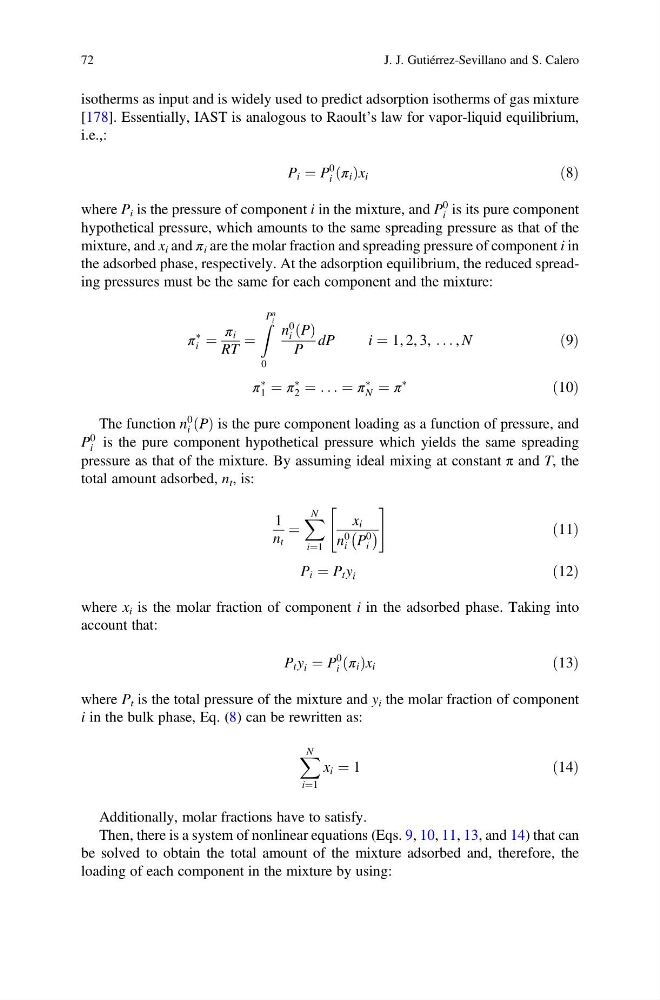
[178]. Essentially, IAST is analogous to Raoult’s law for vapor-liquid equilibrium,
i.e.,:
P i ¼ P
0
i π i
ð Þx i
ð8Þ
where P i is the pressure of component i in the mixture, and P
0
i is its pure component
hypothetical pressure, which amounts to the same spreading pressure as that of the
mixture, and x i and π i are the molar fraction and spreading pressure of component i in
the adsorbed phase, respectively. At the adsorption equilibrium, the reduced spreading pressures must be the same for each component and the mixture:
π
Ã
i ¼
π i
RT
¼
Z P
n
i
0
n
0
i P
ð Þ
P
dP
i ¼ 1, 2, 3, . . . , N
ð9Þ
π
Ã
1 ¼ π
Ã
2 ¼ . . . ¼ π
Ã
N ¼ π
Ã
ð10Þ
The function n
0
i P
ð Þ is the pure component loading as a function of pressure, and
P
0
i is the pure component hypothetical pressure which yields the same spreading
pressure as that of the mixture. By assuming ideal mixing at constant π and T, the
total amount adsorbed, n t , is:
1
n t
¼
X N
i¼1
x i
n
0
i P
0
i
À Á
"
#
ð11Þ
P i ¼ P t y i
ð12Þ
where x i is the molar fraction of component i in the adsorbed phase. Taking into
account that:
P t y i ¼ P
0
i π i
ð Þx i
ð13Þ
where P t is the total pressure of the mixture and y i the molar fraction of component
i in the bulk phase, Eq. (8) can be rewritten as:
X N
i¼1
x i ¼ 1
ð14Þ
Additionally, molar fractions have to satisfy.
Then, there is a system of nonlinear equations (Eqs. 9, 10, 11, 13, and 14) that can
be solved to obtain the total amount of the mixture adsorbed and, therefore, the
loading of each component in the mixture by using:
72
J. J. Gutiérrez-Sevillano and S. Calero
[178]. Essentially, IAST is analogous to Raoult’s law for vapor-liquid equilibrium,
i.e.,:
P i ¼ P
0
i π i
ð Þx i
ð8Þ
where P i is the pressure of component i in the mixture, and P
0
i is its pure component
hypothetical pressure, which amounts to the same spreading pressure as that of the
mixture, and x i and π i are the molar fraction and spreading pressure of component i in
the adsorbed phase, respectively. At the adsorption equilibrium, the reduced spreading pressures must be the same for each component and the mixture:
π
Ã
i ¼
π i
RT
¼
Z P
n
i
0
n
0
i P
ð Þ
P
dP
i ¼ 1, 2, 3, . . . , N
ð9Þ
π
Ã
1 ¼ π
Ã
2 ¼ . . . ¼ π
Ã
N ¼ π
Ã
ð10Þ
The function n
0
i P
ð Þ is the pure component loading as a function of pressure, and
P
0
i is the pure component hypothetical pressure which yields the same spreading
pressure as that of the mixture. By assuming ideal mixing at constant π and T, the
total amount adsorbed, n t , is:
1
n t
¼
X N
i¼1
x i
n
0
i P
0
i
À Á
"
#
ð11Þ
P i ¼ P t y i
ð12Þ
where x i is the molar fraction of component i in the adsorbed phase. Taking into
account that:
P t y i ¼ P
0
i π i
ð Þx i
ð13Þ
where P t is the total pressure of the mixture and y i the molar fraction of component
i in the bulk phase, Eq. (8) can be rewritten as:
X N
i¼1
x i ¼ 1
ð14Þ
Additionally, molar fractions have to satisfy.
Then, there is a system of nonlinear equations (Eqs. 9, 10, 11, 13, and 14) that can
be solved to obtain the total amount of the mixture adsorbed and, therefore, the
loading of each component in the mixture by using:
72
J. J. Gutiérrez-Sevillano and S. Calero