

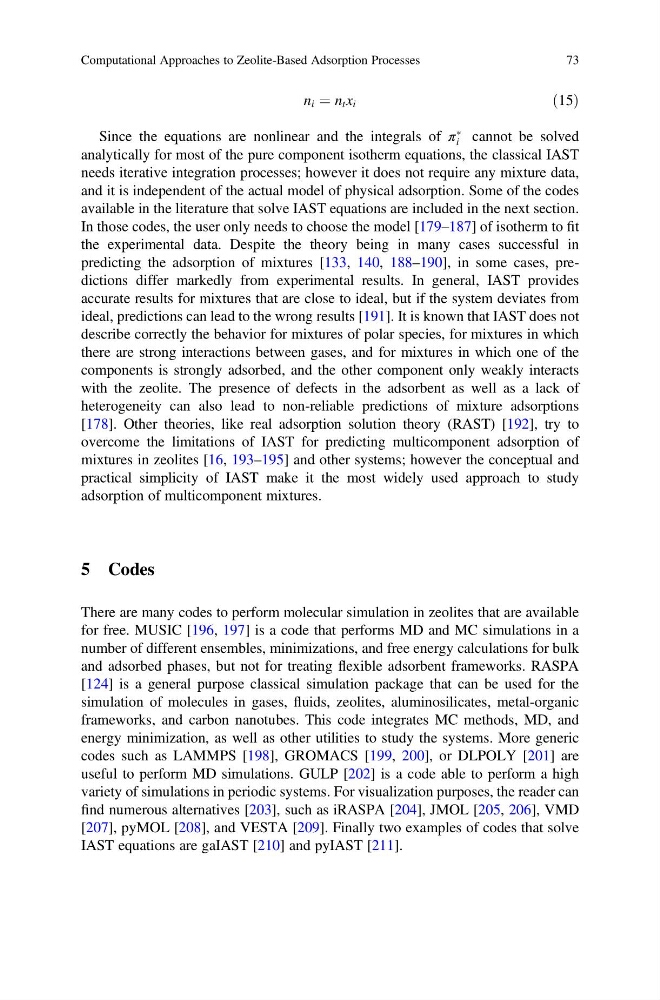
n i ¼ n t x i
ð15Þ
Since the equations are nonlinear and the integrals of π
Ã
i cannot be solved
analytically for most of the pure component isotherm equations, the classical IAST
needs iterative integration processes; however it does not require any mixture data,
and it is independent of the actual model of physical adsorption. Some of the codes
available in the literature that solve IAST equations are included in the next section.
In those codes, the user only needs to choose the model [179–187] of isotherm to fit
the experimental data. Despite the theory being in many cases successful in
predicting the adsorption of mixtures [133, 140, 188–190], in some cases, predictions differ markedly from experimental results. In general, IAST provides
accurate results for mixtures that are close to ideal, but if the system deviates from
ideal, predictions can lead to the wrong results [191]. It is known that IAST does not
describe correctly the behavior for mixtures of polar species, for mixtures in which
there are strong interactions between gases, and for mixtures in which one of the
components is strongly adsorbed, and the other component only weakly interacts
with the zeolite. The presence of defects in the adsorbent as well as a lack of
heterogeneity can also lead to non-reliable predictions of mixture adsorptions
[178]. Other theories, like real adsorption solution theory (RAST) [192], try to
overcome the limitations of IAST for predicting multicomponent adsorption of
mixtures in zeolites [16, 193–195] and other systems; however the conceptual and
practical simplicity of IAST make it the most widely used approach to study
adsorption of multicomponent mixtures.
5 Codes
There are many codes to perform molecular simulation in zeolites that are available
for free. MUSIC [196, 197] is a code that performs MD and MC simulations in a
number of different ensembles, minimizations, and free energy calculations for bulk
and adsorbed phases, but not for treating flexible adsorbent frameworks. RASPA
[124] is a general purpose classical simulation package that can be used for the
simulation of molecules in gases, fluids, zeolites, aluminosilicates, metal-organic
frameworks, and carbon nanotubes. This code integrates MC methods, MD, and
energy minimization, as well as other utilities to study the systems. More generic
codes such as LAMMPS [198], GROMACS [199, 200], or DLPOLY [201] are
useful to perform MD simulations. GULP [202] is a code able to perform a high
variety of simulations in periodic systems. For visualization purposes, the reader can
find numerous alternatives [203], such as iRASPA [204], JMOL [205, 206], VMD
[207], pyMOL [208], and VESTA [209]. Finally two examples of codes that solve
IAST equations are gaIAST [210] and pyIAST [211].
Computational Approaches to Zeolite-Based Adsorption Processes
73
ð15Þ
Since the equations are nonlinear and the integrals of π
Ã
i cannot be solved
analytically for most of the pure component isotherm equations, the classical IAST
needs iterative integration processes; however it does not require any mixture data,
and it is independent of the actual model of physical adsorption. Some of the codes
available in the literature that solve IAST equations are included in the next section.
In those codes, the user only needs to choose the model [179–187] of isotherm to fit
the experimental data. Despite the theory being in many cases successful in
predicting the adsorption of mixtures [133, 140, 188–190], in some cases, predictions differ markedly from experimental results. In general, IAST provides
accurate results for mixtures that are close to ideal, but if the system deviates from
ideal, predictions can lead to the wrong results [191]. It is known that IAST does not
describe correctly the behavior for mixtures of polar species, for mixtures in which
there are strong interactions between gases, and for mixtures in which one of the
components is strongly adsorbed, and the other component only weakly interacts
with the zeolite. The presence of defects in the adsorbent as well as a lack of
heterogeneity can also lead to non-reliable predictions of mixture adsorptions
[178]. Other theories, like real adsorption solution theory (RAST) [192], try to
overcome the limitations of IAST for predicting multicomponent adsorption of
mixtures in zeolites [16, 193–195] and other systems; however the conceptual and
practical simplicity of IAST make it the most widely used approach to study
adsorption of multicomponent mixtures.
5 Codes
There are many codes to perform molecular simulation in zeolites that are available
for free. MUSIC [196, 197] is a code that performs MD and MC simulations in a
number of different ensembles, minimizations, and free energy calculations for bulk
and adsorbed phases, but not for treating flexible adsorbent frameworks. RASPA
[124] is a general purpose classical simulation package that can be used for the
simulation of molecules in gases, fluids, zeolites, aluminosilicates, metal-organic
frameworks, and carbon nanotubes. This code integrates MC methods, MD, and
energy minimization, as well as other utilities to study the systems. More generic
codes such as LAMMPS [198], GROMACS [199, 200], or DLPOLY [201] are
useful to perform MD simulations. GULP [202] is a code able to perform a high
variety of simulations in periodic systems. For visualization purposes, the reader can
find numerous alternatives [203], such as iRASPA [204], JMOL [205, 206], VMD
[207], pyMOL [208], and VESTA [209]. Finally two examples of codes that solve
IAST equations are gaIAST [210] and pyIAST [211].
Computational Approaches to Zeolite-Based Adsorption Processes
73