

transition state theory (TST) methods like the Bennett-Chandler approach
[159, 160], the Ruiz-Montero method [161], path sampling [162], transition interface sampling [163, 164], hyperdynamics [165], parallel replica dynamics [166],
temperature-accelerated dynamics [167], and on-the-fly kinetic Monte Carlo
[168]. In principle, all of these methods can be used to study events on a time
scale which is several orders of magnitude lower than typical diffusion rates in
zeolites while still retaining full atomistic detail [169–173]. One example is the
diffusion of propane and propylene in the zeolite ITQ-12, but many others can be
found in the literature [172, 174–176]. In the case of the ITQ-12 zeolite, the narrow
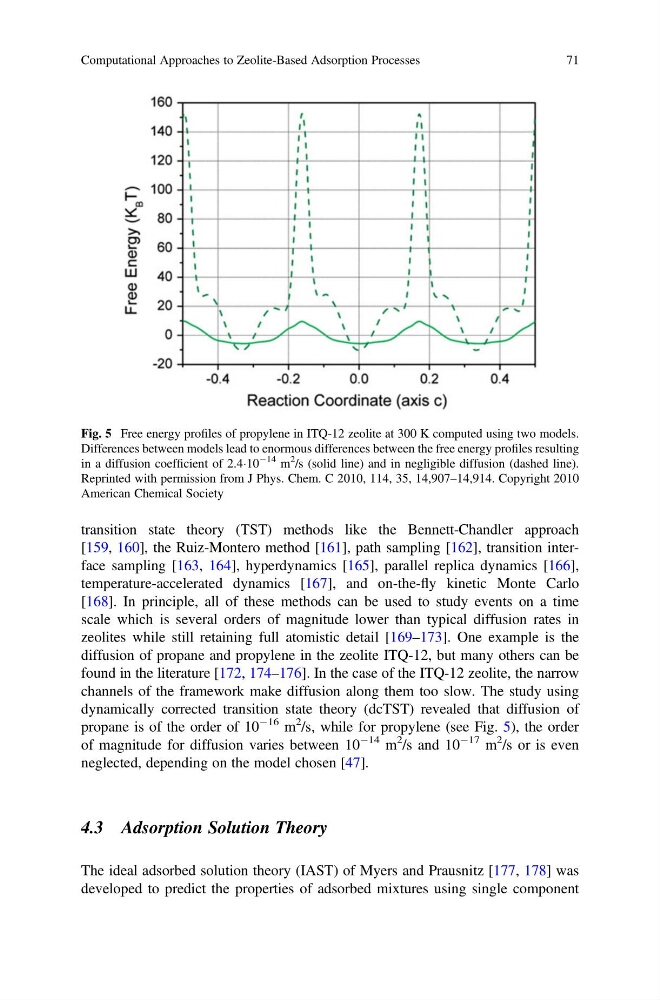
channels of the framework make diffusion along them too slow. The study using
dynamically corrected transition state theory (dcTST) revealed that diffusion of
propane is of the order of 10
À16 m
2 /s, while for propylene (see Fig. 5), the order
of magnitude for diffusion varies between 10
À14 m
2 /s and 10
À17 m
2 /s or is even
neglected, depending on the model chosen [47].
4.3 Adsorption Solution Theory
The ideal adsorbed solution theory (IAST) of Myers and Prausnitz [177, 178] was
developed to predict the properties of adsorbed mixtures using single component
Fig. 5 Free energy profiles of propylene in ITQ-12 zeolite at 300 K computed using two models.
Differences between models lead to enormous differences between the free energy profiles resulting
in a diffusion coefficient of 2.4Á10
À14 m
2
/s (solid line) and in negligible diffusion (dashed line).
Reprinted with permission from J Phys. Chem. C 2010, 114, 35, 14,907–14,914. Copyright 2010
American Chemical Society
Computational Approaches to Zeolite-Based Adsorption Processes
71
[159, 160], the Ruiz-Montero method [161], path sampling [162], transition interface sampling [163, 164], hyperdynamics [165], parallel replica dynamics [166],
temperature-accelerated dynamics [167], and on-the-fly kinetic Monte Carlo
[168]. In principle, all of these methods can be used to study events on a time
scale which is several orders of magnitude lower than typical diffusion rates in
zeolites while still retaining full atomistic detail [169–173]. One example is the
diffusion of propane and propylene in the zeolite ITQ-12, but many others can be
found in the literature [172, 174–176]. In the case of the ITQ-12 zeolite, the narrow
channels of the framework make diffusion along them too slow. The study using
dynamically corrected transition state theory (dcTST) revealed that diffusion of
propane is of the order of 10
À16 m
2 /s, while for propylene (see Fig. 5), the order
of magnitude for diffusion varies between 10
À14 m
2 /s and 10
À17 m
2 /s or is even
neglected, depending on the model chosen [47].
4.3 Adsorption Solution Theory
The ideal adsorbed solution theory (IAST) of Myers and Prausnitz [177, 178] was
developed to predict the properties of adsorbed mixtures using single component
Fig. 5 Free energy profiles of propylene in ITQ-12 zeolite at 300 K computed using two models.
Differences between models lead to enormous differences between the free energy profiles resulting
in a diffusion coefficient of 2.4Á10
À14 m
2
/s (solid line) and in negligible diffusion (dashed line).
Reprinted with permission from J Phys. Chem. C 2010, 114, 35, 14,907–14,914. Copyright 2010
American Chemical Society
Computational Approaches to Zeolite-Based Adsorption Processes
71