

ammonia production in all the zeolites studied. RxMC has been also applied to the
study of nitrogen oxides in zeolites [127]. Another type of MC move developed in
the last decade is the “chiral inversion move.” Van Erp et al. [128] added a replica
exchange procedure to the configurational bias move, in such a way that in simulations describing one particular gas content swaps of molecules are possible. Then,
for chiral mixtures, they introduced the chiral inversion, allowing to exchange a
chiral molecule for its enantiomer. They also developed a mathematical model [129]
to describe enantioselective adsorption in non-chiral nanoporous materials. One
advantage of this method is that it allows the study of chiral mixtures in the
macroscopic limit [21, 65, 130].
Because simulation methods are improving over time and the computational
capacity of computers increases, molecular simulation is currently a powerful tool
that enables the study of a given property over all (or a very large number of)
reported zeolites [20, 131–138]. This screening has been applied, for example, to the
adsorption of sulfur hexafluoride [15] and nitrogen oxides [127] or to perform gas
separation of carbon dioxides and other gases [1, 20, 133]. Screening studies also
explore the capacity of zeolites to store and release hydrogen [8] or to separate
hydrogen isotopes [139, 140].
4.2 Molecular Dynamics
Molecular dynamics (MD) simulation is a method for computing the equilibrium and
transport properties of a system. It is based on computing the trajectories of the
particles in the system by solving Newton’s laws. The idea of MD is very simple: in
a given system, the initial positions and velocities of the particles are known (the
setting of initial conditions can be done using randomness and/or crystal positions
and may be constrained by further structural constraints). The forces between
particles are a function of the position, so it is possible to compute them from the
initial configuration. The force acting on one particle is the sum of the forces due to
all neighbors of the particle (this is the most time-consuming part of the method).
Once that all the forces between particles have been calculated, the next step is to
integrate the Newtonian equations of motion to obtain the new positions of the
particles. To perform this integration, there are many algorithms to choose from. One
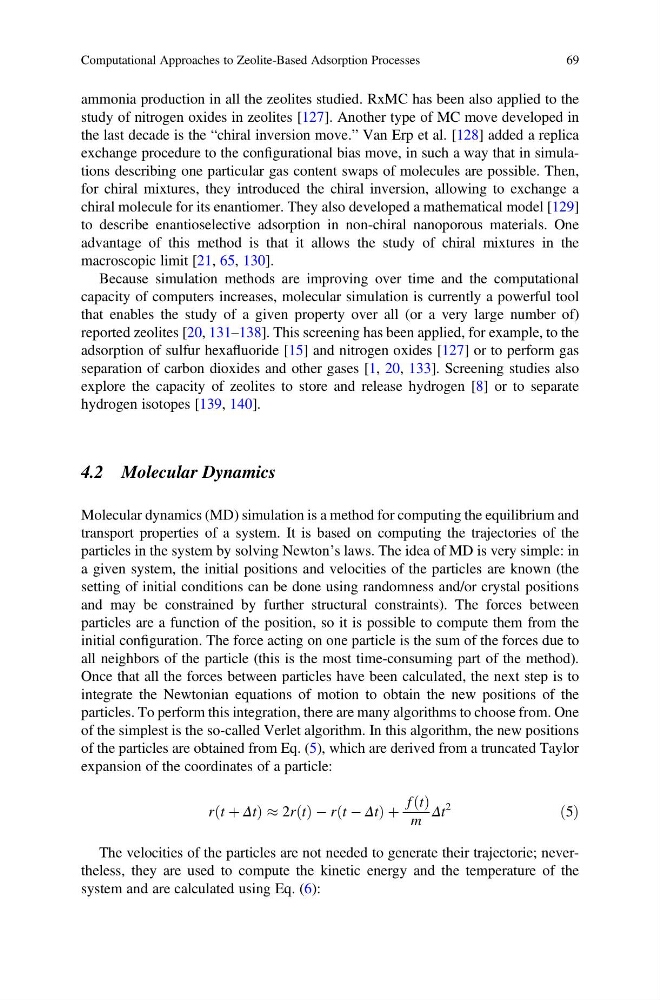
of the simplest is the so-called Verlet algorithm. In this algorithm, the new positions
of the particles are obtained from Eq. (5), which are derived from a truncated Taylor
expansion of the coordinates of a particle:
r t þ Δt
ð
Þ%2r t
ð Þ À r t À Δt
ð
Þþ
f t
ð Þ
m
Δt
2
ð5Þ
The velocities of the particles are not needed to generate their trajectorie; nevertheless, they are used to compute the kinetic energy and the temperature of the
system and are calculated using Eq. (6):
Computational Approaches to Zeolite-Based Adsorption Processes
69
study of nitrogen oxides in zeolites [127]. Another type of MC move developed in
the last decade is the “chiral inversion move.” Van Erp et al. [128] added a replica
exchange procedure to the configurational bias move, in such a way that in simulations describing one particular gas content swaps of molecules are possible. Then,
for chiral mixtures, they introduced the chiral inversion, allowing to exchange a
chiral molecule for its enantiomer. They also developed a mathematical model [129]
to describe enantioselective adsorption in non-chiral nanoporous materials. One
advantage of this method is that it allows the study of chiral mixtures in the
macroscopic limit [21, 65, 130].
Because simulation methods are improving over time and the computational
capacity of computers increases, molecular simulation is currently a powerful tool
that enables the study of a given property over all (or a very large number of)
reported zeolites [20, 131–138]. This screening has been applied, for example, to the
adsorption of sulfur hexafluoride [15] and nitrogen oxides [127] or to perform gas
separation of carbon dioxides and other gases [1, 20, 133]. Screening studies also
explore the capacity of zeolites to store and release hydrogen [8] or to separate
hydrogen isotopes [139, 140].
4.2 Molecular Dynamics
Molecular dynamics (MD) simulation is a method for computing the equilibrium and
transport properties of a system. It is based on computing the trajectories of the
particles in the system by solving Newton’s laws. The idea of MD is very simple: in
a given system, the initial positions and velocities of the particles are known (the
setting of initial conditions can be done using randomness and/or crystal positions
and may be constrained by further structural constraints). The forces between
particles are a function of the position, so it is possible to compute them from the
initial configuration. The force acting on one particle is the sum of the forces due to
all neighbors of the particle (this is the most time-consuming part of the method).
Once that all the forces between particles have been calculated, the next step is to
integrate the Newtonian equations of motion to obtain the new positions of the
particles. To perform this integration, there are many algorithms to choose from. One
of the simplest is the so-called Verlet algorithm. In this algorithm, the new positions
of the particles are obtained from Eq. (5), which are derived from a truncated Taylor
expansion of the coordinates of a particle:
r t þ Δt
ð
Þ%2r t
ð Þ À r t À Δt
ð
Þþ
f t
ð Þ
m
Δt
2
ð5Þ
The velocities of the particles are not needed to generate their trajectorie; nevertheless, they are used to compute the kinetic energy and the temperature of the
system and are calculated using Eq. (6):
Computational Approaches to Zeolite-Based Adsorption Processes
69