

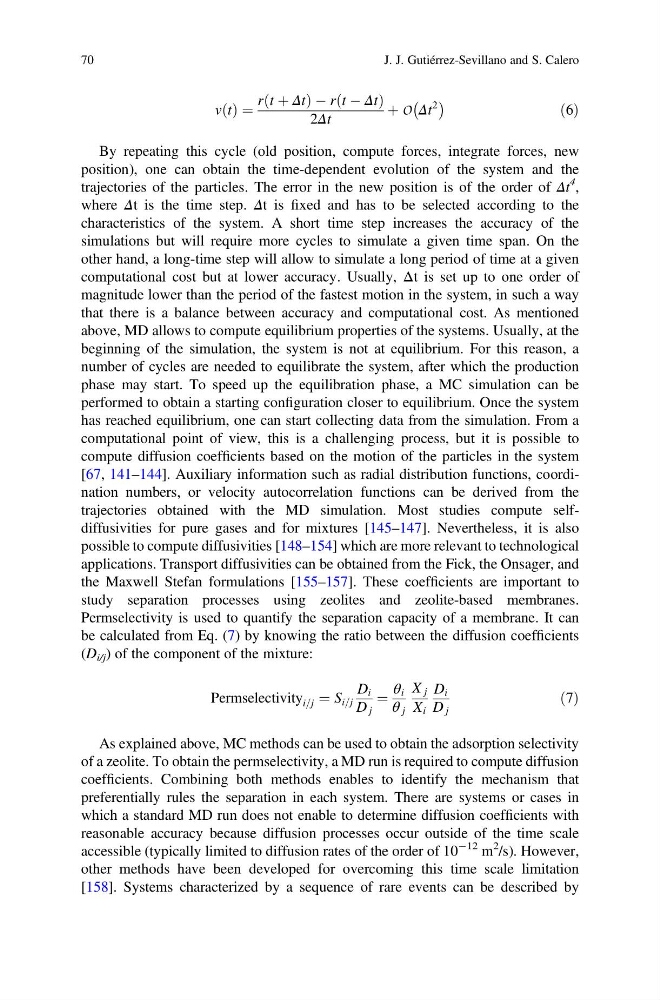
v t
ð Þ ¼
r t þ Δt
ð
ÞÀr t À Δt
ð
Þ
2Δt
þ O Δt
2
À Á
ð6Þ
By repeating this cycle (old position, compute forces, integrate forces, new
position), one can obtain the time-dependent evolution of the system and the
trajectories of the particles. The error in the new position is of the order of Δt
4 ,
where Δt is the time step. Δt is fixed and has to be selected according to the
characteristics of the system. A short time step increases the accuracy of the
simulations but will require more cycles to simulate a given time span. On the
other hand, a long-time step will allow to simulate a long period of time at a given
computational cost but at lower accuracy. Usually, Δt is set up to one order of
magnitude lower than the period of the fastest motion in the system, in such a way
that there is a balance between accuracy and computational cost. As mentioned
above, MD allows to compute equilibrium properties of the systems. Usually, at the
beginning of the simulation, the system is not at equilibrium. For this reason, a
number of cycles are needed to equilibrate the system, after which the production
phase may start. To speed up the equilibration phase, a MC simulation can be
performed to obtain a starting configuration closer to equilibrium. Once the system
has reached equilibrium, one can start collecting data from the simulation. From a
computational point of view, this is a challenging process, but it is possible to
compute diffusion coefficients based on the motion of the particles in the system
[67, 141–144]. Auxiliary information such as radial distribution functions, coordination numbers, or velocity autocorrelation functions can be derived from the
trajectories obtained with the MD simulation. Most studies compute selfdiffusivities for pure gases and for mixtures [145–147]. Nevertheless, it is also
possible to compute diffusivities [148–154] which are more relevant to technological
applications. Transport diffusivities can be obtained from the Fick, the Onsager, and
the Maxwell Stefan formulations [155–157]. These coefficients are important to
study separation processes using zeolites and zeolite-based membranes.
Permselectivity is used to quantify the separation capacity of a membrane. It can
be calculated from Eq. (7) by knowing the ratio between the diffusion coefficients
(D i/j ) of the component of the mixture:
Permselectivity i=j ¼ S i=j
D i
D j
¼
θ i
θ j
X j
X i
D i
D j
ð7Þ
As explained above, MC methods can be used to obtain the adsorption selectivity
of a zeolite. To obtain the permselectivity, a MD run is required to compute diffusion
coefficients. Combining both methods enables to identify the mechanism that
preferentially rules the separation in each system. There are systems or cases in
which a standard MD run does not enable to determine diffusion coefficients with
reasonable accuracy because diffusion processes occur outside of the time scale
accessible (typically limited to diffusion rates of the order of 10
À12 m
2
/s). However,
other methods have been developed for overcoming this time scale limitation
[158]. Systems characterized by a sequence of rare events can be described by
70
J. J. Gutiérrez-Sevillano and S. Calero
ð Þ ¼
r t þ Δt
ð
ÞÀr t À Δt
ð
Þ
2Δt
þ O Δt
2
À Á
ð6Þ
By repeating this cycle (old position, compute forces, integrate forces, new
position), one can obtain the time-dependent evolution of the system and the
trajectories of the particles. The error in the new position is of the order of Δt
4 ,
where Δt is the time step. Δt is fixed and has to be selected according to the
characteristics of the system. A short time step increases the accuracy of the
simulations but will require more cycles to simulate a given time span. On the
other hand, a long-time step will allow to simulate a long period of time at a given
computational cost but at lower accuracy. Usually, Δt is set up to one order of
magnitude lower than the period of the fastest motion in the system, in such a way
that there is a balance between accuracy and computational cost. As mentioned
above, MD allows to compute equilibrium properties of the systems. Usually, at the
beginning of the simulation, the system is not at equilibrium. For this reason, a
number of cycles are needed to equilibrate the system, after which the production
phase may start. To speed up the equilibration phase, a MC simulation can be
performed to obtain a starting configuration closer to equilibrium. Once the system
has reached equilibrium, one can start collecting data from the simulation. From a
computational point of view, this is a challenging process, but it is possible to
compute diffusion coefficients based on the motion of the particles in the system
[67, 141–144]. Auxiliary information such as radial distribution functions, coordination numbers, or velocity autocorrelation functions can be derived from the
trajectories obtained with the MD simulation. Most studies compute selfdiffusivities for pure gases and for mixtures [145–147]. Nevertheless, it is also
possible to compute diffusivities [148–154] which are more relevant to technological
applications. Transport diffusivities can be obtained from the Fick, the Onsager, and
the Maxwell Stefan formulations [155–157]. These coefficients are important to
study separation processes using zeolites and zeolite-based membranes.
Permselectivity is used to quantify the separation capacity of a membrane. It can
be calculated from Eq. (7) by knowing the ratio between the diffusion coefficients
(D i/j ) of the component of the mixture:
Permselectivity i=j ¼ S i=j
D i
D j
¼
θ i
θ j
X j
X i
D i
D j
ð7Þ
As explained above, MC methods can be used to obtain the adsorption selectivity
of a zeolite. To obtain the permselectivity, a MD run is required to compute diffusion
coefficients. Combining both methods enables to identify the mechanism that
preferentially rules the separation in each system. There are systems or cases in
which a standard MD run does not enable to determine diffusion coefficients with
reasonable accuracy because diffusion processes occur outside of the time scale
accessible (typically limited to diffusion rates of the order of 10
À12 m
2
/s). However,
other methods have been developed for overcoming this time scale limitation
[158]. Systems characterized by a sequence of rare events can be described by
70
J. J. Gutiérrez-Sevillano and S. Calero