

4.1.2 Adsorption
To calculate adsorption isotherms, simulations are performed in the grand canonical
ensemble (the number of molecules can vary at a given volume, temperature, and
chemical potential). During simulation, molecules are allowed to rotate, translate,
and exchange with a reservoir. The chemical potential is directly related to fugacity,
which is calculated from the pressure using an equation of state [23, 97]. The total
number of molecules adsorbed can vary during the simulation, and the average is
computed based on the absolute adsorption, which is directly related to excess
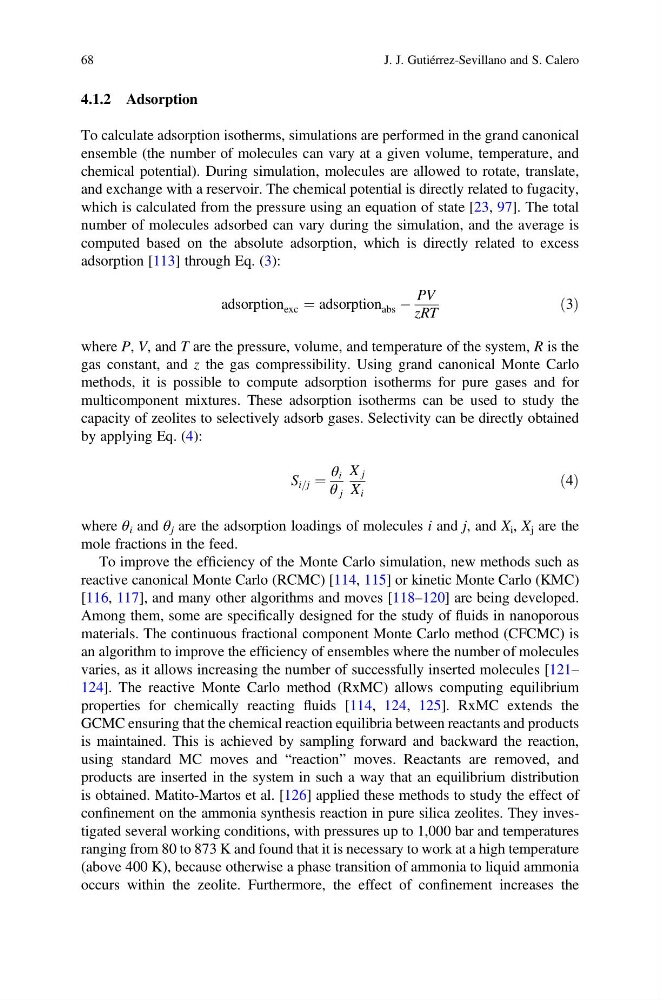
adsorption [113] through Eq. (3):
adsorption exc ¼ adsorption abs À
PV
zRT
ð3Þ
where P, V, and T are the pressure, volume, and temperature of the system, R is the
gas constant, and z the gas compressibility. Using grand canonical Monte Carlo
methods, it is possible to compute adsorption isotherms for pure gases and for
multicomponent mixtures. These adsorption isotherms can be used to study the
capacity of zeolites to selectively adsorb gases. Selectivity can be directly obtained
by applying Eq. (4):
S i=j ¼
θ i
θ j
X j
X i
ð4Þ
where θ i and θ j are the adsorption loadings of molecules i and j, and X i , X j are the
mole fractions in the feed.
To improve the efficiency of the Monte Carlo simulation, new methods such as
reactive canonical Monte Carlo (RCMC) [114, 115] or kinetic Monte Carlo (KMC)
[116, 117], and many other algorithms and moves [118–120] are being developed.
Among them, some are specifically designed for the study of fluids in nanoporous
materials. The continuous fractional component Monte Carlo method (CFCMC) is
an algorithm to improve the efficiency of ensembles where the number of molecules
varies, as it allows increasing the number of successfully inserted molecules [121–
124]. The reactive Monte Carlo method (RxMC) allows computing equilibrium
properties for chemically reacting fluids [114, 124, 125]. RxMC extends the
GCMC ensuring that the chemical reaction equilibria between reactants and products
is maintained. This is achieved by sampling forward and backward the reaction,
using standard MC moves and “reaction” moves. Reactants are removed, and
products are inserted in the system in such a way that an equilibrium distribution
is obtained. Matito-Martos et al. [126] applied these methods to study the effect of
confinement on the ammonia synthesis reaction in pure silica zeolites. They investigated several working conditions, with pressures up to 1,000 bar and temperatures
ranging from 80 to 873 K and found that it is necessary to work at a high temperature
(above 400 K), because otherwise a phase transition of ammonia to liquid ammonia
occurs within the zeolite. Furthermore, the effect of confinement increases the
68
J. J. Gutiérrez-Sevillano and S. Calero
To calculate adsorption isotherms, simulations are performed in the grand canonical
ensemble (the number of molecules can vary at a given volume, temperature, and
chemical potential). During simulation, molecules are allowed to rotate, translate,
and exchange with a reservoir. The chemical potential is directly related to fugacity,
which is calculated from the pressure using an equation of state [23, 97]. The total
number of molecules adsorbed can vary during the simulation, and the average is
computed based on the absolute adsorption, which is directly related to excess
adsorption [113] through Eq. (3):
adsorption exc ¼ adsorption abs À
PV
zRT
ð3Þ
where P, V, and T are the pressure, volume, and temperature of the system, R is the
gas constant, and z the gas compressibility. Using grand canonical Monte Carlo
methods, it is possible to compute adsorption isotherms for pure gases and for
multicomponent mixtures. These adsorption isotherms can be used to study the
capacity of zeolites to selectively adsorb gases. Selectivity can be directly obtained
by applying Eq. (4):
S i=j ¼
θ i
θ j
X j
X i
ð4Þ
where θ i and θ j are the adsorption loadings of molecules i and j, and X i , X j are the
mole fractions in the feed.
To improve the efficiency of the Monte Carlo simulation, new methods such as
reactive canonical Monte Carlo (RCMC) [114, 115] or kinetic Monte Carlo (KMC)
[116, 117], and many other algorithms and moves [118–120] are being developed.
Among them, some are specifically designed for the study of fluids in nanoporous
materials. The continuous fractional component Monte Carlo method (CFCMC) is
an algorithm to improve the efficiency of ensembles where the number of molecules
varies, as it allows increasing the number of successfully inserted molecules [121–
124]. The reactive Monte Carlo method (RxMC) allows computing equilibrium
properties for chemically reacting fluids [114, 124, 125]. RxMC extends the
GCMC ensuring that the chemical reaction equilibria between reactants and products
is maintained. This is achieved by sampling forward and backward the reaction,
using standard MC moves and “reaction” moves. Reactants are removed, and
products are inserted in the system in such a way that an equilibrium distribution
is obtained. Matito-Martos et al. [126] applied these methods to study the effect of
confinement on the ammonia synthesis reaction in pure silica zeolites. They investigated several working conditions, with pressures up to 1,000 bar and temperatures
ranging from 80 to 873 K and found that it is necessary to work at a high temperature
(above 400 K), because otherwise a phase transition of ammonia to liquid ammonia
occurs within the zeolite. Furthermore, the effect of confinement increases the
68
J. J. Gutiérrez-Sevillano and S. Calero