

Table 3 presents the relative pressure ranges and the results obtained by the
application of the BET method for each case. For both isotherms, the original BET
range gives positive C values and a good linear regression coefficient. Here also, the
Rouquerol criterion establishes a maximum relative pressure value to apply the BET
equation, which is less than 0.35.
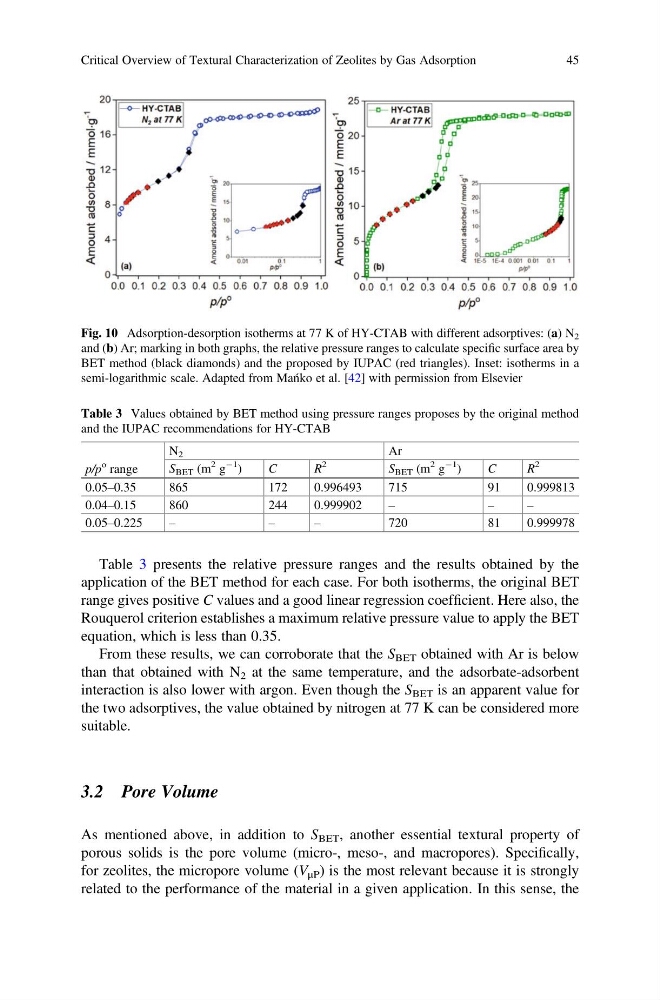
From these results, we can corroborate that the S BET obtained with Ar is below
than that obtained with N 2 at the same temperature, and the adsorbate-adsorbent
interaction is also lower with argon. Even though the S BET is an apparent value for
the two adsorptives, the value obtained by nitrogen at 77 K can be considered more
suitable.
3.2 Pore Volume
As mentioned above, in addition to S BET , another essential textural property of
porous solids is the pore volume (micro-, meso-, and macropores). Specifically,
for zeolites, the micropore volume (V μP ) is the most relevant because it is strongly
related to the performance of the material in a given application. In this sense, the
Fig. 10 Adsorption-desorption isotherms at 77 K of HY-CTAB with different adsorptives: (a) N 2
and (b) Ar; marking in both graphs, the relative pressure ranges to calculate specific surface area by
BET method (black diamonds) and the proposed by IUPAC (red triangles). Inset: isotherms in a
semi-logarithmic scale. Adapted from Mańko et al. [42] with permission from Elsevier
Table 3 Values obtained by BET method using pressure ranges proposes by the original method
and the IUPAC recommendations for HY-CTAB
p/p
o range
N 2
Ar
S BET (m
2 g
À1
)
C
R
2
S BET (m
2 g
À1
)
C
R
2
0.05–0.35
865
172
0.996493
715
91
0.999813
0.04–0.15
860
244
0.999902
–
–
–
0.05–0.225
–
–
–
720
81
0.999978
Critical Overview of Textural Characterization of Zeolites by Gas Adsorption
45
application of the BET method for each case. For both isotherms, the original BET
range gives positive C values and a good linear regression coefficient. Here also, the
Rouquerol criterion establishes a maximum relative pressure value to apply the BET
equation, which is less than 0.35.
From these results, we can corroborate that the S BET obtained with Ar is below
than that obtained with N 2 at the same temperature, and the adsorbate-adsorbent
interaction is also lower with argon. Even though the S BET is an apparent value for
the two adsorptives, the value obtained by nitrogen at 77 K can be considered more
suitable.
3.2 Pore Volume
As mentioned above, in addition to S BET , another essential textural property of
porous solids is the pore volume (micro-, meso-, and macropores). Specifically,
for zeolites, the micropore volume (V μP ) is the most relevant because it is strongly
related to the performance of the material in a given application. In this sense, the
Fig. 10 Adsorption-desorption isotherms at 77 K of HY-CTAB with different adsorptives: (a) N 2
and (b) Ar; marking in both graphs, the relative pressure ranges to calculate specific surface area by
BET method (black diamonds) and the proposed by IUPAC (red triangles). Inset: isotherms in a
semi-logarithmic scale. Adapted from Mańko et al. [42] with permission from Elsevier
Table 3 Values obtained by BET method using pressure ranges proposes by the original method
and the IUPAC recommendations for HY-CTAB
p/p
o range
N 2
Ar
S BET (m
2 g
À1
)
C
R
2
S BET (m
2 g
À1
)
C
R
2
0.05–0.35
865
172
0.996493
715
91
0.999813
0.04–0.15
860
244
0.999902
–
–
–
0.05–0.225
–
–
–
720
81
0.999978
Critical Overview of Textural Characterization of Zeolites by Gas Adsorption
45